
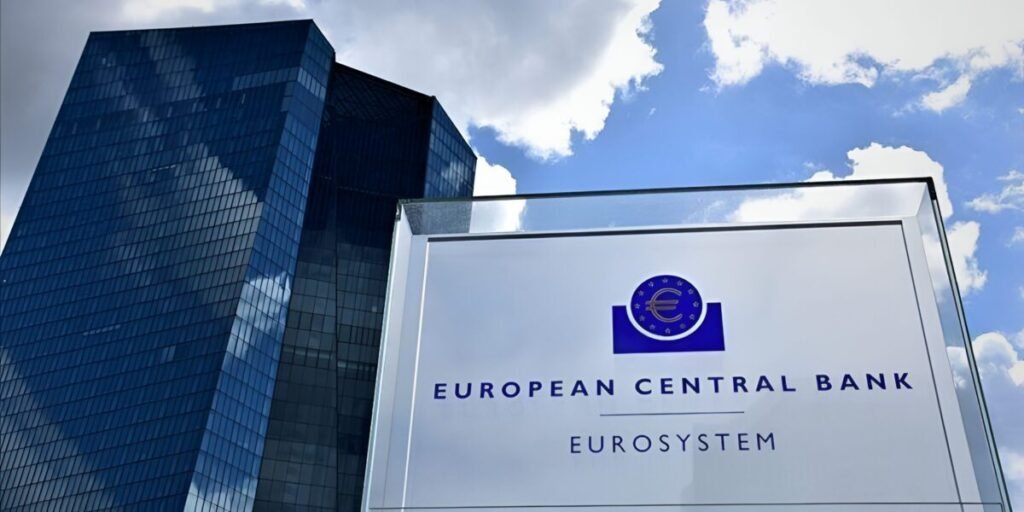
The European Central Bank raised its key rates this morning to combat Iran-war inflation, narrowing the policy gap with the Bank of England and putting fresh pressure on the Federal Reserve, which sets policy next week.
The move ends a four-meeting hold and is the first hawkish turn from Frankfurt since the spring of 2024. The ECB’s Governing Council framed the decision as a direct response to the second-round effects of sustained oil prices on eurozone wages and services inflation, language that mirrors guidance the Bank of England has been issuing since its own surprise hold last month.
What the ECB actually did
Three operational details matter more than the headline number. The Council shifted its forward guidance from data-dependent to explicitly anti-inflation, a wording change that markets read as the door re-opening to back-to-back hikes if the war continues. The marginal lending facility was lifted by a wider increment than the deposit rate, signalling a tilt toward defending the currency rather than supporting credit. And the asset purchase wind-down was accelerated, with the runoff cap raised for the back half of 2026.
The euro firmed against the dollar on the announcement, which is itself part of the strategy: a stronger currency moderates the imported-energy bill that has been the chief driver of European headline prices since February.
The Fed corner
Jerome Powell now faces a sharpened version of an already uncomfortable choice. US May CPI, published Wednesday, showed headline inflation up 0.5 percent — in line with expectations — but core CPI rose only 0.2 percent, below the 0.3 percent forecast. The split reading gives the Fed cover to hold, but the ECB move has just moved the global rate-differential goalposts. A hold next week now reads as relative loosening.
Citigroup analysts noted earlier in the week that energy-driven price pressures are beginning to feed into second-round effects across services, which is exactly the channel the ECB has now formally moved to defend. The pressure on the Fed to acknowledge that channel, even if it does not act on it, is going to be the dominant question at next week’s post-decision press conference.
“The prolonged run-up in crude prices was beginning to spill into broader inflation pressures.”
— Citigroup oil and macro note, June 2026
The UK gap closes
For UK markets the ECB hike is, on balance, helpful. The Bank of England’s 3.75 percent base rate was beginning to look like an outlier on the dovish side relative to where European inflation was heading, and the ECB move pulls the eurozone closer to UK levels. Sterling steadied against the euro on the news. Gilts widened modestly against bunds.
What to watch into next week
Three events dominate the calendar. The Fed decision and dot plot land Wednesday and will reveal whether any FOMC member has formally moved to a hike position. The Bank of England follows on Thursday, with a working assumption of another hold but more split internal voting. And the G7 summit communique, due over the weekend, is now expected to address oil-market stability as a primary line item — a topic that had been a footnote in earlier drafts.

