
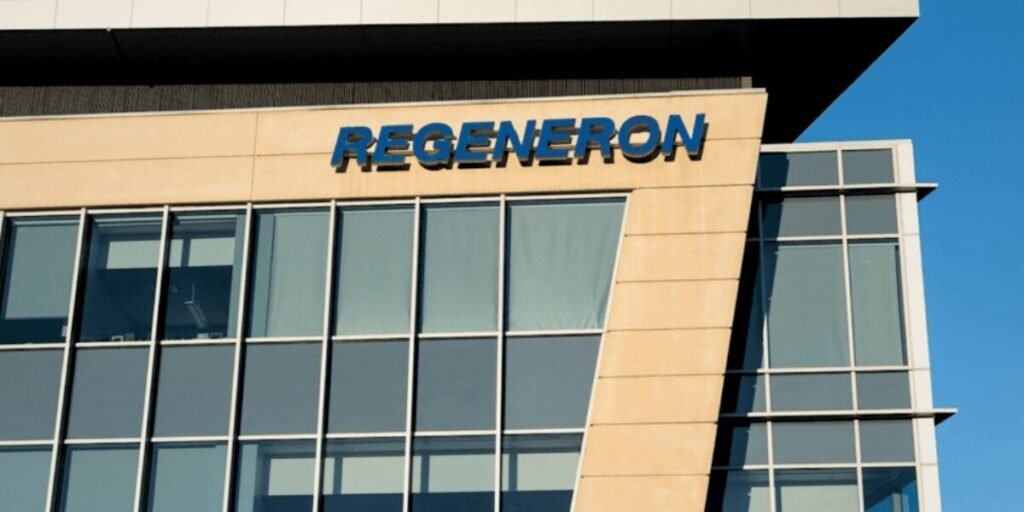
Regeneron Clinical Trial Wipeout parameters have completely destabilized the biopharmaceutical capital markets as we enter the later half of May 2026. Following an unexpected, severe corporate disclosure issued late Friday afternoon, Tarrytown-based biotech pioneer Regeneron Pharmaceuticals Inc. (NASDAQ: REGN) revealed that its premier oncology candidate has collapsed in late-stage testing. The shocking announcement triggered an absolute institutional selloff, forcing Regeneron equity to plummet 9.8% in high-volume morning trading, establishing its lowest valuation threshold since October and wiping away billions in projected pharmaceutical equity value overnight.
This critical pipeline failure has thrown the company’s intermediate oncology expansion blueprints and long-term earnings per share (EPS) curves into complete chaos. Wall Street analysts reacted with unanimous shock, with prominent firms like Leerink Partners and Citi immediately executing rare multi-tier downgrades to “Market Perform” and slashing price targets by as much as 20%. As portfolio managers aggressively remove the asset from their valuation models, the reality of the Regeneron Clinical Trial Wipeout is serving as a cautionary benchmark, forcing a complete re-evaluation of high-risk research and development pipelines across the entire healthcare landscape.
The Science of the Setback: Inside the Phase 3 Melanoma Fracture
To accurately chart the deep structural damage caused by this transaction freeze, asset managers must analyze the precise clinical mechanics of the failed study. The Phase 3 trial was explicitly designed to test Regeneron’s investigational anti-LAG-3 antibody, fianlimab, administered as a combination doublet alongside its approved PD-1 inhibitor, Libtayo (cemiplimab). The objective was to demonstrate that this dual-action immunotherapy could outpace the global standard of care—Merck’s mega-blockbuster monotherapy Keytruda (pembrolizumab)—as a first-line treatment option for patients presenting with unresectable locally advanced or metastatic melanoma.
According to granular data points released via the Regeneron Investor Relations News Portal, the trial failed to reach statistical significance for its primary endpoint of improvement in progression-free survival (PFS). While the high-dose fianlimab combination demonstrated a numeric extension—holding tumors in check for a median of 11.5 months compared to 6.4 months for the Keytruda control group—a late-stage separation in the PFS curves narrowly missed the mandatory statistical boundaries, registering an unconvincing p-value of 0.0627. In the high-stakes arena of commercial oncology execution, being close simply does not count, and the statistical miss has effectively frozen a core blockbuster asset.
5 Devastating Pipeline Shocks Fueling the Regeneron Clinical Trial Wipeout
The systemic financial fallout documented across the clinical landscape exposes five distinct, devastating structural failures that are actively crushing healthcare expansions.
1. The Destruction of the Defining First-Half 2026 Innovation Catalyst
The primary shock anchoring the Regeneron Clinical Trial Wipeout involves the complete erasure of the company’s most critical value driver. Institutional desks had widely benchmarked the first-line melanoma readout as the defining clinical catalyst of the first half of fiscal 2026, with overall market sentiment inextricably tied to its success. The unexpected statistical failure has completely destroyed this near-term growth narrative, placing intense pressure on remaining research pipelines and forcing corporate leadership into an uncomfortable defensive posture before the investment community.
2. The Elimination of a $1.8 Billion Risk-Adjusted Revenue Stream
The secondary financial blow stems from the immediate removal of projected commercial inflows from independent financial models. Leading healthcare analysts had previously modeled the peak annual global sales opportunity for fianlimab between $1.6 billion and $1.8 billion, treating the asset as a highly probable successor to supplement slowing growth curves elsewhere. By failing to clear the primary efficacy hurdle, Regeneron has lost an absolute multi-billion-dollar commercial engine, accelerating sector multiple contraction and triggering immediate revenue downgrades across the street.
3. Intense Compounding of Back-to-Back Late-Stage R&D Stumbles
The third pillar of this operational crisis is the highly troubling pattern of consecutive high-profile clinical execution failures. This setback arrives almost exactly one year after Regeneron and Sanofi disclosed the failure of their Phase 3 trial for itepekimab in chronic obstructive pulmonary disease—an asset initially positioned as the long-term successor to their blockbuster drug Dupixent. This consecutive pattern of late-stage stumbles has severely shaken investor confidence in the firm’s core R&D execution, leading to public grumbling regarding the company’s strategic selection of clinical targets.
4. Looming Franchise Pricing Erosion Across the Core Eylea Portfolio
Beyond immediate oncology complications, the trial collapse exposes the company’s balance sheet to intense revenue risk across its legacy business lines. Regeneron’s foundational, high-margin blockbuster eye-disease franchise, Eylea, is already facing mounting headwinds, with baseline sales dropping 10% to $941 million due to slower-than-expected commercial adoption of its high-dose Eylea HD iteration. With a wave of cheaper, third-party Eylea biosimilars legally scheduled to launch later this year, the failure of the oncology pipeline to provide a structural cushion leaves the firm’s core revenues highly vulnerable to severe pricing erosion.
5. Forced Reliance on High-Risk, Long-Dated Pipeline Catalysts
The fifth and most insidious shock involves the forced elongation of the company’s innovation timeline. With the primary melanoma asset effectively delayed or downgraded to a long shot, investors face an extended holding pattern, waiting until late 2027 or 2030 for alternative blockbuster data drivers to emerge. This includes long-dated readouts for their Factor XI antibody program and ongoing tests in geographic atrophy, forcing institutional managers to shift capital away from the stock in favor of more immediate, near-term clinical pipelines. To track how these structural clinical transformations alter corporate evaluations, market participants consistently parse the regulatory updates on the BioSpace Pharma Tracking Hub.
Strategic Diversification: The $125 Million Parabilis Acceleration
In an immediate operational pivot designed to counter the negative fallout of the oncology setback, Regeneron’s corporate development board announced a massive, $125 million strategic research collaboration with Parabilis Medicines. The alliance is explicitly engineered to leverage Parabilis’ proprietary Helicon peptide platform to develop a next-generation class of Antibody-Helicon Conjugates (AHCs). This technological push targets historically “undruggable” intracellular oncological pathways, representing an aggressive attempt to rebuild the company’s early-stage oncology pipeline through external business development.
| Clinical Pipeline Class | Asset/Mechanism Under Review | Primary Trial Comparator | Immediate Post-Wipeout Status |
| Melonama Doublet | Fianlimab + Libtayo (High Dose) | Merck’s Keytruda Monotherapy | Failed to reach statistical significance. |
| Melanoma Head-to-Head | Fianlimab Combo vs. Opdualag | BMS Fixed-Dose Combination | Ongoing Phase 3 study to salvage asset. |
| I&I Successor Track | Itepekimab (Anti-IL-33) | Placebo Controlled (COPD) | Stalled following Phase 3 trial miss. |
| Oncology Conjugates | Antibody-Helicon Conjugates (AHCs) | Undisclosed Intracellular Targets | Accelerated via $125M Parabilis deal. |
Under the binding terms of the agreement, Regeneron will deploy a $50 million upfront cash payment alongside a $75 million formal equity commitment into Parabilis’ next institutional financing round, with the target company eligible to receive up to $2.2 billion in additional milestone payments. While this collaboration demonstrates structural agility, corporate finance purists note that early-stage peptide discovery cannot substitute for the immediate, multi-billion-dollar cash flows that a successful execution of the fianlimab melanoma franchise would have delivered by late 2026. For complete validation of these corporate agreements, market observers rely on the transactional tracking systems hosted on the Zacks Investment Research Database.
The Institutional Playbook: Capital Protection for Healthcare Boards
For chief executive officers, chief scientific officers, and sophisticated asset managers parsing macroeconomic risks on The Success Digest, the structural fallout from the Regeneron Clinical Trial Wipeout provides a highly definitive blueprint for navigating expensive, high-risk clinical cycles. Assuming linear success across advanced clinical portfolios is an obsolete approach to corporate treasury governance. To preserve institutional equity and maintain a resilient growth trajectory, healthcare boards must execute three critical adjustments to their operational playbooks:
- Dismantle Massive Key-Asset Pipeline Dependencies: Healthcare enterprises must structure their development portfolios to ensure that overall market sentiment and corporate equity values are never inextricably bound to a single clinical catalyst readout.
- Accelerate Aggressive External Business Development: To insulate balance sheets from sudden internal research failures, corporate boards must prioritize external capital deployments, actively utilizing upfront licensing and equity deals to acquire diverse, de-risked mid-stage assets.
- Implement Rigid Non-Inferiority Trial Firewalls: When positioning an asset to challenge an entrenched market monopoly, clinical teams should utilize robust non-inferiority protocols alongside traditional superiority endpoints to maximize the regulatory pathways for securing commercial approval.
As Regeneron attempts to salvage the commercial viability of its anti-LAG-3 franchise through its ongoing head-to-head Phase 3 trial against Bristol Myers Squibb’s market-leading Opdualag immunotherapy, the global investment community will remain highly cautious. Until a permanent chief medical officer structure is codified that can consistently bridge the gap between strong Phase 1 signals and definitive Phase 3 execution, the stock will likely continue to trade at compressed multiples.
The long-term lessons taught by the ongoing Regeneron Clinical Trial Wipeout have made it clear that in the modern digital economy, clinical execution and structural diversification are the ultimate prerequisites for wealth preservation. Those who rely on yesterday’s models will inevitably see their market valuations erased by the brutal math of statistical significance.
Internal Links
Discover more enterprise AI developments at OpenAI Raises $4 Billion for New Enterprise Deployment Arm.
Read our latest semiconductor industry coverage on Intel’s Tumultuous 2025 AI Push and Strategic Shifts.

