
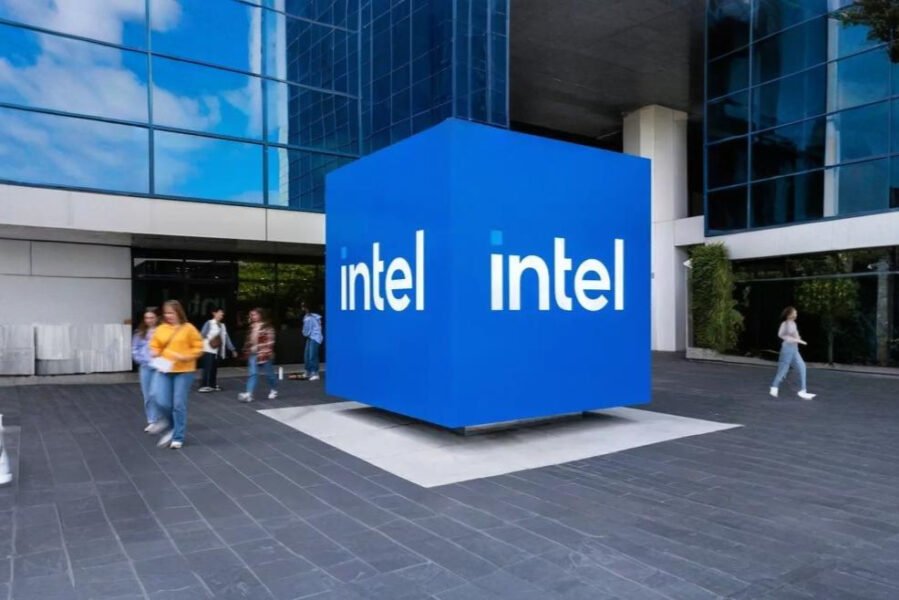
As the Consumer Electronics Show kicks off in Las Vegas, Intel Corporation has grabbed headlines with a significant uptick in its share price, driven by fresh product reveals and optimism around its manufacturing turnaround. On January 7, 2026, Intel stock climbed over 8 percent in morning trading, reflecting investor enthusiasm for the company’s latest advancements in artificial intelligence-enabled processors and its strategic push into new markets. This movement underscores the ongoing Intel stock news narrative of recovery and innovation in a competitive semiconductor landscape, where AI and edge computing are reshaping industry dynamics.
The Intel stock price opened at around 40.18 USD, reaching a high of 44.54 USD before settling near 43.46 USD by midday, marking a notable gain from the previous close of 40.04 USD. This surge builds on a strong 2025, where Intel shares soared approximately 84 percent, rebounding from multi-year lows amid broader market volatility. Investors tracking Intel share price analysis will note the stock’s 52-week range from 17.67 USD to 44.57 USD, highlighting both resilience and the potential for further upside as the company executes its roadmap.
Recent Performance and Market Context
Intel’s stock has experienced a rollercoaster, but the latest Intel stock news points to renewed momentum. The company’s market capitalization now stands at about 207.85 billion USD, with a beta of 1.35 indicating higher volatility compared to the broader market. Over the trailing twelve months, Intel generated revenue of 53.44 billion USD, though net income remained modest at 198 million USD, resulting in an earnings per share of 0.06 USD. The price-to-earnings ratio sits at a lofty 726.25, suggesting investors are betting on future growth rather than current profitability.
In the third quarter of 2025, Intel reported earnings per share of 0.11 USD, beating expectations, but the second quarter showed a loss of 0.26 USD per share. For the fourth quarter of 2025, the company guided revenue between 12.8 billion and 13.8 billion USD, with an anticipated diluted loss per share of 0.14 USD. Analysts project an overall annual loss of 0.11 USD per share for 2025, with earnings reports scheduled for late January 2026.
The broader context includes a global semiconductor rally fueled by memory chip shortages and AI demand, which has benefited Intel alongside peers. In my view, this performance signals Intel’s gradual shift from legacy challenges toward AI-centric opportunities, though sustaining this trajectory will require flawless execution in a field dominated by rivals like Nvidia and AMD.
Analyst Opinions and Price Targets
Wall Street’s perspective on Intel stock remains mixed but increasingly optimistic following recent developments. The consensus rating is a “Hold,” with an average price target of 38.31 USD, implying some caution despite the recent rally. However, bullish voices are emerging; Melius Research recently upgraded its forecast, suggesting shares could rally an additional 27 percent after a 97 percent surge over the past year. Analysts highlight Intel’s undervaluation compared to Taiwan Semiconductor Manufacturing Company, positioning it as a buy for value-oriented investors.
Loop Capital and others have noted Intel’s progress in foundry services and AI processors as key drivers. From my perspective, these opinions reflect a broader industry inflection point where Intel’s investments in domestic manufacturing could yield long-term advantages, especially amid geopolitical tensions affecting global supply chains.
Technological Advances and Strategic Initiatives
At the heart of the latest Intel stock news is the CES 2026 showcase, where the company unveiled the Intel Core Ultra Series 3 processors, the first built on its advanced 18A process technology. These chips, including models like the Core Ultra X9 and X7, feature up to 16 CPU cores, 12 Xe GPU cores, and significant improvements: 60 percent better multithreaded performance, 77 percent faster gaming, and up to 27 hours of battery life. Designed for AI applications, they will power over 200 PC designs from partners like Lenovo and extend to handheld gaming devices, robotics, smart cities, and healthcare.
Intel also confirmed plans for a new dedicated gaming processor and platform based on Core Series 3, marking a return to its gaming roots. Under CEO Lip-Bu Tan, this forms part of a turnaround strategy to regain market share, with pre-orders starting January 6 and global availability from January 27. Additionally, Intel’s stake in Mobileye contributed to the rally, as Mobileye’s stock surged following a 900 million USD acquisition in humanoid robotics.
Partnerships, such as with Eli Lilly for market cap movers, further bolster sentiment. In my assessment, these initiatives position Intel well in the AI PC upgrade cycle expected to accelerate through 2026, potentially driving revenue growth as on-device AI becomes mainstream.
Financial Highlights and Growth Metrics
Diving into the numbers, Intel’s financials show a company in transition. Trailing twelve-month revenue of 53.44 billion USD reflects stability, but profitability remains challenged with net income at 198 million USD. The third quarter of 2025 saw revenue aligned with guidance, but earlier quarters highlighted losses from restructuring and investments in foundry capabilities.
Looking ahead, analysts anticipate limited growth in 2025, with modest expansion in 2026 and 2027. The foundry business, bolstered by the 18A node, is seen as a catalyst, with potential major customer wins propelling the stock higher. Institutional interest is evident, with funds increasing stakes amid the rally.
Personally, I see Intel’s balance sheet as a foundation for recovery, with cash flows supporting R&D in AI and autonomy, though high capital expenditures will test margins in the near term.
Challenges and Risks Ahead
Despite the positives, Intel faces headwinds that could temper the rally. Competition from Nvidia in AI chips and AMD in CPUs remains fierce, with Intel lagging in some metrics. Manufacturing delays on the 18A process have been a concern, and geopolitical risks in supply chains add uncertainty.
Valuation pressures persist, with the high P/E ratio signaling expectations that must be met. Economic slowdowns could delay the AI PC cycle, impacting demand. In my observation, Intel’s challenges stem from past underinvestment, but current leadership’s focus on U.S.-based fabs could mitigate some risks over time.
Key Takeaways
- Intel stock price surged over 8 percent on January 7, 2026, driven by CES announcements of Core Ultra Series 3 processors on the 18A node.
- The company reported strong 2025 performance with an 84 percent stock gain, rebounding from lows amid AI optimism.
- Analyst targets suggest moderate upside, with some forecasting 27 percent additional gains based on undervaluation.
- New gaming chips and partnerships highlight strategic diversification into AI, edge, and robotics.
- Financials show revenue stability but profitability challenges, with Q4 2025 guidance indicating near-term losses.
Future Outlook and Projections
Peering into Intel stock forecasts, projections vary but lean positive for 2026. Some analysts see the stock reaching new highs if foundry wins materialize, potentially exceeding 50 USD. Earnings growth is expected to resume modestly, with AI PCs driving demand for up to 200 million units annually by 2027.
The Panther Lake roadmap and extensions to industrial applications could add billions in revenue. Broader trends like memory shortages and AI scaling favor Intel, though execution risks loom.
In my insight, Intel’s future hinges on reclaiming technological leadership; success in 18A could redefine its role in a U.S.-centric semiconductor ecosystem, offering substantial returns for patient investors.
As Intel navigates this pivotal year, the coming earnings and product launches will be critical. For those following Intel share price trends, staying attuned to these developments is key in a rapidly evolving tech sector.

