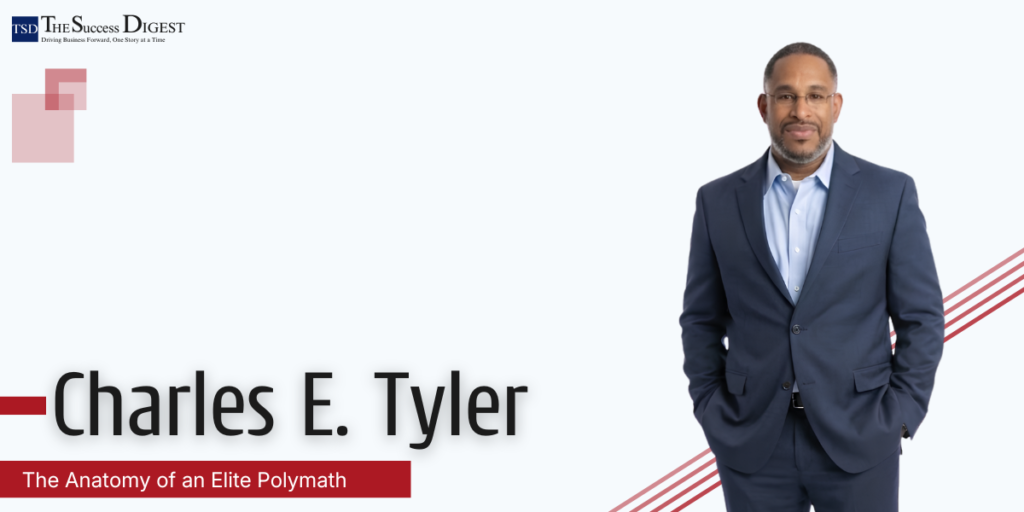
Some leaders build a career like a tower — one discipline, raised higher and higher. Charles E. Tyler built his like a bridge network. Educator, operator, technologist, coach, and trust architect, he is that rarest of professionals: an elite polymath whose value lies not in any single field, but in the connections between them.
Across more than two decades, Tyler has moved between worlds that rarely speak to one another. He holds more than eighty certifications and has studied at Harvard, Duke, INSEAD, and Yale, yet he resists the word specialist. To understand him, you cannot study one thing he does. You have to take the whole apart, piece by piece — and then watch how it fits back together.
The Making of a Polymath
Every polymath has an origin, and Tyler’s begins with a phrase his mother repeated until it became a kind of inheritance: “You have to put something back.” A historian, educator, and cultural preservationist, she taught him that knowledge is not a possession to hoard but a responsibility to pass on. His father reinforced it differently — a life of integrity and service without applause.
That upbringing produced an early leader. By eighth grade Tyler was stepping into command; at the Cleveland Naval Academy he rose to company commander, earning a Distinguished Service Award from the U.S. Marine Corps. The lesson beneath the medals has outlasted them by decades: leadership is not about titles, but about character, service, and the trust others are willing to place in you.
The Educator at the Core
Strip everything else away, and Tyler is a teacher. Over the past 26 years, he has taught, coached, and mentored thousands of college students — the through-line that predates and outlasts every other role.
It is also the lens through which he sees all his later work. Education taught him how people learn, decide, and change their minds, and it gave him a conviction he has never abandoned: that the highest form of expertise is making complex ideas understandable without dumbing them down. Every framework he has since built carries that teacher’s instinct — to take knowledge that belongs to insiders and place it, intact, into ordinary hands.
The Operator’s Discipline
Layered onto the educator is the operator. As a Certified Lean Six Sigma Champion and two-time Master Black Belt, Tyler spent years in operational excellence, leading large-scale operations and refining systems, processes, and measurement.
That discipline taught him a truth he now applies everywhere: sustainable results come from structure and accountability, not good intentions. It is why his approach to any problem — technological, ethical, or human — begins by asking how a system actually behaves under pressure, not how it is supposed to behave on paper.
The Technologist’s Conscience
Then came the chapter that made him a public figure. Like many capable newcomers to cryptocurrency, Tyler entered the space optimistic — and was defrauded, losing thousands. He could have walked away. Instead, he asked his mother’s question: how do I put something back?
The answer was Tyler’s 8 Pillars of Trust for Blockchain & Crypto™, a framework, now copyrighted and published through SSRN, that helps ordinary people evaluate digital projects through eight structured questions — transparency, education, accountability, ethical finance, privacy, inclusion, sustainability, and leadership. It predicts nothing and promotes nothing. Each pillar is scored, mapped to a decision path, and governed by a single golden rule: if you cannot verify it, score it low. “My mission is not to tell people what to invest in,” Tyler says. “It is to help them ask better questions before they invest.”
The Ethicist in the Age of AI
The technologist is inseparable from the ethicist. As artificial intelligence accelerates, Tyler warns against treating it as a purely technical problem when it is equally a question of governance and human responsibility.
His alternative is what he calls augmented intelligence — technology that makes people more capable rather than removing them from decisions that shape lives and finances. He frames responsible AI around four principles: transparency, accountability, fairness, and human oversight. “Technology should expand human capability,” he says, “not replace human conscience.”
The Coach and the Communicator
Two final components complete the anatomy. As a self-described Agile Servant Leader, informed by advanced Scrum and Mental Performance Mastery training, Tyler coaches leaders, students, and athletes toward what he calls intellectual self-mastery — the ability to think critically, regulate emotion, and decide well under uncertainty. “Technical expertise builds capability,” he says. “Intellectual self-mastery builds wisdom.”
And late in his career, he did something unexpected for a man of his credentials: he pursued top marketing certifications, not to become a marketer, but to become a better communicator. Brilliance that does not translate, he realized, does not travel.
The Thread That Connects Everything
Here is the paradox of the polymath. Examined part by part, Tyler looks like several people. Examined as a whole, he is unmistakably one — and the thing that unifies him is trust.
Trust is what the educator builds, what the operator systematizes, what the technologist protects, what the ethicist defends, and what the coach cultivates. His real strength, he has come to believe, was never that he lived deeply in one world. It was that he could build bridges between many of them. A mentor once told him the most strategic person in the room is often the quietest — and in an era that rewards noise, Tyler’s quiet, integrated conviction may be exactly what modern leadership requires.