
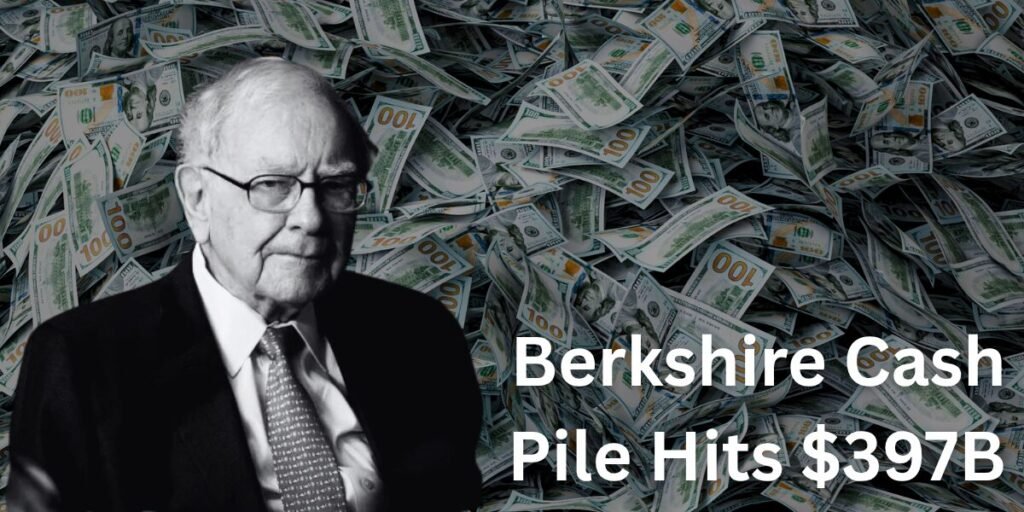
Berkshire Cash Pile levels have officially reached an unprecedented $397.4 billion, a staggering record confirmed during the conglomerate’s first annual meeting without Warren Buffett serving as CEO. While the headline profit for the first quarter of 2026 more than doubled, the atmosphere in Omaha was far from celebratory. Attendance dropped sharply as investors grappled with a symbolic transition and a stark message from the Oracle himself: the current investing backdrop is no longer about value; it is about gambling.
This massive accumulation of dry powder signals a historic retreat from a market that Buffett believes has decoupled from reality. While hyperscalers and tech giants are engaged in a multi-billion dollar arms race, Berkshire Hathaway is effectively building a financial fortress, waiting for a storm that the rest of Wall Street seems to be ignoring.
Why the Berkshire Cash Pile is a Red Flag for 2026
The primary reason the Berkshire Cash Pile has grown to nearly $400 billion is Buffett’s refusal to “reach” for stocks at current valuations. During his weekend remarks, he flagged that today’s market feels closer to a casino than a venue for disciplined capital allocation. This sentiment is a direct response to a market where the S&P 500 recently hit a record high of 7,209, yet faces a forward 12-month P/E of 20.9—well above the 10-year average of 18.9.
Institutional buyers are currently paying high multiples for growth, but Berkshire’s cash position suggests that the “smart money” sees no safety margin in these prices. When the most successful investor in history chooses to sit on $397.4 billion rather than buy back his own stock or acquire new businesses, it serves as a silent, brutal indictment of the current rally.
The Gambling Economy: Buffett’s Ominous Warning
Understanding why the Berkshire Cash Pile is at an all-time high requires looking at the broader economic friction points. The “gambling” comment targets the speculative fervor driving the broader Wall Street AI Rally. While firms like OpenAI raise $4 billion for enterprise deployment and Meta commits over $115 billion to robotics and AI capex, Berkshire is signaling that much of this spending may not yield the value the market currently expects.
- Energy-Led Inflation: The ongoing Iran war has kept Brent crude stubbornly above $111 a barrel, reigniting inflation conversations that markets had largely dismissed in late 2025.
- The Fed’s Dilemma: Markets had been pricing in two rate cuts before year-end, but energy-led inflation pressure complicates that math significantly.
- Manufacturing Fatigue: The latest ISM Manufacturing survey prices-paid sub-index pushed to its highest level since April 2022 as oil and diesel costs filter through to factory inputs.
Multiples and the Berkshire Cash Pile Threshold
If Berkshire is not buying at these multiples, fewer institutional buyers will want to be the ones reaching for the top. The growth of the Berkshire Cash Pile stands in stark contrast to the distress seen in other sectors. For instance, the recent Spirit Airlines Shutdown has stranded travelers and signaled a thinning of the budget-travel layer, proving that not every industry is thriving in 2026.
Furthermore, as UK Inflation climbs back to 3.3% and the Bank of England holds rates at 3.75%, the global economic operating environment is becoming increasingly tighter. In such a climate, liquidity is king. The Berkshire Cash Pile ensures that when the “gambling” phase of the market ends, Berkshire Hathaway will be the only entity with the capital necessary to acquire distressed, high-quality assets at a discount.
3 Ominous Warnings Hidden in the Cash
- Speculation over Substance: The record 20.9 P/E on the S&P 500 leaves limited room for disappointment.
- War-Driven Volatility: 47% of ISM survey respondents explicitly flagged the Iran war as a negative influence in their commentary.
- The CEO Vacuum: The drop in attendance at the annual meeting signals a shift in market trust during this “Buffett-less” moment.
Strategic Diversification: An Alternative View
While Berkshire hoards cash, other segments of the market are finding value in aggressive “capability-led” deals. For those not following the value-only path of the Berkshire Cash Pile, the focus has shifted to “embodied AI” and infrastructure. For example:
- Meta acquired a robotics AI firm to fill its capability gaps in perception and planning.
- OpenAI established “The Deployment Company” to transition from token pricing to outcome-linked enterprise contracts.
These moves suggest that while value is scarce, “strategic necessity” is still driving the tape. Even Berkshire isn’t completely static; it maintains a roughly 30% stake in Occidental Petroleum, where a measured CEO transition to Richard Jackson is currently underway.
For a deeper look at capital allocation trends, visit the SEC EDGAR Database or monitor the latest ISM Manufacturing Briefings. For more localized market impacts, you can review our breakdown of UK Inflation and Scotch Whisky Tariffs.
How do you think this massive cash reserve will influence the next round of Federal Reserve rate discussions?
Internal Links
Read our latest cloud technology coverage on
Technology News.
Check our latest business market analysis on
Business & Markets Coverage.

