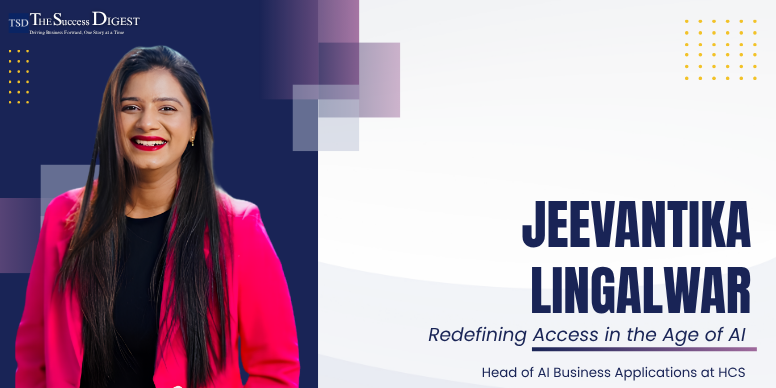
Growing up in Nagpur, Jeevantika Lingalwar was certain of one thing: she wanted to be a singer. Music was her first love — expressive, emotional, instinctive. Technology was nowhere in the plan. But like many in middle-class Indian households at the time, she stepped into Computer Science Engineering less by design than by cultural consensus. Engineering, in her world, was not just a career. It was a statement of stability and respect.
What began as a practical decision quietly became transformative. “Once I entered the world of technology, my natural curiosity took over,” she recalls. “I discovered that technology, much like music, is built on patterns, creativity, and rhythm.” The singer did not disappear — she simply found a larger stage. And the city she came from left a permanent mark. “Coming from a city like Nagpur grounded me early. It instilled humility, perseverance, and the mindset that progress is earned, not inherited.”
Today, Jeevantika is the Head of AI Business Applications at HCS, a former Partner Solution Architect at Microsoft, a TEDx speaker, a podcast host, and the founder of a global community of more than 8,000 women in technology. But the through-line of her journey is not the titles. It is a single, stubborn conviction: that access to opportunity should never be rationed by privilege, geography, or circumstance.
From a Mortgaged Home to a Master’s Abroad
The most defining chapter of Jeevantika’s life began with a leap built on belief rather than certainty. To pursue her Master’s in Ireland, her family mortgaged their home to fund the education loan. That responsibility stayed with her every single day. “It was not just my dream at stake,” she says. “It was my family’s trust, sacrifice, and future.”
To sustain herself, she worked security shifts and cash-store jobs alongside her studies. The nights were long, physically exhausting, and often humbling. But they were also, in her words, deeply grounding. “When you are balancing survival with ambition, excuses disappear very quickly. You learn discipline. You learn resilience. Most importantly, you learn empathy.”
That period shaped her leadership values more than any formal training could. It taught her ownership when resources were scarce, humility about every role, and a respect for effort over outcome that she carries into how she builds teams today. “That chapter did not harden me,” she reflects. “It grounded me.”
The Birth of International Women in Tech
International Women in Tech (IWIT) was born out of a very personal need. As a student, Jeevantika reached a point where she needed real career guidance — and the consultation she found cost ₹12,000, an amount completely unaffordable to her at the time. “I remember thinking that if access felt this difficult for me, there must be countless others navigating the same uncertainty in silence.”
IWIT began as a small group of ten women who shared ambition but lacked access. There was no funding plan and no long-term strategy — just a space to share experiences and support one another honestly. What surprised her was how quickly that sense of belonging grew. From those ten founding members, IWIT has become a global community of more than 8,000.
The growth reshaped her definition of leadership. “You do not need to have all the answers to create impact. Sometimes, leadership simply means creating space.” For Jeevantika, success is no longer purely personal. “It is about how many doors you leave open behind you.”
Mentorship Without a Price Tag
That philosophy is most visible in Coffee Chat with Jeevantika, her free, borderless mentorship programme that has now reached over 350 mentees. The principle behind it is deliberate. “If someone had the courage to ask a question, they deserved an honest conversation — regardless of where they were from, what they earned, or what stage of their career they were in.”
Early in her own journey, she had found that guidance often came at a cost, both financial and psychological. “If someone is already navigating uncertainty, impostor syndrome, or transition, adding a price tag only deepens the barrier. Mentorship should uplift, not intimidate.” She believes guidance is not a product but a responsibility. “If you have walked a path, struggled through it, and learned from it, there is value in sharing that knowledge forward.”
At the Frontier of AI and Quantum
Across a career spanning Cloud Architecture, Artificial Intelligence, and Quantum Computing, Jeevantika has developed a clear philosophy for staying current without burning out. “I focus on patterns over tools, principles over platforms, and outcomes over hype. I spend time learning, but I also spend time unlearning.”
For professionals overwhelmed by the pace of change, her advice is to anchor rather than chase. “Choose a direction, not a destination. Anchor yourself in one strong core skill and let adjacent learning build naturally around it. Depth creates confidence, and confidence makes change manageable.”
She is also one of the few voices bringing Quantum Computing to children aged eight to sixteen — not through equations, but through wonder. “When children realise that these powerful technologies are shaped by human curiosity and creativity, something shifts. Fear turns into fascination.” The work, she insists, is about mindset, not curriculum. “The goal is not to create quantum physicists at eight years old. The goal is to raise a generation that is unafraid of the unknown.”
Rethinking What Inclusion Means
At IWIT, Jeevantika defines true inclusivity as “equity in experience, not just opportunity” — a distinction she considers fundamental. “Opportunity is offering a seat at the table. Equity in experience is making sure that voice is heard, that questions are welcomed, that mistakes are treated as learning.” Too often, she notes, people are technically included but emotionally excluded.
She is equally candid about what organisations get wrong about diversity and inclusion. “They treat it as a programme instead of a practice — a box to tick, a metric to report, rather than a daily discipline embedded into how decisions are made.” The most common mistake, in her view, is focusing on representation at entry points while neglecting progression. Meaningful DEI, she argues, is uncomfortable by design. “Real progress happens when accountability is clear, when sponsorship replaces symbolic support, and when leaders are measured not just on results, but on how inclusively those results are achieved.”
Storytelling as a Tool for Change
Through her podcast, The Unplanned Journey: Thriving Amidst the Unpredictable, Jeevantika captures the real, often untold stories behind women’s success in technology. She chose storytelling deliberately. “Systems rarely change when we only talk about success at the finish line. When people hear honest journeys, they recognise themselves, and that recognition is what gives them permission to continue, to pivot, or to begin again.”
One story has stayed with her: a woman who nearly left tech entirely after being repeatedly passed over for leadership despite delivering results — until a single sponsor changed her trajectory by saying, out loud, “You are ready.” For Jeevantika, that moment captured a truth too many women experience but rarely articulate. “The issue is often not lack of skill or drive, but lack of validation at critical moments.”
The Future She Is Building
Recognised as the Most Influential Leader in Diversity and Inclusion 2025 and named a Top Voice of the New Era of Leaders, Jeevantika holds the scale of recognition and the intimacy of individual impact in careful balance. “Scale gives credibility to the work. Intimacy gives it meaning. One without the other feels incomplete.”
When she looks ahead, the future she is working to make inevitable is one of normalisation rather than celebration — “a future where women leading in technology is not celebrated as exceptional, but accepted as expected.” For IWIT, she envisions an evolution from a powerful community into a lasting ecosystem. For the next generation, she wants something simpler still: the belief that technology is theirs to shape, not just consume.
It all returns to the mantra that has guided her since long before she had the language for it: “I do not fear losing. I fear not trying.” It is a philosophy forged watching her family take risks without guarantees, and tested every time she stepped into a room not built for her. “You may lose a role, an opportunity, or a moment,” she says. “But you only lose potential when you choose not to try.”
In the end, her measure of success is unchanged from the day ten women first gathered because one consultation cost too much. “Leadership is not about being seen everywhere,” she says. “It is about being present where it counts.”