
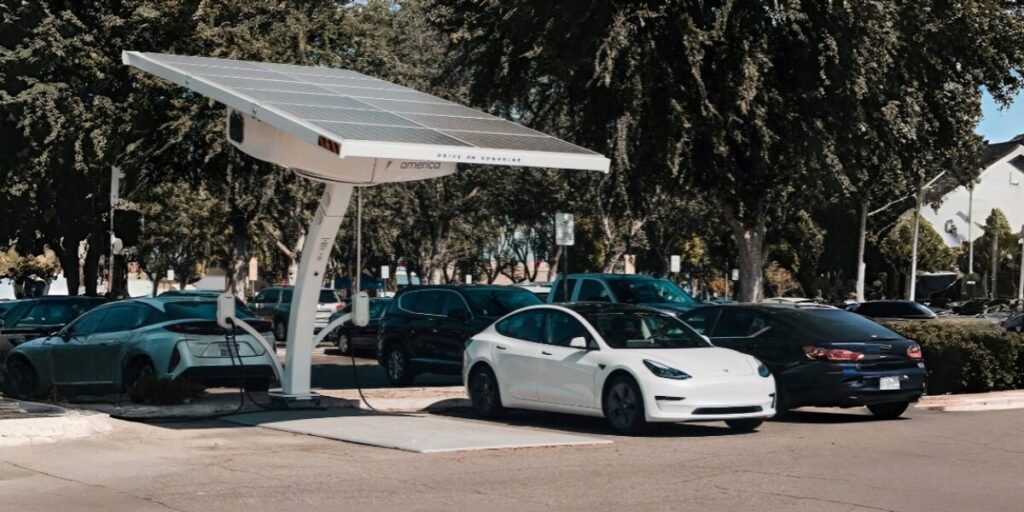
US Automaker EV Surge momentum has officially hit a fever pitch as we cross the midway point of 2026. Domestic manufacturers like Ford, GM, and Rivian are no longer just participating in the electric transition; they are dominating it through a series of high-stakes capital pivots. This movement is being supercharged by federal support, which has reached a historic peak this year, offering billions in subsidies for companies that can prove domestic sourcing and manufacturing excellence.
While international rivals struggle with shifting tariff landscapes, the US Automaker EV Surge is being defined by a “home court advantage.” By aligning their production cycles with the latest federal requirements, Detroit’s titans are effectively locking out foreign competition and reclaiming market share in the high-growth clean energy segment.
The Mechanics of the US Automaker EV Surge
The current US Automaker EV Surge is not an accident of the market; it is a calculated response to the “Federal Incentive War.” The 2026 updates to the Inflation Reduction Act (IRA) have introduced even stricter “Made in America” requirements for battery components and critical minerals. According to the latest U.S. Department of Energy (DOE) Reports, automakers that meet these thresholds can unlock up to $7,500 in consumer tax credits per vehicle, plus significant manufacturing tax credits.
This financial environment has forced a radical restructuring of global supply chains. To sustain the US Automaker EV Surge, domestic brands have spent the last 18 months localized their battery production, moving away from overseas reliance and toward “Battery Belt” gigafactories in states like Michigan, Tennessee, and Georgia.
4 Bold Strategies Fueling the US Automaker EV Surge
To win the federal incentive war, manufacturers are deploying four critical and disruptive strategies that are reshaping the industry.
1. Vertical Integration of Battery Chemistry
A core pillar of the US Automaker EV Surge is the move toward vertical integration. Companies are now partnering directly with lithium and nickel mining operations within the U.S. and free-trade partner countries. This ensures that every kilowatt-hour of battery capacity qualifies for the maximum federal subsidy, allowing domestic brands to undercut the pricing of imported models.
2. The Pivot to “Affordable Luxury” Models
While the early years of the EV transition focused on high-end flagship trucks, the current US Automaker EV Surge is driven by the $30,000 to $45,000 price bracket. By utilizing LFP (Lithium Iron Phosphate) battery technology—which is cheaper and more durable—American manufacturers are finally bringing electric mobility to the mass market.
3. Software-Defined Vehicle (SDV) Architecture
Data is the new fuel. The US Automaker EV Surge is being powered by a shift toward vehicles that improve over time via over-the-air (OTA) updates. This allows manufacturers to monetize the vehicle long after the initial sale through subscription-based features like advanced driver assistance systems (ADAS) and enhanced infotainment.
4. Massive Infrastructure Standardization
The “Charging Anxiety” that once plagued the industry is being solved through the rapid adoption of the North American Charging Standard (NACS). By providing seamless access to reliable fast-charging networks, domestic brands are removing the final barrier to entry for hesitant consumers, further accelerating the US Automaker EV Surge.
Challenges Facing the US Automaker EV Surge
Despite the stunning progress, the US Automaker EV Surge faces significant headwinds. Global commodity prices remain volatile, and the ongoing geopolitical tensions in the Middle East have caused a spike in logistics costs. Furthermore, as International Market Reports suggest, the competition from Chinese manufacturers remains a long-term threat, even with current tariff protections in place.
However, the sheer scale of the 2026 federal incentives acts as a powerful buffer. As long as domestic manufacturers continue to innovate in battery density and autonomous software, the US Automaker EV Surge appears to be a durable trend that will define the next decade of American industrial output.
Internal Links
Read our latest cloud technology coverage on
Technology News.
Explore more AI industry insights at
AI Industry Updates.

