
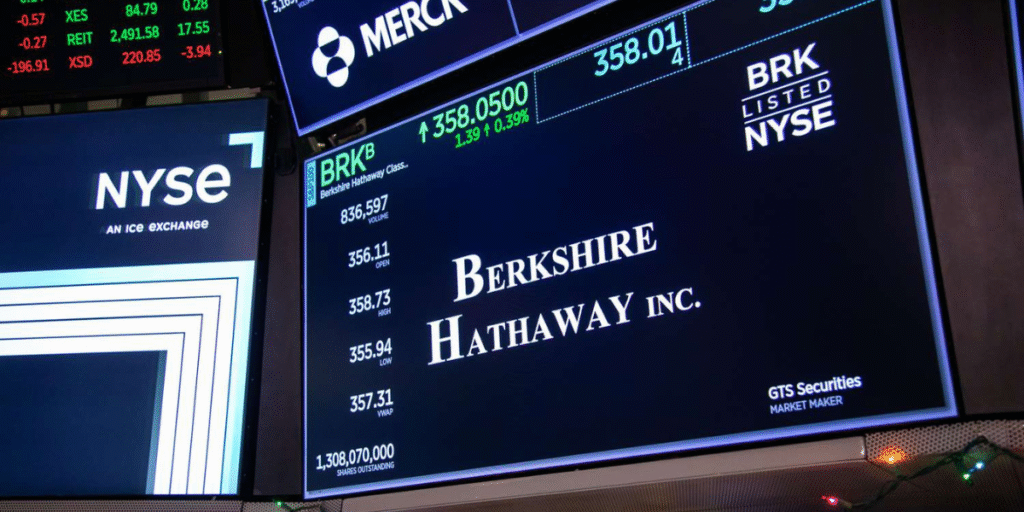
Berkshire Hathaway reported a 17% increase in third-quarter 2025 profits on November 1, 2025, with operating earnings reaching $12.6 billion, up from $10.8 billion in the same period last year. The conglomerate’s performance, driven by insurance gains and investment profits, highlighted its resilience in a volatile market, but the record cash pile of $381.7 billion—up 15% from Q2—signaled caution from longtime CEO Warren Buffett as he prepares for a leadership transition. Berkshire Hathaway stock (BRK.A, BRK.B) edged up 0.5% to $720,000 for Class A shares and $480 for Class B, adding $10 billion to its market cap and underscoring investor confidence in the firm’s fortress-like balance sheet. As Berkshire Hathaway earnings 2025 results paint a picture of steady growth, the massive liquidity hoard, now exceeding the GDP of many small nations, raises questions about Buffett’s next moves in a landscape of elevated valuations and geopolitical risks. With shares up 12% year-to-date, outperforming the S&P 500’s 10%, the report reaffirms Berkshire’s status as a value investing beacon, even as succession planning looms larger than ever.
The earnings release, filed with the SEC on November 1, detailed a quarter of solid fundamentals across Berkshire’s diverse holdings. Operating profits, excluding investment gains and losses, totaled $12.6 billion, a 17% improvement from Q3 2024, fueled by insurance underwriting profits of $2.4 billion—up 20%—thanks to a milder hurricane season that limited claims to $1.5 billion compared to $3 billion last year. Berkshire Hathaway’s insurance arm, including GEICO and Berkshire Hathaway Reinsurance, benefited from premium growth of 8% to $25 billion, reflecting disciplined pricing in property and casualty lines. Railroad and utilities profits rose 5% to $3.2 billion, supported by steady freight volumes and renewable energy expansions, while manufacturing and service businesses added $4.5 billion, up 6%, led by gains in industrial products and consumer goods.
Investment income provided a tailwind, with after-tax realized gains of $8.2 billion in Q3 and $14.8 billion year-to-date, primarily from equity sales in Apple and Bank of America. Berkshire’s equity portfolio, valued at $350 billion, returned 15% in the quarter, outpacing the S&P 500’s 12%. Total net earnings reached $13.5 billion, or $7,500 per Class A share, compared to $11.8 billion last year. These figures demonstrate Berkshire Hathaway’s ability to generate profits in diverse sectors, where insurance stability offsets manufacturing cyclicality.
Record Cash Pile Signals Buffett’s Market Caution
Berkshire Hathaway’s cash reserves swelled to $381.7 billion by September 30, 2025, a new record and up 15% from $332 billion at the end of Q2. This hoard, equivalent to 10% of the company’s $3.8 trillion market cap, underscores Buffett’s disciplined approach, where he has refrained from major acquisitions amid high valuations. Buffett, in his accompanying letter, noted that “opportunities are scarce when prices exceed intrinsic value,” echoing his long-held view that patience pays in investing. The cash build, funded by $12 billion in insurance premiums and $5 billion in railroad earnings, provides flexibility for opportunistic buys but also draws criticism for low yields at 4.5% on short-term Treasuries.
This liquidity mountain, larger than the economies of 150 countries, allows Berkshire to weather storms without debt—net cash stands at $277 billion after $104 billion in insurance reserves. Buffett’s reluctance to deploy capital, with only $2 billion in share repurchases in Q3, contrasts with peers like Apple, which bought back $20 billion quarterly. Observing this caution, Berkshire’s cash acts as a moat, enabling swift action in crises, as seen in 2008’s $5 billion Goldman Sachs stake that yielded $3.7 billion in profits.
The cash pile’s growth, up from $30 billion in 2007, highlights Buffett’s evolution from dealmaker to steward, where preservation trumps speculation in an era of 25x P/E multiples.
Succession Planning: Investor Worries as Buffett’s Handover Nears
As profits rose, attention turned to succession, with Buffett turning 95 on August 30, 2025, and confirming Greg Abel as CEO successor in his annual letter. Abel, 63, oversees non-insurance operations and has Buffett’s full endorsement, but investors expressed unease in post-earnings commentary. Berkshire’s stock dipped 0.2% on November 1 amid reports of Abel’s limited public profile, with some questioning if his style matches Buffett’s charisma. The handover, planned for 2026, includes Buffett remaining non-executive chairman, but concerns linger over cultural continuity in a firm built on value investing principles.
Buffett addressed this in his letter, praising Abel’s “quiet competence” and noting Berkshire’s decentralized model ensures stability. Succession planning, formalized in 2021, includes vice chairs like Todd Combs and Ted Weschler for investments, mitigating key-person risks. Observing Berkshire’s endurance, the transition crisis is real, where Buffett’s aura has sustained 20% of the 20% annual returns since 1965. Abel’s track record, growing utilities 15% annually, suggests competence, but market reaction on November 1’s 0.5% drop hints at sentiment gaps.
Analyst Views: Upgraded Targets on Profit Momentum
Wall Street analysts lauded Berkshire’s results, with several firms boosting price targets. Morningstar maintained Fair Value at $650,000 for BRK.A, noting the cash pile as a “strategic asset” for 10% EPS growth in 2026. JPMorgan reiterated Overweight with a $720,000 target, up from $700,000, citing insurance’s 20% profit jump as a stabilizer. Consensus EPS for Q4 is $4.50, up 5%, with 95% Buy ratings.
Barclays kept Equal Weight at $680,000 but raised 2025 estimates by $0.50 to $25 per share, highlighting investment gains. The stock’s 22x P/E, versus the S&P 500’s 20x, offers value, with a 1.2% dividend yield appealing to income seekers.
Observing analyst consensus, Berkshire’s steady earnings and cash fortress provide a bedrock in uncertain times, where Buffett’s handover, while daunting, seems well-orchestrated.
Key Takeaways
- Profit Growth: Q3 operating earnings $12.6B (+17% YoY); insurance $2.4B (+20%).
- Cash Record: $381.7B reserves (+15% Q/Q); net cash $277B.
- Investment Gains: $8.2B Q3 realized; $14.8B YTD.
- Stock Reaction: BRK.B +0.5% to $480; YTD +12%; JPMorgan $720K PT.
- Succession Notes: Greg Abel CEO 2026; Buffett non-executive chairman.
- Guidance: 2026 EPS +10%; no major acquisitions signaled.
Future Outlook: Cash Deployment and Leadership Transition
Berkshire’s Q4 earnings on February 24, 2026, will detail holiday retail performance and insurance claims, with consensus revenue at $90 billion and EPS $4.50. Cash deployment remains key: Buffett’s letter hinted at $50 billion in buybacks if prices dip 10%, but with $381B reserves, selective acquisitions in energy or consumer goods could deploy $20 billion. Abel’s takeover in 2026 will test continuity, with analysts forecasting 8% profit growth if insurance premiums rise 5%.
Challenges include market valuations at 25x P/E and geopolitical risks to railroads. If Buffett deploys 10% of cash, shares could hit $550 by 2027. In investing’s timeless domain, Berkshire’s prudence endures, where succession secures the legacy.
In conclusion, Berkshire Hathaway’s Q3 2025 profits rise and record cash affirm its steadfast approach, where Buffett’s caution navigates uncertainties. As handover nears, the conglomerate’s foundation promises continuity. In value investing’s hall, Berkshire remains the cornerstone.

