
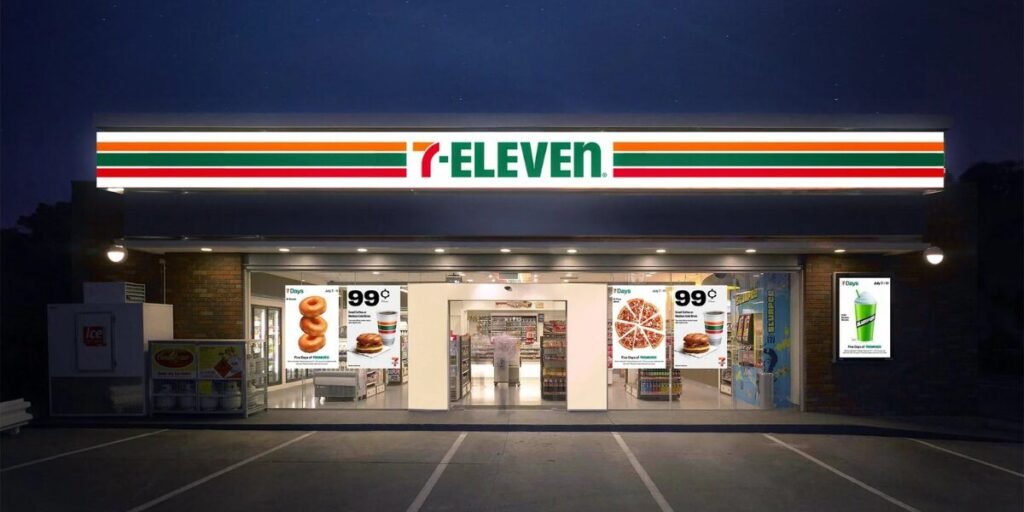
7-Eleven store closures are set to dominate the retail news cycle as the world’s largest convenience chain accelerates its massive portfolio restructuring. Seven & i Holdings, the Japanese parent company, has officially confirmed that 7-Eleven store closures will impact 645 underperforming locations across North America during the 2026 fiscal year (March 2026 – February 2027).
This move follows a trend of “portfolio optimization” that has already seen over 600 locations shuttered across 2024 and 2025. For the fifth year in a row, the company is projected to close more storefronts than it opens, signaling a historic pivot in the convenience store industry.
The Economic Drivers Behind 7-Eleven Store Closures
The decision to move forward with widespread 7-Eleven store closures stems from a “perfect storm” of economic pressures. While the U.S. economy remains resilient, the convenience sector is facing specific challenges:
1. The Decline of Tobacco and Fuel Revenue
Historically, tobacco and gasoline were the primary drivers of foot traffic. However, tobacco sales have plummeted by nearly 26% since 2019. Smaller, older 7-Eleven sites that rely heavily on these categories are no longer financially viable, leading directly to the current wave of 7-Eleven store closures.
2. Persistent Inflation and Consumer Spending
Rising costs of living have hit low-to-middle-income households particularly hard. This has resulted in a “softening” of consumer sentiment, with a notable 7.3% drop in foot traffic recorded recently. When customers cut back on high-margin “impulse buys” like snacks and soda, the overhead costs of underperforming stores become unsustainable.
Strategy Shift: From “Small Box” to “Food-First”
It is important to note that 7-Eleven store closures do not mean the brand is disappearing. Instead, the company is “pruning” its weakest branches to invest in a more profitable model: The Large-Format Food Store.
The Rise of Fresh Food and 7NOW Delivery
Demand for prepared meals has seen a double-digit increase (12% year-over-year). To compete with regional giants like Wawa and Sheetz, 7-Eleven is replacing small, cramped shops with destination-style outlets featuring:
- Enhanced Fresh Food Menus: Including specialty beverages, “Seven Café Bakery” items, and premium hot meals.
- 7NOW Delivery Hubs: Utilizing the company’s proprietary delivery service to reach 50% of the U.S. population.
- Wholesale Fuel Conversions: Many closing locations will be converted into unmanned wholesale fuel stations, reducing labor costs while retaining gasoline revenue.
Preparing for the 2027 IPO
Experts believe the acceleration of 7-Eleven store closures is a strategic cleanup ahead of a highly anticipated Initial Public Offering (IPO) for the North American unit. By closing underperforming assets and increasing the private-brand (PB) product growth—which offers three times the margin of national brands—Seven & i Holdings is boosting its valuation for Wall Street.

