
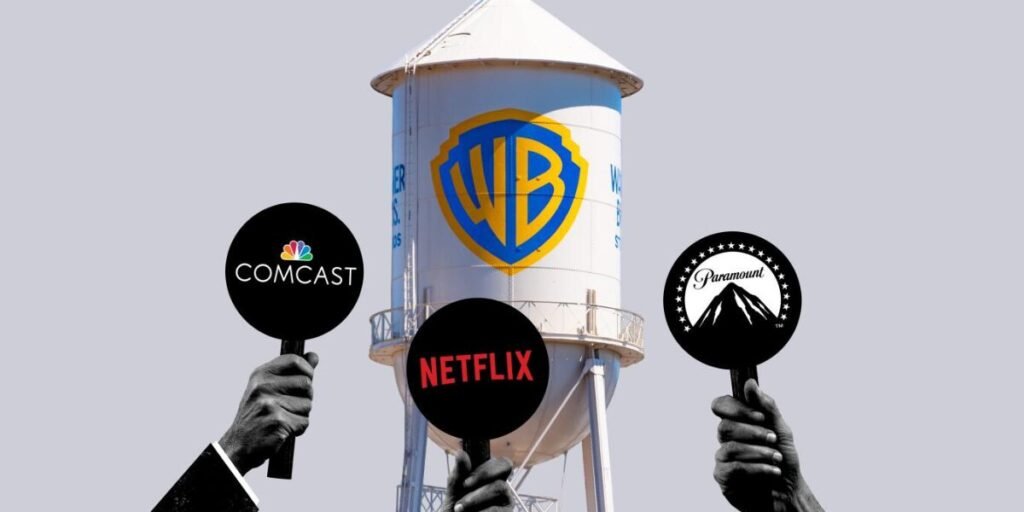
Warner Bros. Discovery(WBD) is on the verge of a transformative sale, with Netflix poised to acquire the company’s storied film studio and streaming assets in a deal valued at $82.7 billion, according to sources close to the negotiations. The agreement, which would see Netflix absorb Warner Bros. Pictures, New Line Cinema, and Max while spinning off WBD’s cable networks into a separate entity called Discovery Global, marks the culmination of a fierce bidding war that pitted streaming giant Netflix against Paramount Skydance and Comcast’s NBCUniversal. Announced in stages through leaks and official statements in early December 2025, this Warner Bros. Discovery Netflix acquisition 2025 saga has captivated Hollywood, raising questions about consolidation, regulatory hurdles, and the future of legacy media in an era dominated by tech-driven platforms. As CEO David Zaslav prepares to transition to a role leading the Warner Bros. studio under Netflix, the deal promises a $5.8 billion breakup fee for WBD shareholders and a potential $1 billion in annual synergies for Netflix. However, Paramount’s aggressive pushback, including a hostile takeover bid and accusations of a “tainted” sales process, has injected uncertainty, with President-elect Donald Trump’s comments on the transaction adding a layer of political intrigue. With shares of WBD surging 5% to $12.50 on December 6 amid the news, the outcome could reshape the $500 billion global entertainment industry, where streaming now accounts for 40% of revenue.
The bidding war, which ignited in late October 2025, began with unsolicited overtures from Paramount Skydance CEO David Ellison, fresh off his $8.4 billion acquisition of Paramount in August. Ellison, backed by his father Oracle founder Larry Ellison the world’s second-richest person proposed multiple bids for all of WBD, starting at $23.50 per share in October, a mix of 80% cash and 20% stock that would have positioned Zaslav as co-chairman. WBD’s board rejected the initial offer as undervaluing the company, but Ellison’s persistence, coupled with his ties to the incoming Trump administration, kept Paramount in the mix. By November 20, the first round of formal bids included Paramount’s all-encompassing proposal, Netflix’s cash-heavy offer focused on the studio and Max, and Comcast’s bid for select assets.
Netflix, led by co-CEOs Ted Sarandos and Greg Peters, emerged as the frontrunner in the second round on December 1, with a bid that valued WBD’s core entertainment assets at a premium, including a $5.8 billion breakup fee to sweeten the deal for shareholders. Sources indicate Netflix’s offer topped Paramount’s by $18 billion for the full company, emphasizing a “best-of-both” approach that preserves Warner Bros.’ creative independence while integrating Max into Netflix’s 300 million subscriber base. The structure would spin off WBD’s linear networks CNN, TBS, and TNT into Discovery Global, led by current CFO Gunnar Wiedenfels, reducing Netflix’s regulatory exposure.
Paramount’s response was swift and combative. On December 3, lawyers for Paramount Skydance sent a scathing letter to Zaslav, accusing WBD of a “tainted” auction process that favored Netflix through undisclosed meetings and predetermined outcomes. The missive cited a reported Brussels encounter between WBD international president Gerhard Zeiler and EU tech commissioner Henna Virkkunen, suggesting collusion to preserve “media diversity” against Paramount’s bid. Undeterred, Paramount escalated on December 8 with a hostile all-cash tender offer for all WBD shares at $30 per share the same terms as its December 4 proposal claiming it delivers superior value without the “illusory” spin-off valuations in Netflix’s plan. Paramount attorneys argued that Discovery Global, saddled with high debt, would trade at $1 per share, making Netflix’s structure a “mirage” for investors.
The drama reached a fever pitch with Trump’s intervention. On December 7, the president-elect declared, “I’ll be involved in that decision” regarding the merger’s approval, a rare presidential foray into corporate transactions. Trump’s affinity for Ellison whose father Larry donated $100 million to his campaign and disdain for Zaslav, whom he called a “Hollywood elitist,” has fueled speculation of favoritism toward Paramount. Netflix co-CEO Sarandos reportedly met with Trump in November to discuss the deal, assuring a “fair process,” but the comments rattled markets, with WBD shares volatile at $12.50, up 5% on the Netflix news but down 2% post-Trump.
Zaslav, who has steered WBD through $9 billion in cost cuts since the 2022 merger, views the sale as a capstone. In a memo to staff on December 5, he framed it as a “generational change” that secures Warner Bros.’ legacy within Netflix’s scale, promising job security and creative autonomy. Sarandos echoed this in his own address, stating the acquisition combines “two storytelling titans” to deliver beloved content to more viewers. Discovery Global, with its cable assets, will operate independently, targeting $10 billion in revenue and focusing on sports rights like TNT’s NBA package.
Bidding War Timeline: From Ellison’s Overtures to Netflix’s Victory
The Warner Bros. Discovery acquisition 2025 saga unfolded rapidly. In early October, Ellison approached Zaslav with a $23.50 per share bid for all of WBD, proposing Zaslav as co-CEO a vision of a media supergiant blending Paramount, Warner, and Skydance. WBD rebuffed it as too low, but Ellison persisted with five more offers over 12 weeks, escalating to $30 per share in December. On November 20, the first formal bids arrived: Paramount’s full buyout, Netflix’s cash offer for the studio and Max, and Comcast’s selective assets grab.
By December 1, Netflix led the second round with a premium bid, entering exclusive talks on December 4 after WBD’s board deemed it the “safer option” with fewer regulatory risks. Paramount fired back on December 3 with a letter decrying the “unfair” process, alleging favoritism toward Netflix via undisclosed EU meetings. On December 8, Paramount launched its hostile tender offer at $30 per share, asserting WBD’s spin-off valuations were “unsupported” and burdened by debt.
Trump’s December 7 remark, “I’ll be involved,” amplified the chaos, with his Ellison ties Larry donated $100 million to his campaign contrasting his Zaslav barbs. Netflix’s Sarandos met Trump in November, securing assurances, but Paramount leveraged the moment to rally shareholders.
This timeline, spanning 12 weeks, rivals the 2022 Twitter saga, where bids flew amid regulatory scrutiny. WBD’s board, advised by Lazard, prioritized Netflix’s $82.7 billion offer for its cash certainty and $5.8 billion breakup fee.
Regulatory and Political Shadows: Trump’s Role and Antitrust Hurdles
The Warner Bros. Discovery Netflix deal 2025 faces a gauntlet of regulatory and political challenges. The FTC, under Lina Khan, has intensified merger scrutiny, blocking 20% more deals in 2025, and could probe Netflix’s 40% streaming share post-acquisition. The DOJ’s antitrust division, eyeing vertical integration, may demand divestitures of HBO Max content or Warner’s TV rights.
Trump’s involvement adds unpredictability. His “I’ll be involved” comment, the first presidential nod to a private merger, invokes his AT&T-Time Warner block in 2017, overturned on appeal. Ellison’s Trump alignment Larry’s donations and Jared Kushner’s Saudi ties positions Paramount as a favored alternative, potentially swaying FTC reviews. Netflix’s Sarandos-Trump meeting in November, discussing “fair competition,” aimed to preempt this, but Paramount’s December 8 bid includes Kushner as an advisor, escalating the political angle.
EU regulators, via Henna Virkkunen, may demand concessions on European content rights, where Netflix holds 30% share. The deal’s $5.8 billion breakup fee incentivizes closure, but delays could push completion to mid-2026.
This scrutiny reflects Hollywood’s consolidation wave, where 2025 saw 10 major mergers, but antitrust blocks rose 25%.
Zaslav’s Legacy: From Cost-Cutter to Deal Architect
David Zaslav, WBD’s CEO since the 2022 merger, has navigated a rocky tenure, slashing $9 billion in costs but facing 20% stock drops on streaming losses. The Netflix sale caps his era, with Zaslav transitioning to Warner Bros. studio head under Sarandos, securing a $100 million payout and creative control. His memo to staff called it a “generational change,” preserving Warner’s independence within Netflix’s scale.
Critics decry Zaslav’s HBO Max cuts and strikes handling, but the deal’s $82.7 billion valuation up 50% from merger lows validates his strategy. Sarandos praised Zaslav as a “storytelling visionary,” signaling continuity.
Zaslav’s arc, from Discovery CEO to media mogul, embodies Hollywood’s flux, where cost discipline meets tech convergence.
Key Takeaways
- Deal Value: Netflix’s $82.7B bid for Warner Bros. studio and Max; $5.8B breakup fee.
- Bidding Rivals: Paramount’s $30/share hostile offer; Comcast selective bid.
- Political Twist: Trump’s “involved” comment favors Ellison; Sarandos-Trump meeting.
- Stock Impact: WBD +5% to $12.50; year-to-date -20%.
- Regulatory Risks: FTC scrutiny on Netflix’s 40% streaming share; EU content concessions.
- Zaslav Role: Transitions to Warner studio head; $100M payout.
Future Outlook: Deal Closure and Media Landscape Shift
The Warner Bros. Discovery Netflix acquisition 2025 could close mid-2026, with consensus revenue $40B for combined streaming in 2026. Synergies of $1B from content sharing boost Netflix’s 300M subscribers. Paramount’s hostile bid may force $90B counter, but regulatory blocks risk 30% delay.
Challenges include FTC’s 20% block rate and Trump’s influence. If approved, Netflix claims 50% market, reshaping $500B entertainment. In media’s merger maelstrom, Netflix asserts dominance.
In conclusion, Warner Bros. Discovery’s Netflix deal in 2025, amid Paramount rivalry and Trump intrigue, redefines Hollywood. As bids clash, Zaslav’s legacy crystallizes. In entertainment’s bold consolidation, Netflix claims the spotlight.

