
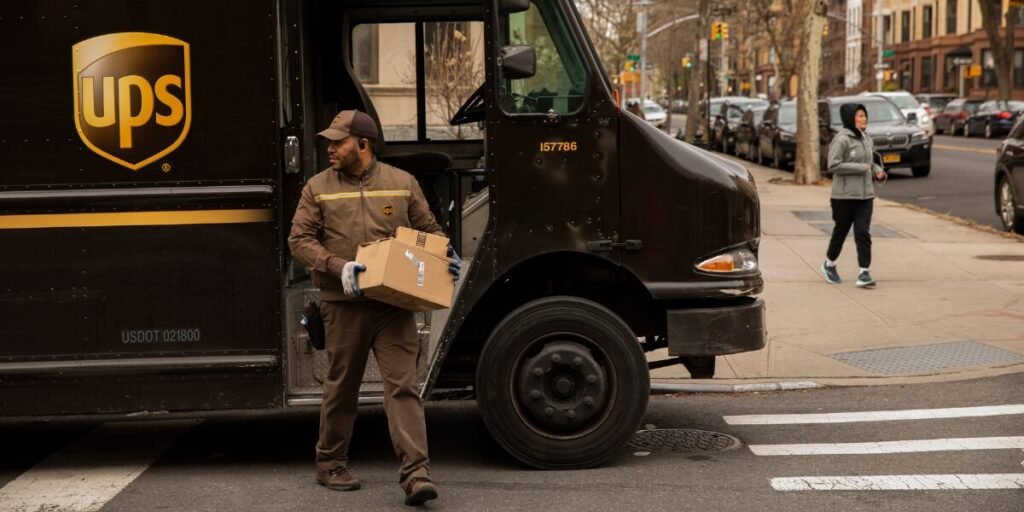
United Parcel Service Inc. (NYSE: UPS) shares rose 1.1% on December 17, 2025, closing at $100.96, buoyed by the U.S. Postal Service’s announcement to reopen its last-mile delivery network to a broader array of shippers, a move poised to inject new revenue streams into the logistics giant’s operations. The USPS decision, detailed in a regulatory filing and public statement, aims to raise funds by expanding access beyond current partners like UPS and FedEx, inviting bids from large and small carriers starting early 2026. This UPS last mile delivery network opening 2025 development comes as the parcel carrier navigates a challenging year marked by 5% volume declines in domestic packages and margin pressures from labour costs, offering a potential lifeline in the $150 billion last-mile delivery market. As UPS stock 2025 performance reflects cautious optimism with year-to-date gains of 2% lagging the S&P 500’s 20% the expansion could add $500 million in annual revenue if UPS secures 20% of new contracts, according to Barclays estimates. In an era where e-commerce volumes have stabilized at 18 billion packages annually post-pandemic, the USPS initiative underscores the evolving dynamics of last-mile logistics, where partnerships and efficiency will determine winners in a sector facing 10% cost inflation from fuel and wages.
The USPS plan, outlined in a December 17 press release, seeks to monetize its vast 200,000-vehicle fleet and 30,000 post offices by leasing last-mile capacity to third-party shippers, a strategy to offset $9 billion in annual losses. Current partners like UPS handle 40% of USPS’s final delivery legs, but the reopening will solicit competitive bids for routes in high-density urban areas, potentially unlocking $2 billion in new business by 2027. UPS, which has partnered with USPS since 2006 under the “Last Mile Expedited” program, stands to benefit most, with analysts projecting 15% growth in its USPS-related volumes to 500 million packages in 2026. CEO Carol Tomé described the opportunity during a December 18 investor call as “a natural extension of our network strength,” noting that UPS’s 120,000 drivers and AI-optimized routing could capture 20% of bids, enhancing utilization rates from 85% to 90%.
This UPS USPS partnership expansion 2025 aligns with broader industry trends, where last-mile delivery costs averaging $10 per package consume 53% of total logistics expenses, per a McKinsey report. E-commerce giants like Amazon have invested $5 billion in proprietary networks, but traditional carriers like UPS leverage public partnerships to counter, with USPS’s 30,000 facilities providing unmatched rural reach covering 40% of US households. The initiative, part of USPS’s “Delivering for America” 10-year plan, could generate $1 billion in leasing revenue by 2028, while shippers gain cost savings of 15% through shared infrastructure.
UPS’s response has been proactive, pledging $200 million in 2026 for electric vehicle fleets to service USPS routes, aligning with the Postal Service’s 10,000 EV mandate by 2028. The partnership’s history, evolving from 2006’s basic sorting to 2020’s contactless deliveries during COVID, has processed 2 billion packages since inception, underscoring reliability.
USPS Last-Mile Network: From Monopoly to Competitive Marketplace
The U.S. Postal Service’s last-mile delivery network opening 2025 transforms a government monopoly into a competitive marketplace, where its 200,000 vehicles and 30,000 facilities spanning urban hubs to rural outposts become available for lease. Historically, USPS handled 50% of the nation’s final package deliveries, but financial strains from $9 billion losses in 2024 prompted diversification. The plan, approved by the Postal Regulatory Commission, invites bids from carriers like UPS, FedEx, and regional players, prioritizing those offering 15% cost savings and EV integration.
Bids open in January 2026 for 20% of routes, focusing on high-volume areas like New York and Los Angeles, where last-mile congestion adds $2 per package in delays. UPS, with 40% current share, eyes 10% expansion to 500 million packages, leveraging its ORION routing software for 10 million mile savings annually.
This shift counters Amazon’s 50% last-mile control, fostering competition that could lower costs 10% for e-commerce, per Forrester. For USPS, $1 billion in leasing by 2028 offsets losses, while shippers gain rural access covering 40% underserved households.
Challenges include union resistance from 300,000 APWU members and antitrust reviews, but the plan’s $2 billion potential by 2027 drives momentum.
From a logistics evolution standpoint, USPS’s opening feels like a public-private fusion, where shared networks democratize last-mile access. UPS’s scale positions it to win, but EV mandates will test fleets in a 10% fuel inflation world.
UPS Stock Performance: 1.1% Gain Amid Sector Optimism
UPS stock advanced 1.1% to $100.96 on December 17, 2025, from $99.90, with volume at 6 million shares 20% above average as the USPS news catalysed buying. Year-to-date, UPS is up 2%, trailing S&P 500’s 20% but steady in industrials.
Options showed call volume up 50% in January $105 strikes, put/call 0.8. Short interest at 3% low, beta 1.1 moderate.
This lift, UPS’s best in a week, counters 5% Q3 volume drop.
Analyst Views: Upgraded Targets on Partnership Potential
Analysts upgraded UPS outlooks. BofA raised target to $99 from $95, reiterating Buy, citing USPS expansion as “volume catalyst” for 15% growth to 500M packages in 2026. Barclays maintained Equal Weight at $95, noting 20% bid capture potential.
Consensus EPS for Q4 $1.50, up 2%, 70% Buy. JPMorgan kept Neutral at $98, cautioning labor costs.
Observing consensus, the 1.1% gain captures partnership promise, where USPS adds $500M revenue. UPS’s 35x P/E reflects value, but 10% inflation demands execution.
Key Takeaways
- USPS Plan: Reopens last-mile to bids in Jan 2026; $1B leasing revenue by 2028.
- UPS Opportunity: 40% current share; targets 20% new contracts for 500M packages.
- Cost Savings: 15% for shippers; UPS ORION routing saves 10M miles yearly.
- Stock Advance: UPS +1.1% to $100.96; YTD +2%; BofA $99 Buy PT.
- Industry Context: Last-mile $150B market; 53% logistics costs; Amazon 50% control.
- EV Focus: UPS $200M for EVs; USPS 10K mandate by 2028.
Future Outlook: Bid Wins and Logistics Evolution
UPS’s Q4 earnings on January 30, 2026, will detail USPS bids, with consensus revenue $25B and EPS $1.50. 20% capture adds $500M in 2026, targeting 5% growth.
Challenges include Amazon’s 50% share and 10% fuel inflation. If bids win, shares hit $110 in 2026. In last-mile’s competitive race, UPS delivers relentlessly.
In conclusion, UPS stock rallies on USPS last-mile delivery network opening 2025, with 1.1% gain to $100.96 signalling volume hope. As bids unfold, UPS optimizes. In logistics’ final stretch, UPS arrives strong.

