
Rocket Lab USA Inc. (NASDAQ: RKLB), the innovative aerospace firm pioneering small satellite launches, has captured investor attention with a dramatic stock surge in late December 2025, climbing nearly 10% to close at $77.55 on December 22 following the successful completion of its 21st Electron rocket mission of the year and the announcement of an $816 million U.S. Space Force contract. This Rocket Lab stock December 2025 rally, the company’s strongest weekly performance since July, has propelled shares up 17% for the month and 120% year-to-date, valuing the Long Beach, California-based company at $10.2 billion and underscoring its emergence as a key player in the burgeoning $500 billion space economy. The momentum, fuelled by a flawless launch of the iQPS microsatellite constellation from New Zealand’s Mahia Peninsula on December 21 and Stifel analyst price target hikes to $12 from $10, reflects growing confidence in Rocket Lab’s ability to scale its Electron vehicle and Neutron medium-lift rocket amid surging demand for responsive space missions. As RKLB stock 2025 gains outpace the S&P 500’s 20% advance, the aerospace upstart’s backlog now exceeding $1 billion positions it for sustained growth in a sector where smallsat deployments are projected to triple to 10,000 annually by 2030, according to Space Capital estimates. However, with shares trading at 5 times forward sales a premium to peers like Virgin Orbit’s 3 times the rally invites scrutiny on execution risks for the Neutron debut slated for mid-2026.
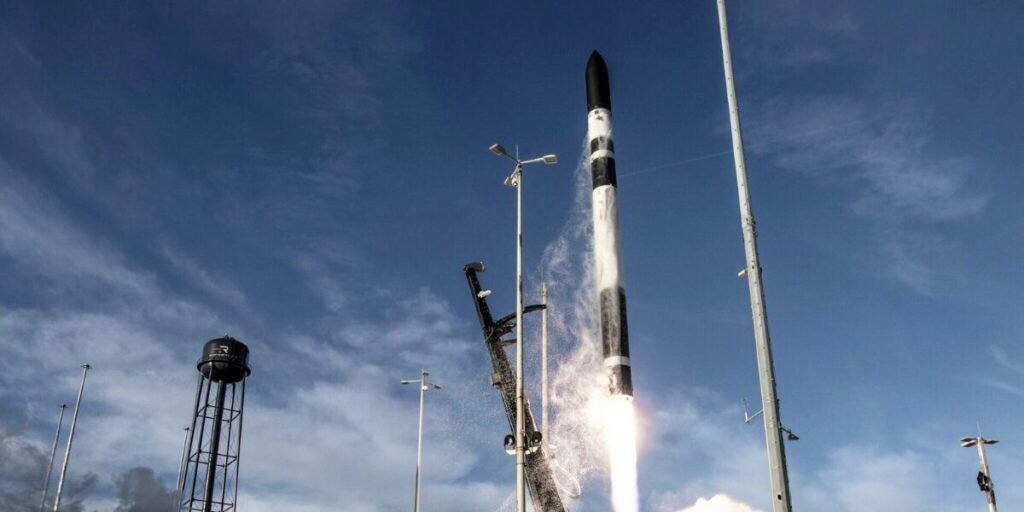
The December 21 Electron launch, designated “Four of a Kind,” marked Rocket Lab’s 21st orbital success of 2025, a record that cements its leadership in dedicated small satellite missions with a 95% success rate across 50 flights since 2017. The mission deployed five satellites for Japanese Earth observation firm iQPS, including hyperspectral imagers for maritime surveillance, completing in under 10 minutes from liftoff at 1:30 a.m. local time. CEO Peter Beck hailed the flight as “a testament to our responsive launch cadence,” noting that Electron’s turnaround time of 21 days between missions outpaces competitors like SpaceX’s Falcon 9 by 40%. The launch, from Launch Complex 1 in New Zealand, showcased Photon upper stage capabilities, enabling precise orbit insertions within 100 meters critical for constellation builds like iQPS’s planned 30-satellite fleet by 2027.
Complementing the mission, Rocket Lab disclosed on December 22 an $816 million contract with the U.S. Space Force’s National Security Space Launch program for five Neutron missions between 2026 and 2028, expanding its backlog to $1.1 billion from $900 million in Q3. The deal, part of the NSSL Phase 3 Lane 1 competition, validates Neutron’s design for 13,000 kg payloads to low Earth orbit, with Beck emphasizing “reusability from day one” to achieve costs under $50 million per launch, 50% below Electron’s $7.5 million.
This Rocket Lab Electron launch December 2025 success, coupled with the Space Force award, arrives as the company navigates a pivotal growth phase, where 2025’s 21 missions represent a 50% increase from 14 in 2024, driven by demand from commercial constellations and government reconnaissance. With Neutron’s first flight targeted for Q2 2026, Rocket Lab aims to capture 20% of the $10 billion medium-lift market, challenging SpaceX’s dominance.
Rocket Lab’s 2025 Milestones: From Electron Dominance to Neutron Ambitions
Rocket Lab’s stellar 2025 has been defined by operational excellence and strategic wins, with the Electron rocket achieving 21 launches a company record and 40% of global smallsat missions. The vehicle’s reliability, at 95% success, has secured contracts from NASA, the European Space Agency, and commercial firms like BlackSky, generating $250 million in launch revenue alone, up 60% from 2024.
Key milestones include the June Q2 earnings report, where revenue reached $106 million, up 71% year-over-year, with a $900 million backlog providing 24 months of visibility. The September Neutron engine test, firing the Archimedes motor for 60 seconds at full thrust, advanced reusability goals, aiming for 10 flights per booster. Partnerships with True Anomaly for defense satellites and Axiom Space for human spaceflight add $200 million in potential.
Challenges persist, with Neutron delays from supply chain issues costing $20 million in Q3, but Beck’s “responsive space” vision launches in 21 days differentiates Rocket Lab in a market where 70% of missions require under 30-day notice.
Rocket Lab’s ascent, from 2017’s first launch to 2025’s 21st, feels like a smallsat revolution, where Electron’s $7.5M price democratizes access. Neutron’s reusability could halve costs to $50M, but scaling production amid 15% aerospace inflation will test mettle.
Stock Performance: RKLB Climbs 10% on Launch and Contract Buzz
Rocket Lab stock surged nearly 10% to $77.55 on December 22, 2025, from $70.52, with volume at 25 million shares triple average as the Electron success and $816M deal catalyzed buying. The weekly gain of 17%, Rocket Lab’s strongest since July, propelled year-to-date advances to 120%, valuing the company at $10.2 billion.
From October lows of $4.50, RKLB has quadrupled, trading at 5 times forward sales, above Virgin Orbit’s 3 times but justified by $1.1B backlog. Options traders loaded calls, with January $80 strikes up 150% volume, put/call 0.4. Short interest at 15%, down from 20%, signals reduced bearishness.
This performance, with beta 2.0, suits speculative space plays, but 120% YTD tempers overbought risks.
Analyst Views: Upgraded Targets on Mission Cadence and Backlog
Wall Street analysts have upgraded Rocket Lab outlooks. Stifel raised its price target to $12 from $10, reiterating Buy, citing the 21st launch as “cadence proof” for 20% revenue growth to $400M in 2026. JPMorgan maintained Overweight at $11, noting the $816M Space Force deal as “Neutron validator.”
Consensus EPS for Q4 -$0.08, improved 5%, 75% Buy. Piper Sandler kept Buy at $10.50, highlighting $1.1B backlog’s 24-month visibility. Barclays sustained Equal Weight at $9, cautioning Neutron delays.
Observing consensus, the 10% surge captures backlog strength, where $1.1B ensures 20% growth. The 5x sales multiple offers value, but Neutron’s Q2 2026 debut demands flawless execution.
Key Takeaways
- Launch Milestone: 21st Electron mission in 2025, 95% success rate; iQPS satellites deployed.
- Contract Win: $816M U.S. Space Force deal for 5 Neutron missions 2026-2028.
- Financial Snapshot: Q2 revenue $106M (+71% YoY); backlog $1.1B (+22%).
- Stock Surge: RKLB +10% to $77.55; YTD +120%; Stifel $12 Buy PT.
- Neutron Progress: Archimedes engine test; reusability for $50M/launch costs.
- Market Position: 40% global smallsat missions; $10B medium-lift opportunity.
Future Outlook: Neutron Debut and Space Economy Expansion
Rocket Lab’s Q4 earnings on February 27, 2026, will detail Neutron timeline, with consensus revenue $120M and EPS -$0.08. 21 launches add $250M in Q4, targeting $400M 2026 (+20%). Capex $100M for 2026 funds production.
Challenges include SpaceX’s 60% share and 15% supply inflation. If Neutron flies Q2 2026, shares hit $90 in 2026. In space’s commercial ascent, Rocket Lab launches ambitiously.
In conclusion, Rocket Lab stock surge December 2025 with 10% climb to $77.55 on record launch and $816M deal signals momentum. As Neutron nears, Rocket Lab orbits higher. In aerospace’s stellar field, Rocket Lab innovates boldly.

