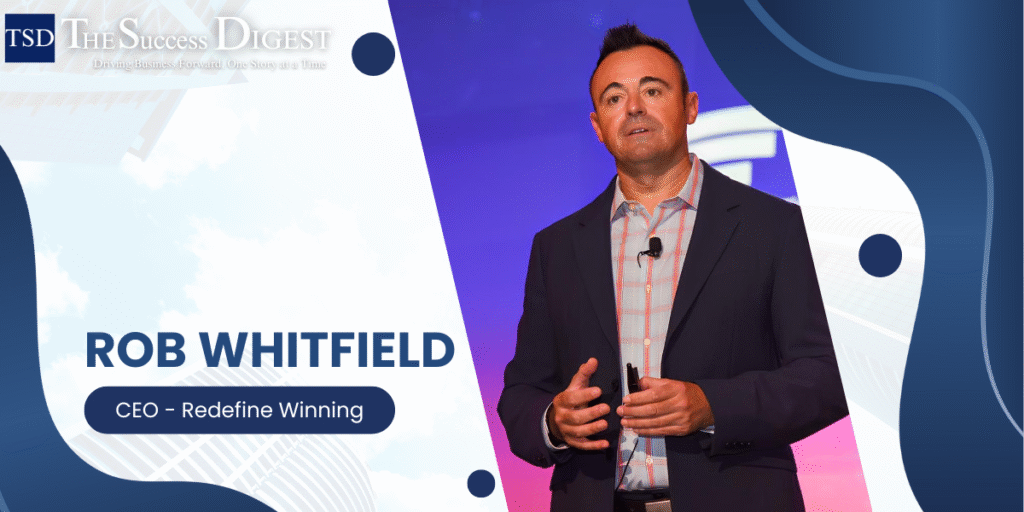
When Rob Whitfield began his career in technology consulting, the work was clear-cut: code the system, test the solution, deliver the project. But early on, he saw a recurring problem that no line of code could fix teams. Sophisticated technology was only as powerful as the people using it, and without alignment, collaboration, and trust, even the best solutions faltered.
“It became clear that technology wasn’t the issue,” Rob recalls. “The problem was how people worked together.” That realization led him out of pure tech and into the deeper world of behavioural science, organizational psychology, and team transformation territory where the real levers of sustainable success could be pulled.
The Birth of “Redefine Winning”
The pivotal moment came when Rob recognized that traditional consulting had hit a ceiling. Organizations were still clinging to hierarchical, siloed leadership models that throttled innovation and slowed execution. “I envisioned a new way of working, one built on cross-functional collaboration, empowerment, and agility,” he explains. That vision became Redefine Winning, a consultancy devoted to shifting the definition of success from individual heroics to collective achievement.
At the heart of this approach is his proprietary Co-Exponential Cohesive Teams™ methodology, a blueprint for operational alignment and cultural transformation. The goal? To cure what Rob calls Teamitis, the chronic misalignment and miscommunication that plague organizations of every size and sector.
Having worked with global powerhouses like Coca-Cola, Verizon, and the World Bank, Rob has seen the same challenges play out regardless of industry: disconnection between strategic vision and execution, leadership teams distanced from the realities their people face, and communication breakdowns that erode trust.
“The challenge is rarely about strategy or technology,” he says. “It’s about the human element- getting people to work together across silos.”
Rob’s interventions focus on creating shared understanding, common language, and team-based accountability. The transformation is measurable: one client achieved a 138% EBITDA increase after implementing his methods.
In Rob’s world, winning isn’t just about quarterly results. “Redefining winning is about agreeing on what success really means and achieving it in a way that’s sustainable and aligned with purpose,” he says. Traditional metrics often ignore the factors that make those numbers possible – psychological safety, cohesion, and shared ownership.
By focusing on these deeper levers, Redefine Winning delivers what Rob calls 10X success, exponential gains triggered by relatively small behavioural shifts. That can look like 40–60% increases in sales revenue, a 20% drop in IT costs, or dramatic jumps in employee satisfaction scores.
The Power of Re-Contracting
One of Rob’s signature tools is re-contracting a structured process in which leadership teams explicitly revisit and realign their commitments. It’s part trust exercise, part strategy reset, and part cultural cleanse.
“Most teams operate on a web of implicit agreements,” Rob explains. “Re-contracting makes those explicit, clears the air, and re-establishes shared ownership of outcomes.” This clarity can dissolve tensions, reduce friction, and refocus leaders on the same objectives.
Rob is adamant that psychological safety isn’t a “soft” factor, it’s a business driver. In organizations rooted in fear-based management, innovation stalls and agility evaporates. His approach begins at the top: leaders must model humility, invite dissent, and truly listen.
“It’s about creating a culture where people aren’t just allowed to speak up but where they’re expected to,” Rob says. This shift often requires unlearning decades of hierarchical habits, but the payoff is a surge in trust, collaboration, and speed.
One of the boldest aspects of Redefine Winning is its “no risk guarantee.” If they don’t deliver the promised outcomes, they make it right. For Rob, this isn’t a gimmick, it’s an extension of his philosophy.
“This guarantee builds trust and keeps us accountable,” he says. Clients respond to that confidence; many rate the firm a perfect 5/5 for focus on their success.
A Common Language for Uncommon Results
Part of the transformation process involves creating a shared vocabulary that cuts across departments and functions. “Without a common language, teams waste time and energy on misunderstandings,” Rob notes. Whether it’s clarifying what silence means in a meeting or defining the terms for decision-making, these micro-agreements eliminate confusion and accelerate execution.
Despite working with some of the world’s most powerful companies, Rob has learned that size and prestige don’t protect teams from dysfunction. “Even the most successful leaders struggle with alignment,” he observes. “They’re still human, bringing the rational, the emotional, and the political into the room.”
It’s why his coaching often includes building empathy as a core leadership skill. Executives who don’t naturally lead that way learn to strengthen their emotional intelligence, practice active listening, and open up to perspectives they might otherwise dismiss.
Internally, Redefine Winning holds itself to the same standards it demands of clients. The team measures its own cohesion, alignment with purpose, and execution quality as rigorously as it tracks client outcomes.
“Our mission is to transform society by transforming teams,” Rob says. “We can’t do that if we’re not modeling it ourselves.”
Looking ahead, Rob sees agile teamwork evolving toward even greater adaptability, digital fluency, and cross-cultural competence. Distributed teams will be the norm, making self-management and comfort with ambiguity non-negotiable skills.
“Some of the most competitive teams of the next decade are still in school or college right now,” he says. “Leaders who fail to adapt will lose to those who do.”
A Legacy of Collective Success
Rob’s ultimate ambition isn’t about personal recognition, it’s about leaving behind stronger systems and cultures. “Your real legacy isn’t what people remember about you,” he says. “It’s the culture you leave behind for them to build on.”
In his vision of the future, the hero-leader myth has been replaced by something far more powerful: organizations where everyone is empowered to win together.