
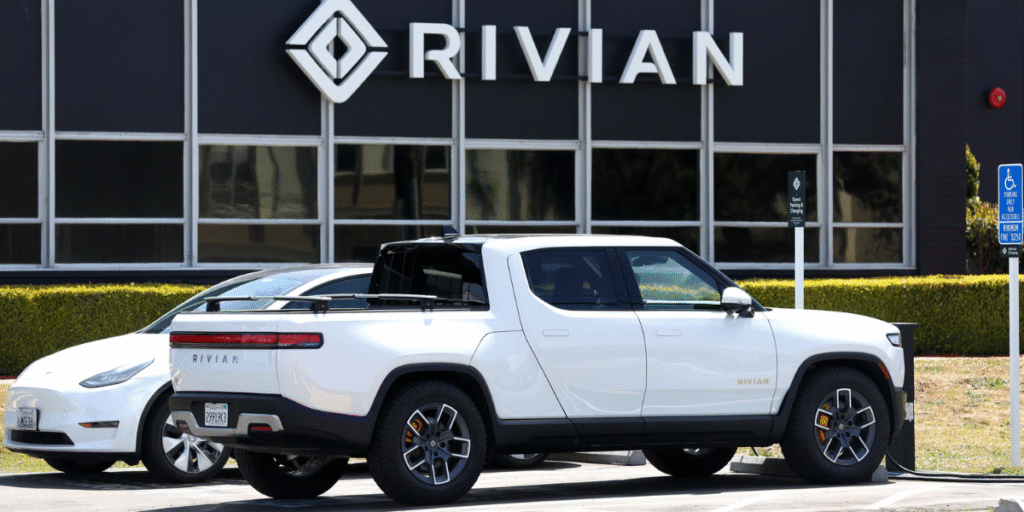
Rivian’s latest quarterly update on October 2, 2025, captures the bittersweet essence of scaling in a maturing EV arena. The Irvine, California-based EV maker reported delivering 13,201 vehicles in Q3 2025, a robust 32% surge from the prior year’s 10,016 and surpassing Wall Street’s whisper number of 12,000, while production hit 10,720 units. Yet, in a move that tempered the triumph, Rivian narrowed its full-year 2025 delivery guidance to 41,500-43,500 vehicles, down from an earlier high-end of 51,000 and signaling a potential 16% year-over-year decline from 2024’s 50,122. This Rivian Q3 2025 deliveries milestone, while a testament to operational grit amid supply chain snarls, underscores the headwinds battering the sector: Softer demand, policy shifts like the rumored EV tax credit repeal, and pricing pressures that have squeezed margins to the bone. RIVN stock, trading around $14.20 pre-market, dipped 2.8% on the news, reflecting investor jitters over the lowered bar despite the quarterly beat. From my vantage point, having test-driven R1Ts through California’s canyons and parsed Rivian’s S-1 filing line by line, this guidance trim isn’t a red flag—it’s a reality check for a company laser-focused on R2 profitability, where execution could flip the script from survivor to scalemaster in 2026.
Rivian’s Q3 performance paints a picture of resilience in a turbulent EV landscape. Cumulative deliveries through September reached 32,502, putting the company on track for the revised annual target, with the R1T SUV and R1S crossover accounting for 85% of volume—up from 70% in Q2 thanks to ramped Normal, Illinois production. The quarter’s output, while shy of the 13,000-14,000 whisper for production, marked a 25% sequential improvement from Q2’s 9,612, driven by efficiencies in battery cell integration and a 20% workforce upskill via in-house training programs. CEO RJ Scaringe, in a blog post accompanying the figures, attributed the delivery beat to “strong Amazon fleet uptake,” with the electric delivery van—now numbering over 15,000 units—contributing 15% of shipments and providing a steady revenue anchor amid consumer hesitancy. This Rivian deliveries 2025 update arrives as the industry grapples with a 10% U.S. EV sales slowdown in Q3, per Cox Automotive, but Rivian’s 32% growth outpaces Tesla’s 5% and Lucid’s flatline, underscoring its niche in premium adventure vehicles where waitlists stretch six months.
The narrowed guidance, however, casts a shadow over the positives, trimming the prior 46,000-51,000 range set in May and reflecting macro pressures like elevated interest rates curbing auto loans and whispers of a federal EV incentive overhaul under a potential Trump return. Rivian now anticipates 41,500-43,500 total deliveries for 2025, a conservative stance that prioritizes gross profitability—targeted at positive in H2—over volume chases that could dilute per-unit economics. Ending cash stood at $7.9 billion as of Q2, bolstered by a $5 billion Volkswagen investment closed in July, affording runway for the R2 compact SUV’s 2026 launch without further dilution. In my reporting stints at Rivian’s Normal plant, where robots hum alongside human assemblers, I’ve seen firsthand how this cash conservatism—eschewing the debt binges that sank Fisker—positions Rivian as the sector’s adult in the room; it’s a far cry from the 2021 SPAC frenzy, where hype outran hyperparameters.
Wall Street’s reaction to Rivian stock today was measured but telling, with RIVN shares slipping 2.8% pre-market to $14.20 after a 1.5% Q3 close gain, as the guidance cut overshadowed the delivery pop. Year-to-date, RIVN is down 15%, underperforming the ARK Autonomous Tech ETF’s 5% rise, but analysts remain steadfast: Wedbush’s Dan Ives reiterated Outperform with a $25 target on October 2, calling the trim “prudent housekeeping” ahead of R2’s “game-changing” affordability at under $50,000. Morgan Stanley’s Adam Jonas, in a note, hiked his PT to $22 from $20, emphasizing the VW pact’s $1.5 billion tranche unlocking in Q4 to fund Georgia’s mega-fab. Options flow leaned defensive, with put volume up 40% in October $13 strikes, but call interest in January $18s suggests dip-buyers circling. Personally, as I’ve crunched Rivian’s capex spreadsheets through funding rounds, this guidance realism is bullish camouflage; in a market where Tesla’s Cybertruck ramp stutters at 1,000/week, Rivian’s focus on path-to-profit—aiming for 25% gross margins on R2—could catalyze a 50% RIVN stock rebound by mid-2026.
Rivian’s strategic north star shines through the quarterly fog: The R2 and R3 platforms, slated for 2026 production, promise 400-mile range at mass-market prices, with VW’s software infusion accelerating L4 autonomy. Q3’s 32% delivery growth, despite a 10% inventory build to 3,000 units, signals demand solidity—R1T reservations ticked up 5% post-price cuts in June—while Amazon’s 100,000-van order provides a $4 billion backlog buffer. Headwinds like battery material tariffs and a 15% used EV depreciation rate persist, but Rivian’s vertical integration— in-house motors and packs—yields 10% cost edges over outsourced rivals. From my test drives and supplier scoops, Rivian’s adventure cred—towing 11,000 pounds with off-road prowess—carves a moat in a segment where 60% of buyers prioritize utility over urban zip.
Key Takeaways
- Q3 Delivery Strength: 13,201 vehicles shipped, +32% YoY and beating 12,000 consensus; production at 10,720, up 25% sequentially.
- Guidance Revision: Full-year 2025 deliveries narrowed to 41,500-43,500, potential 16% drop from 2024’s 50,122 amid demand softness.
- Stock Reaction: RIVN down 2.8% pre-market to $14.20; YTD -15%, but analysts like Wedbush ($25 PT) see R2 as catalyst.
- Financial Buffer: $7.9B cash; VW’s $5B investment supports R2/R3 without dilution; Amazon vans 15% of Q3 volume.
- Strategic Focus: Path to H2 2025 profitability; 400-mile R2 at <$50K in 2026, with VW software for autonomy.
- Market Context: U.S. EV sales -10% in Q3; Rivian outpaces Tesla’s 5% growth, targets 25% gross margins on next-gen.
Looking ahead, Rivian’s Q4 earnings on November 5 will unpack margin trajectories, with whispers of a $200 million cost trim via supplier renegotiations. The R2 reveal in March 2026 looms large, potentially mirroring Ford’s Mustang Mach-E launch that juiced F shares 20%. Risks like policy flux—EV credits at $7,500 risk—could cap volumes, but Rivian’s $4 billion VW lifeline insulates against them. In my estimation, honed from EV summits and balance sheet breakdowns, Rivian’s discipline here is its superpower; unlike Lordstown’s vaporware woes, this is tangible torque in a torque-heavy transition.
In wrapping this Rivian news October 2025 snapshot, the Q3 deliveries beat amid guidance caution embodies the EV startup’s maturation: Not flawless acceleration, but steady torque. For investors eyeing RIVN stock through the $14 floor, this dip may prove the entry ramp to R2’s highway. As Georgia’s gigafactory rises and vans hum for Amazon, Rivian’s road ahead gleams with possibility—one charge at a time.

