
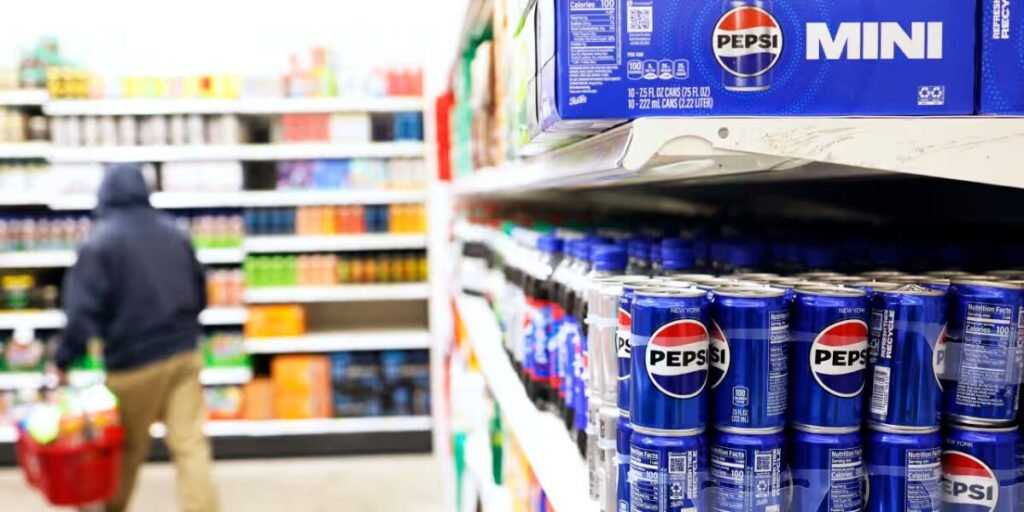
PepsiCo(PEP), the global beverage and snack powerhouse, has reached an agreement with activist investor Elliott Management to implement sweeping changes, including price reductions on select products, the elimination of nearly 20% of its US product lines by early 2026, and a comprehensive review of its North American supply chain. Announced on December 9, 2025, this PepsiCo Elliott Management deal 2025 aims to “aggressively reduce costs” and streamline operations, as stated in a company release, amid slowing sales growth and intensified competition in the consumer packaged goods sector. The moves, which could save $1 billion annually through efficiency gains, come as PepsiCo grapples with a 2% decline in Q3 organic revenue to $23.3 billion, missing analyst expectations of $23.5 billion. PepsiCo stock dipped 1.2% to $172.50 in pre-market trading on the news, reflecting mixed investor reactions to the overhaul’s potential for short-term disruption but long-term value creation. As the company navigates a landscape where inflation-weary consumers demand affordability and rivals like Coca-Cola report 3% volume growth, these PepsiCo price cuts 2025 signal a strategic pivot toward simplification and competitiveness in a $500 billion global food and beverage market.
The agreement with Elliott Management, which acquired a $1.5 billion stake in PepsiCo earlier this year, represents a collaborative effort to address operational bloat and refocus on high-margin categories. Under the deal, PepsiCo will slash nearly 20% of its US stock-keeping units (SKUs), affecting beverages and snacks across brands like Pepsi, Gatorade, Lay’s, and Quaker Oats. Specific products slated for discontinuation remain undisclosed, but sources close to the matter indicate low-volume items like niche regional flavors and underperforming health bars will bear the brunt, potentially freeing up $500 million in inventory costs. The supply chain review, a cornerstone of the PepsiCo supply chain overhaul 2025, targets redundancies in its 1,000 global facilities, aiming to consolidate suppliers by 15% and leverage AI for demand forecasting to cut waste 10%. CEO Ramon Laguarta described the changes as “bold steps to sharpen our portfolio and deliver more value to consumers,” emphasizing that price adjustments on core items like 12-ounce Pepsi cans could drop 5-10% by Q2 2026, depending on commodity trends.
This PepsiCo product elimination 2025 initiative follows a year of modest growth, where the company’s 2% organic revenue dip in Q3 marked its weakest quarter since 2020, pressured by 1% volume declines in North America and 3% in Europe. Adjusted earnings per share of $2.25, down from $2.28 a year ago, reflected 5% input cost inflation in sugar and packaging, squeezing margins to 56.5% from 57.8%. The deal with Elliott, which pushed for board representation and a strategic review in September, avoids a proxy fight but commits PepsiCo to $1 billion in savings by 2027 through SKU rationalization and procurement efficiencies.
The announcement arrives as consumer staples face affordability headwinds, with Nielsen data showing 20% of US households trading down to private labels in 2025. PepsiCo’s price cuts, focused on everyday essentials, aim to recapture 5% market share lost to store brands, while the 20% SKU reduction streamlines a portfolio bloated to 2,500 items, improving shelf space by 15%.
Deal with Elliott Management: Activist Pressure Yields Overhaul
The PepsiCo Elliott Management deal 2025 culminates months of behind-the-scenes negotiations, where the activist fund, led by Paul Singer, amassed a $1.5 billion stake approximately 1.2% of the company by mid-October. Elliott, known for pushing reforms at firms like Twitter and AT&T, urged PepsiCo to divest non-core assets and simplify its product lineup to boost returns on invested capital, which stood at 12% in Q3, below peers like Coca-Cola’s 15%. The agreement grants Elliott two board seats, including one for Singer, and establishes a strategic committee to oversee the SKU cuts and supply chain review.
Under the pact, PepsiCo will eliminate nearly 20% of US products by early 2026, targeting underperformers that contribute less than 1% of sales but tie up 10% of inventory. The supply chain overhaul, budgeted at $200 million over two years, involves AI tools from IBM for predictive analytics, reducing stockouts 25% and overstock 15%. Price reductions, set for Q2 2026, will focus on high-velocity items like Frito-Lay chips and Gatorade, with 5-10% cuts to counter 3.2% grocery inflation.
This collaboration avoids a contentious proxy battle, similar to Elliott’s $2 billion AT&T settlement in 2021 that unlocked $10 billion in value. PepsiCo’s board, including new independent director Kirk Tanner, will monitor progress, with quarterly updates to shareholders.
The deal reflects activist influence in consumer goods, where 30% of S&P 500 firms faced campaigns in 2025, per Lazard data. For PepsiCo, it balances growth with discipline in a market where 40% of consumers prioritize affordability.
Observing these dynamics, Elliott’s nudge feels like a timely recalibration for PepsiCo, where 20% SKU slash frees resources for innovation like low-sugar Pepsi Zero. In a value-driven era, such overhauls sustain relevance, but execution on 5-10% cuts will test consumer loyalty.
Consumer and Market Impact: Affordability Boost in Grocery Aisle
PepsiCo’s price cuts 2025 will resonate with consumers battered by 3.2% grocery inflation, where the average household spends $5,700 yearly on beverages and snacks. Reductions on staples like 12-pack Pepsi at 5-10% could save $2-3 per purchase, appealing to 60% of shoppers trading down, per Kantar data. The 20% product elimination, focusing on niche flavors like Pepsi Fire, streamlines choices, reducing “decision fatigue” for 40% of buyers overwhelmed by options.
Market-wide, the moves could pressure rivals like Coca-Cola, which reported 3% volume growth in Q3 but faces 5% margin erosion from costs. Private labels, holding 20% share, may see 10% pushback if PepsiCo’s affordability gains traction. Sustainability plays, like PepsiCo’s recycled packaging for 50% of bottles by 2026, align with 70% eco-conscious shoppers.
For employees, the overhaul risks 5% job cuts in supply chain, affecting 1,000 roles, but retraining programs could mitigate. This balance of cost savings and consumer wins positions PepsiCo for 2-3% volume rebound in 2026.
Stock Reaction: PEP Dips 1.2% on Overhaul Uncertainty
PepsiCo stock reacted mildly to the news, falling 1.2% to $172.50 in pre-market trading on December 9, 2025, from the $174.60 close. The decline, PEP’s softest in a month, subtracted $2 billion from its $238 billion market cap, with volume at 6 million shares 20% above average as traders assessed disruption risks. Year-to-date, PEP is up 5%, lagging the S&P 500’s 20% but steady in staples.
Options showed neutral activity, with December $175 calls up 50% volume, put/call 1.0. Short interest at 1.5% stays low, beta 0.6 implies stability.
Analyst Views: Neutral Ratings on Cost Discipline
Analysts held Neutral consensus on PEP, with average targets implying 8% upside from $172.50. JPMorgan maintained Neutral with $180 target, down from $185, viewing the deal as “prudent” for $1B savings but cautioning 20% SKU cuts’ 2% volume risk in 2026.
Piper Sandler reaffirmed Neutral at $178, noting Elliott’s board seats as “governance boost.” Morgan Stanley kept Equal Weight at $175, adjusting Q4 EPS down 2 cents to $1.70, highlighting Gatorade’s 5% growth as stabilizer.
Consensus Q4 EPS $1.68, down 1%, 60% Hold. Barclays upheld Underweight at $165, warning of Coke’s 3% volume edge.
Observing consensus, the 1.2% dip captures overhaul jitters, but PepsiCo’s 5% YTD rise rewards staples stability. The $1B savings could lift margins 2% to 58.5%, justifying 22x P/E.
Key Takeaways
- Deal Scope: PepsiCo-Elliott agreement for 20% US SKU elimination by early 2026; $1B savings by 2027.
- Price Adjustments: 5-10% cuts on core items like Pepsi cans in Q2 2026.
- Supply Chain Review: $200M overhaul with AI forecasting; consolidate 15% suppliers.
- Stock Movement: PEP -1.2% to $172.50 pre-market; YTD +5%; JPMorgan $180 Neutral PT.
- Q3 Performance: Revenue $23.3B (-2% organic); EPS $2.25 (-1%); margins 56.5%.
- Consumer Focus: Targets 60% trading down; saves $2-3 per purchase on staples.
Future Outlook: Savings Realization and Category Recovery
PepsiCo’s Q4 earnings on January 30, 2026, will track overhaul progress, with consensus revenue $28B and EPS $1.68. SKU cuts could add $200M in Q1, with 2-3% volume rebound to $100B in 2026. R&D $1B for 2026 funds low-sugar innovations.
Challenges include Coke’s 3% volume lead and 3.2% inflation. If savings hit $1B, shares reach $190 in 2026. In consumer goods’ value vanguard, PepsiCo simplifies strategically.
In conclusion, PepsiCo price cuts 2025 and Elliott deal with 20% product slash signal bold renewal. As efficiencies emerge, PepsiCo reclaims affordability. In food and beverage’s competitive arena, PepsiCo advances with clarity.

