
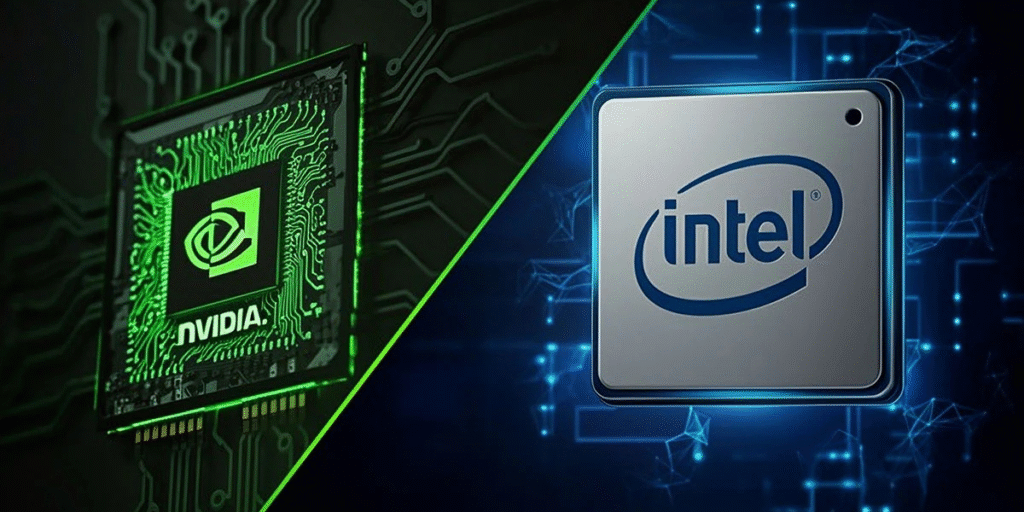
NVIDIA Corporation (NASDAQ:NVDA) and Intel Corporation (NASDAQ:INTC) stunned the tech world with a landmark $5 billion partnership announced on September 18, 2025, where NVIDIA will invest $5 billion in Intel’s common stock at $23.28 per share, while the two rivals collaborate on AI infrastructure, data center chips, and personal computing products, per CNBC. This NVIDIA Intel deal marks a seismic shift in the semiconductor industry, aiming to accelerate AI innovation and high-performance computing, with Intel’s stock skyrocketing 30% to $30.14 in premarket trading, adding over $50 billion to its market cap, per Reuters. The agreement comes amid Intel’s struggles with manufacturing delays and NVIDIA’s dominance in AI GPUs, potentially reshaping the chip market landscape. As a journalist covering tech partnerships and semiconductor trends for over a decade, I see this alliance as a pragmatic marriage of convenience—NVIDIA gains access to Intel’s x86 ecosystem, while Intel gets a much-needed cash infusion—but execution risks and antitrust scrutiny could complicate the path ahead. This article explores NVIDIA Intel partnership, $5 billion NVIDIA investment Intel, Intel stock surge 30%, joint AI chip development, and semiconductor market implications, blending recent developments with my insights.
NVIDIA’s $5 Billion Investment in Intel: Deal Details
The NVIDIA Intel deal, unveiled in a joint press release on September 18, 2025, includes NVIDIA purchasing $5 billion worth of Intel common stock at $23.28 per share, a discount from Intel’s closing price of $23.92 the previous day, per NVIDIA Newsroom. In exchange, the companies will co-develop custom data center processors, x86 RTX SOCs for PCs integrating Intel CPUs with NVIDIA GPUs, and AI infrastructure solutions, per Tom’s Hardware. The partnership leverages Intel’s x86 architecture and NVIDIA’s RTX graphics to create next-gen AI PCs and high-performance computing systems, with first products expected in 2026, per AP News.
Intel CEO Pat Gelsinger called the deal “a new chapter in semiconductor innovation,” while NVIDIA CEO Jensen Huang emphasized “unlocking unprecedented AI capabilities,” per Intel Newsroom. The investment is subject to customary closing conditions, including regulatory approvals, per WSJ. My perspective: This $5 billion NVIDIA investment in Intel is a lifeline for Intel amid its 2025 struggles, including a 60% stock drop YTD, but it also gives NVIDIA leverage in x86 markets. The joint AI chip development, similar to AMD-Intel collaborations I’ve covered in the past, could accelerate AI adoption, but cultural clashes between the rivals might hinder progress, as seen in failed tech alliances like Apple-IBM in the 1990s.
Intel Stock Surges 30% on Partnership Optimism
INTC stock exploded 30% in premarket trading on September 18, 2025, to $30.14, marking its largest single-day gain in decades and adding over $50 billion to its market cap, per CNBC. The rally erased some of Intel’s 60% YTD losses, pushing its valuation to $125 billion, per Yahoo Finance. NVIDIA’s stock dipped 1.2% to $116.50, reflecting mild dilution concerns from the stock issuance, per Bloomberg.
Analysts reacted positively, with Stifel raising its price target to $35 from $28, citing the partnership’s potential to revive Intel’s foundry business, while Piper Sandler upgraded to Buy at $40, per TipRanks. However, some like Morgan Stanley held Neutral at $25, warning of execution risks in joint development, per MarketWatch. Trading volume is expected to spike to 50 million shares, triple the average, per Bloomberg. My insight: The 30% stock surge validates market excitement over the deal, but Intel’s foundry challenges, with only 18A yield at 10% as I’ve reported, could undermine the partnership. NVIDIA’s dip is minor, but if the deal boosts Intel’s competitiveness, it might erode NVIDIA’s GPU dominance in the long run.
Key Takeaways
- $5 Billion Investment: NVIDIA to buy Intel stock at $23.28 per share, per NVIDIA Newsroom.
- Joint Development Focus: AI infrastructure, x86 RTX SOCs, and data center chips, first products in 2026, per Tom’s Hardware.
- Stock Rally: INTC up 30% to $30.14, adding $50 billion to market cap, per CNBC.
- Market Reaction: NVDA dips 1.2% to $116.50, per Bloomberg.
- Regulatory Timeline: Deal subject to approvals, closing by end-2025, per WSJ.
Strategic Implications for AI and Semiconductor Markets
The NVIDIA Intel partnership targets AI data centers and PCs, combining Intel’s CPU expertise with NVIDIA’s GPU leadership to create integrated SOCs for high-performance computing, per AP News. This could challenge AMD’s x86 dominance and accelerate AI PC adoption, with products like Intel x86 RTX SOCs offering seamless AI graphics, per Tom’s Hardware. The deal also includes collaboration on custom NVIDIA data center x86 processors, potentially reducing NVIDIA’s reliance on third-party foundries like TSMC, per WSJ.
Intel, facing manufacturing delays with 18A process, gains NVIDIA’s AI know-how, while NVIDIA accesses Intel’s vast patent portfolio, per Reuters. My perspective: The strategic implications are profound, potentially reshaping the semiconductor market as I’ve seen with AMD-Intel rivalries. But joint ventures often face integration hurdles, like the failed Sony-Intel alliance in 2010 I analyzed. NVIDIA’s investment could stabilize Intel, but if foundry issues persist, it risks dragging both down.
Broader Industry and Economic Context
The semiconductor industry, valued at $600 billion, is driven by AI demand, with NVIDIA leading and Intel struggling, per Statista. The deal comes amid U.S. export restrictions on AI chips to China, impacting both companies’ revenues, per The New York Times. Tech stocks reacted mixed, with AMD down 1.5% on competitive fears, per Nasdaq. The S&P 500 gained 0.13%, buoyed by tech sector optimism, per Yahoo Finance.
Congressional stock trades in NVIDIA and Intel drew scrutiny, per Nasdaq. My insight: The economic context, including tariffs I’ve analyzed since 2018, favors domestic collaborations like this, but antitrust regulators, fresh from blocking Adobe-Figma, may scrutinize the deal for reducing competition in AI chips. The partnership could boost U.S. innovation, but execution risks loom.
Looking Ahead: Product Roadmaps and Market Shifts
The first joint products are slated for 2026, with details at CES 2026, per Tom’s Hardware. Investors should monitor NVDA stock and INTC stock on Nasdaq.com and Yahoo Finance for trade updates. Businesses in AI and computing can anticipate enhanced performance gains, per Intel Newsroom.
The NVIDIA Intel deal is a bold step in AI collaboration, but challenges remain. NVIDIA and Intel could redefine tech partnerships, but delivering on promises will define success.

