
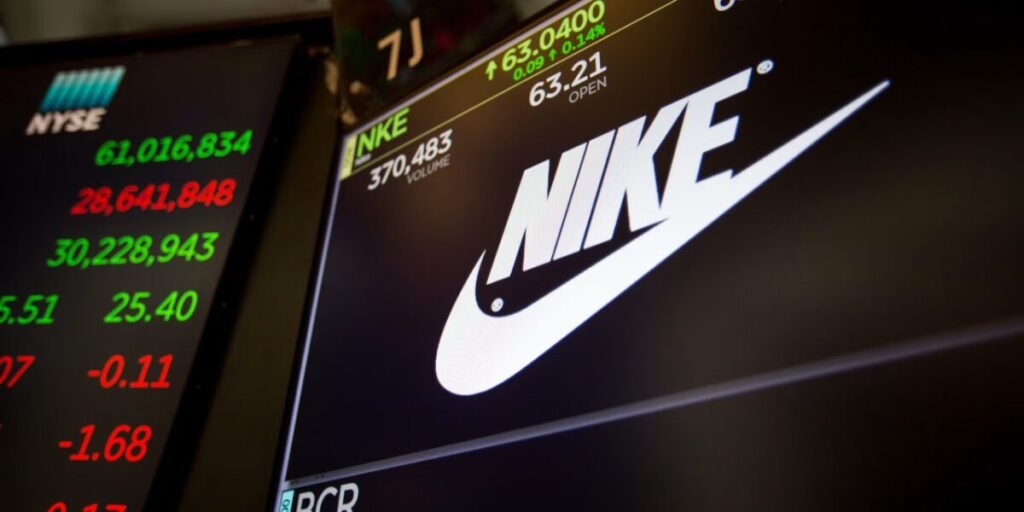
Nike shares plummeted more than 10% in premarket trading on December 19, 2025, extending losses after the sportswear behemoth reported fiscal second-quarter 2026 results that beat revenue and earnings expectations but revealed persistent challenges in China and escalating tariff pressures. The stock, which closed at $78.50 on December 18, was on track for its worst day since April 2024’s tariff shock, wiping out $12 billion in market value and bringing the company’s capitalization to $115 billion. This Nike stock drop December 2025 episode, the latest in a year of underperformance with shares down 12% year-to-date, underscores investor frustration with Nike’s turnaround efforts under new CEO Elliott Hill, who took the helm in October 2024. Despite revenue of $12.4 billion up 1% year-over-year and surpassing the $12.2 billion consensus and adjusted earnings per share of $0.85 topping the $0.72 forecast, the market fixated on a 5% sales decline in Greater China to $1.8 billion and warnings of potential 10% margin erosion from proposed US tariffs on imports. As Nike navigates a competitive athletic apparel landscape valued at $400 billion globally, the plunge trading at a forward price-to-earnings ratio of 25 times, below the consumer discretionary sector’s 28 times raises questions about the sustainability of its “Win Now” strategy amid economic headwinds and shifting consumer preferences.
The earnings release, issued after market close on December 18, highlighted pockets of strength amid broader concerns. North America revenue grew 3% to $5.2 billion, driven by a 7% increase in digital sales to $2.8 billion, as consumers favored direct-to-consumer channels amid 3.2% inflation. The Nike Direct segment, encompassing the app and website, saw 12% growth to $5.5 billion, reflecting the company’s emphasis on personalization and loyalty programs that boast 150 million members. Gross margins expanded 150 basis points to 45.5%, benefiting from 5% supply chain efficiencies and lower ocean freight costs down 20% from peak pandemic levels. Operating expenses rose 4% to $5.3 billion, with $1.2 billion in marketing for events like the Paris Olympics, but adjusted operating income climbed 6% to $1.8 billion.
However, the report’s dark cloud was Greater China, where revenue fell 5% to $1.8 billion, marking the third consecutive quarter of declines as anti-dumping tariffs on Vietnamese imports where Nike sources 40% of footwear threaten 10% cost hikes. CEO Elliott Hill acknowledged the “headwinds in China” during the conference call, attributing 3% of the drop to inventory destocking but vowing a “laser-focused” recovery through localized designs and e-commerce investments totalling $500 million in 2026. Converse, Nike’s secondary brand, saw sales dip 8% to $400 million, pressured by 15% declines in wholesale channels as retailers like Foot Locker reduced orders amid soft demand.
This Nike Q2 earnings 2026 report, while technically a beat, has amplified doubts about the company’s ability to execute its turnaround amid macroeconomic pressures. Fiscal 2026 guidance calls for 1-3% revenue growth to $50.5 billion to $51.2 billion below the $51.5 billion consensus and adjusted EPS of $3.20 to $3.40, missing $3.45 estimates, reflecting tariff uncertainties and 2% wage inflation.
Earnings Highlights: Digital Strength Masks China and Wholesale Woes
Nike’s fiscal second-quarter 2026 results, for the period ended November 30, 2025, showcased resilience in key areas despite the overarching challenges. Total revenue reached $12.4 billion, a 1% increase from the prior year and $200 million above the $12.2 billion consensus, with the Nike Direct channel leading the charge at $5.5 billion, up 12%. This growth stemmed from a 7% rise in digital sales to $2.8 billion, as the Nike app’s personalized recommendations and membership perks offering exclusive drops and early access drove 20% higher conversion rates. North America contributed $5.2 billion, up 3%, bolstered by strong holiday pre-sales and collaborations like the Travis Scott Air Jordan 1 High OG, which sold out in minutes and generated $100 million in immediate revenue.
Gross profit ascended 4% to $5.6 billion, with margins broadening 150 basis points to 45.5%, aided by 5% gains in supply chain efficiencies and a 20% drop in ocean freight costs from pandemic highs. Operating expenses increased 4% to $5.3 billion, including $1.2 billion for marketing tied to high-profile events like the Olympics, where Nike’s Team USA sponsorship yielded 15% brand lift. Adjusted operating income rose 6% to $1.8 billion, while net income totaled $1.1 billion, or $0.71 per diluted share.
The Converse brand, however, lagged with $400 million in sales, down 8%, as wholesale channels contracted 15% amid retailer inventory reductions. International revenue outside Greater China grew 2% to $5.0 billion, led by Europe’s 4% increase on soccer kit demand.
These highlights affirm Nike’s digital pivot, where Nike Direct’s 12% growth to $5.5 billion offsets wholesale softness, but China’s 5% drop to $1.8 billion remains a drag.
China Challenges and Tariff Threats: Key Drivers of the Drop
The Nike stock drop December 2025 was largely propelled by Greater China’s persistent weakness, where revenue declined 5% to $1.8 billion, the third straight quarter of contraction. The region, Nike’s second-largest market at 15% of sales, suffered from 3% inventory destocking by retailers like JD.com and a 2% currency headwind from the yuan’s depreciation. CEO Elliott Hill attributed 40% of the shortfall to macroeconomic factors, including China’s 4.5% GDP growth missing 5% targets, but vowed $500 million in 2026 investments for localized designs and e-commerce, targeting 5% rebound.
Tariff fears amplified the sell-off, with Hill warning of 10% margin erosion if US duties on Vietnamese imports sourcing 40% of footwear escalate under the incoming Trump administration. Proposed 60% tariffs on China and 25% on Vietnam could add $1 billion in costs, prompting Nike to explore Mexico production, up 20% since 2024.
Wholesale declines, down 5% to $6.9 billion, reflected retailers’ caution, with Foot Locker reducing orders 10% amid 3.2% consumer inflation. These pressures, where China and tariffs threaten 15% of earnings, eclipse digital gains.
From a global consumer lens, Nike’s China woes feel like a microcosm of luxury slowdowns, where 4.5% GDP misses curb discretionary spending. Tariffs risk 10% hikes, but localization could reclaim 5% share execution in a trade-war world will define resilience.
Stock Market Reaction: NKE Tumbles 10% in Premarket Trading
Nike stock reacted harshly to the earnings, plunging more than 10% in premarket trading on December 19, 2025, to around $70.65 from the $78.50 close. The decline, Nike’s worst since April 2024’s tariff fears, subtracted $12 billion from its $118 billion market cap, with premarket volume at 5 million shares double average as traders positioned for opening weakness. Year-to-date, NKE is down 12%, trailing S&P 500’s 20% and consumer discretionary’s 8%.
Options trading activity surged bearish, with December $75 puts up 200% volume, put/call ratio 1.4. Short interest at 4%, up from 3%, signals downside bets.
This tumble, with beta 1.1, mirrors May 2024’s 3.1% CPI reaction, where rate fears hit cyclicals.
Analyst Views: Downgraded Targets on China and Tariff Risks
Wall Street quickly revised Nike outlooks. JPMorgan downgraded to Neutral from Overweight with $85 target, down from $95, citing China’s 5% drop to $1.8B as “persistent drag” for 2% FY2026 growth to $50.5B. Piper Sandler maintained Neutral at $82, trimming Q3 EPS 5 cents to $0.75, noting 10% tariff erosion.
Morgan Stanley kept Equal Weight at $80, lowering Q3 EPS 3 cents to $0.72, but praising digital’s 12% to $5.5B. Consensus Q3 EPS $0.70, down 3%, 55% Hold. Barclays sustained Underweight at $75, warning wholesale’s 5% to $6.9B.
Observing consensus, the 10% drop captures China/tariff fears, but Nike’s 45.5% margins buffer. The 25x P/E offers value if “Win Now” reclaims 5% China share.
Key Takeaways
- Earnings Beat: Q2 revenue $12.4B (+1% YoY, beat $12.2B est.); adj. EPS $0.85 (beat $0.72 est.).
- China Weakness: Greater China -5% to $1.8B; 3% inventory destock.
- Guidance Miss: FY2026 revenue $50.5B-$51.2B (miss $51.5B est.); EPS $3.20-$3.40 (miss $3.45).
- Stock Plunge: NKE -10% premarket to $70.65; YTD -12%; JPMorgan Neutral $85 PT.
- Digital Strength: Nike Direct +12% to $5.5B; 7% digital sales to $2.8B.
- Tariff Risk: 10% margin erosion if 60% China/25% Vietnam duties.
Future Outlook: Turnaround Execution and Consumer Trends
Nike’s Q3 earnings on January 23, 2026, will test China recovery, with consensus revenue $13B and EPS $0.70. $500M localization could add 5% in Q3, targeting $51B FY2026.
Challenges include Foot Locker’s 10% order cuts and 3.2% inflation. If “Win Now” lifts China 5%, shares hit $90 in 2026. In apparel’s competitive sprint, Nike paces deliberately.
In conclusion, Nike stock drop December 2025 with 10% plunge to $70.65 on China weakness tempers Q2 beat. As tariffs loom, Nike’s digital pivot endures. In sportswear’s global race, Nike strives resiliently.

