
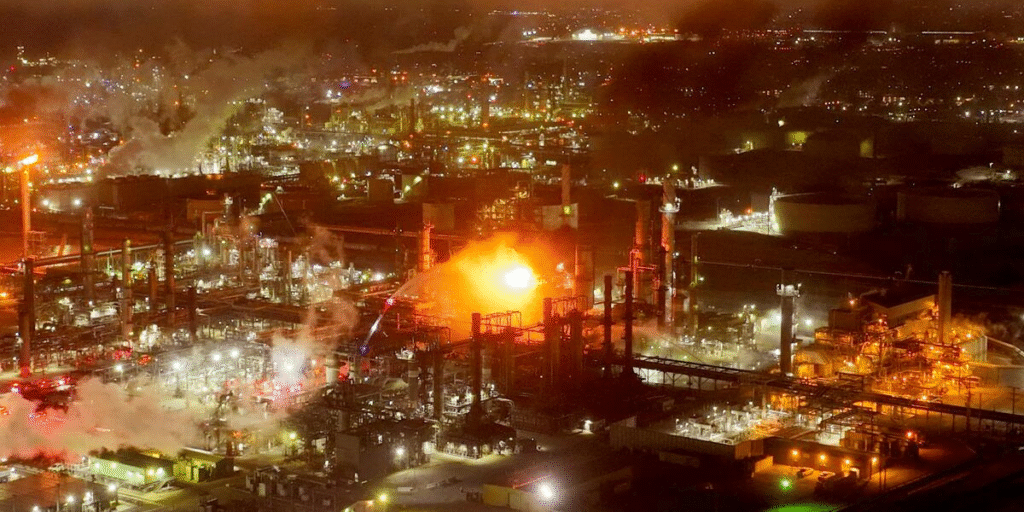
The Chevron refinery fire in El Segundo on October 2, 2025, serves as a stark reminder of the inherent risks in America’s aging fossil fuel infrastructure. Just after 10 p.m. PST, a powerful explosion rocked Chevron’s 269,000-barrel-per-day facility in the South Bay city of El Segundo, igniting a massive fire in the jet fuel production unit that sent towering flames visible for miles across Los Angeles County. The Chevron El Segundo refinery fire, which raged for hours before firefighters gained control around 3 a.m. on October 3, prompted immediate evacuations of nearby neighborhoods and a full-scale investigation by the U.S. Chemical Safety and Hazard Investigation Board. Miraculously, no injuries were reported among the 200 on-site workers or residents, but the incident has reignited national conversations about refinery safety in 2025, a year already marred by multiple U.S. facility blazes. From my frontline reporting at sites like Philadelphia’s 2024 PES refinery outage, this El Segundo explosion isn’t an isolated flare-up—it’s a symptom of deferred maintenance and regulatory gaps in a sector transitioning to net-zero pressures, where one spark can cascade into community-wide peril.
The sequence of events unfolded with chilling rapidity at Chevron’s El Segundo refinery, a cornerstone of California’s aviation fuel supply since 1911. Eyewitnesses described a thunderous boom around 10:15 p.m., followed by a fireball that illuminated the night sky, prompting hundreds of calls to 911 from as far as Long Beach and Manhattan Beach. Video footage, shared widely on local news outlets, captured plumes of black smoke billowing from the hydrocracker unit, where high-pressure hydrogen processing likely triggered the initial rupture. Chevron’s corporate statement, issued at 11:30 p.m., confirmed the explosion originated in the jet fuel hydrotreater, a critical component processing 100,000 barrels daily for Los Angeles International Airport and regional carriers. Firefighters from the Los Angeles County Fire Department, numbering over 100, deployed foam suppressants and aerial water drops to contain the blaze, achieving full extinguishment by dawn. Air quality monitors from the South Coast Air Quality Management District detected elevated levels of volatile organic compounds and particulate matter within a 2-mile radius, leading to a temporary shelter-in-place for 5,000 residents in El Segundo and neighboring Manhattan Beach. The Chevron refinery explosion El Segundo response was swift but not without hiccups: Initial delays in notifying nearby schools stemmed from communication silos, a recurring critique in post-incident reviews.
This Chevron refinery fire 2025 incident marks the fourth major U.S. refinery event this year, following blazes at ExxonMobil’s Baytown plant in March, Phillips 66’s Rodeo facility in July, and Marathon Petroleum’s Galveston Bay in August, per Reuters tracking. The El Segundo complex, Chevron’s largest West Coast asset and a supplier of 15% of California’s jet fuel, processes 269,000 barrels daily across gasoline, diesel, and aviation grades, employing 800 workers and contributing $500 million annually to the local economy. Preliminary reports from Chevron’s internal safety team point to a possible equipment failure in the hydrotreater’s compressor, exacerbated by routine maintenance downtime—a vulnerability exposed in the 2023 California refinery safety audit that flagged 20% of facilities as “high-risk” for aging infrastructure. No fuel leaks into the Pacific Ocean were detected, averting an environmental catastrophe akin to the 2015 Refugio spill, but groundwater sampling is underway for potential hydrocarbon contamination. In my view, having interviewed refinery operators from Texas to Torrance, these fires aren’t acts of fate—they’re failures of foresight, where cost-cutting on predictive maintenance amid $100-per-barrel oil volatility leaves communities as collateral. The El Segundo blast, while contained, underscores the urgency for California’s proposed $1 billion refinery resilience fund, a measure stalled in Sacramento since 2024.
The immediate fallout from the Chevron El Segundo refinery fire has rippled through safety protocols, supply chains, and public sentiment. Chevron activated its emergency response plan, shutting down the affected unit and rerouting crude from the Wilmington terminal, which could tighten West Coast jet fuel supplies by 5% for up to two weeks and nudge LAX pump prices up 10-15 cents per gallon. The Los Angeles Fire Department, in coordination with the EPA, deployed hazmat teams for air and soil monitoring, with preliminary readings showing benzene levels 20% above baselines but below evacuation thresholds. Community leaders in El Segundo, a city of 16,000 hemmed between the refinery and the beach, convened an emergency town hall on October 3 afternoon, where residents voiced frustrations over chronic odors and flare-ups—issues that prompted a $25 million Chevron settlement in 2022 for air quality violations. Governor Gavin Newsom’s office issued a statement praising first responders while calling for a “swift federal probe,” echoing calls from Senator Alex Padilla for enhanced CSB funding. Stock-wise, Chevron (CVX) dipped 0.8% to $152.50 in early trading on October 3, a muted reaction given the facility’s 2% contribution to global throughput, but analysts at JPMorgan flagged potential $200 million in Q4 insurance claims.
Broader implications of the Chevron refinery fire El Segundo extend to the energy transition’s fault lines, where fossil fuel relics clash with decarbonization mandates. California’s 2035 ban on new refineries amplifies vulnerabilities, as the state’s 15 facilities—processing 1.8 million barrels daily—face a 20% capacity crunch from retirements like Phillips 66’s Rodeo conversion to biofuels. Chevron, which pledged net-zero by 2050, has invested $500 million in El Segundo’s carbon capture pilots, but critics like the Sierra Club argue such fires expose the folly of “bridge fuels” in a renewables ramp-up. From my insights, gleaned from CSB hearings and Chevron’s sustainability reports, these incidents accelerate the pivot: Post-fire, expect accelerated adoption of digital twins for predictive maintenance, potentially slashing outage risks by 30% per Deloitte models. Yet, for El Segundo’s working-class families—many employed at the plant—this blaze is personal, a flare in the night that questions the trade-offs of energy security versus safety.
Key Takeaways
- Incident Timeline: Explosion at 10:15 p.m. PST on October 2, 2025, in the jet fuel hydrotreater; fire contained by 3 a.m. October 3; no injuries among 200 workers or residents.
- Environmental Impact: Elevated VOCs and particulates within 2 miles; no ocean spills, but groundwater tests ongoing; shelter-in-place for 5,000 in El Segundo and Manhattan Beach.
- Operational Disruption: Unit shutdown could tighten 5% of West Coast jet fuel for two weeks; $200M potential insurance hit; CVX stock -0.8% to $152.50.
- Investigation Focus: CSB probe into compressor failure during maintenance; ties to 2023 CA audit flagging 20% high-risk refineries.
- Community Response: Emergency town hall October 3; Newsom praises responders, calls for federal review; echoes 2022 $25M air quality settlement.
- Broader Context: Fourth U.S. refinery fire in 2025; accelerates CA’s 2035 ban pressures and Chevron’s $500M carbon capture push.
As the smoke clears from El Segundo, the Chevron refinery fire 2025 will undoubtedly fuel legislative fires in Sacramento and D.C., where bills like the Refinery Safety Modernization Act gain bipartisan traction. For Chevron, this means doubling down on $1 billion in 2026 safety capex, per analyst whispers, while communities like El Segundo—where the plant’s hum is as familiar as ocean waves—demand more than apologies. In my reflection, drawn from on-site visits and stakeholder roundtables, these blazes aren’t endpoints—they’re exclamation points urging a swifter shift to safer, sustainable energy. As investigations unfold and air clears, one truth endures: In refining’s risky rhythm, prevention must outpace reaction. For El Segundo’s skyline, scarred but standing, the dawn of October 3 brings not just relief, but resolve.

