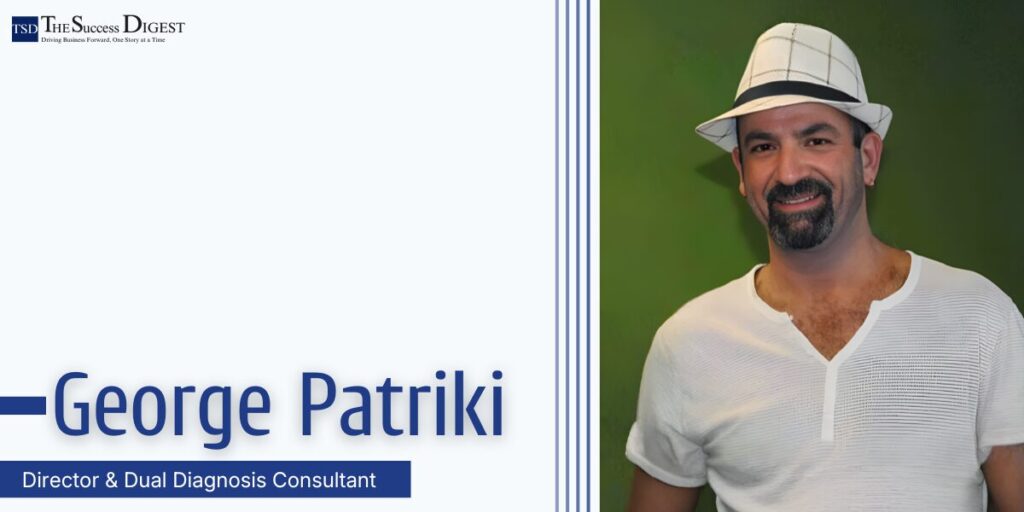
There is a particular kind of expertise that no curriculum can confer. It is the kind built not in lecture halls or research labs but in lived experience — the slow, unglamorous accumulation of lessons that only come to a person who has been all the way down and found their way back. George Patriki has that kind of expertise. And for more than three decades, he has been putting it to work.
Patriki is the Clinical Director and Dual Diagnosis Consultant at Gold Coast Addiction & Treatment Rehab, a practitioner whose career sits at one of the most complex and underserved intersections in modern healthcare: the overlap between substance use and mental illness. He did not arrive at this work through academic interest alone. He arrived at it through recovery. By his own account, he spent some seven years in active addiction before leaving that world behind in 1983. What followed was not a clean break but a long, deliberate process of working through the underlying trauma and pain that had fuelled the addiction in the first place — a process that took more than a decade and became, in time, the foundation of his entire clinical philosophy.
When Patriki tells a client that recovery is possible, he is not offering a professional reassurance. He is offering evidence.
Treating the Whole Person
The insight that defines Patriki’s practice is one the addiction field has been slow to operationalise, even when it has acknowledged it in theory: addiction is rarely the whole problem. It is usually the visible edge of something deeper — unresolved trauma, biochemical imbalance, fractured relationships, a loss of meaning. Treat only the substance, and a person tends to relapse. Treat the whole person, and real, lasting change becomes possible.
That conviction gave rise to his Integrative Holistic Framework, an approach built around four simultaneous dimensions of a person’s life: the biological, the psychological, the spiritual, and the social. In practice, this means drawing on a wide and deliberately tailored range of modalities — cognitive behavioural therapy, acceptance and commitment therapy, trauma-model work, EMDR, motivational interviewing, and psycho-education, among others — while also attending to what happens in the body. Patriki incorporates allied health approaches to help calm the nervous systems of clients carrying significant anxiety and post-traumatic stress, and encourages clients to examine their own biochemistry alongside integrative medical practitioners. A brain under chronic stress cannot do the work of recovery; stabilising the body is part of treating the mind.
Equally deliberate is his attention to what happens after formal treatment ends. Patriki is emphatic that recovery does not conclude at discharge. His clinic is structured around what he calls the Tripod of Support — regular one-to-one counselling, peer group participation, and recovery sponsorship — designed to hold a person steady through exactly the period when relapse risk is highest and clinical contact has traditionally fallen away.
A Reach Beyond the Clinic
One clinician can only treat so many people in a lifetime. Patriki understood that limit early, and his answer to it has become, in many ways, his most significant contribution. Since 2000, he has delivered dual diagnosis training to government and non-government organisations internationally, equipping frontline practitioners to deliver early interventions and more advanced psychotherapeutic skills to people facing co-occurring addiction and mental illness. His online platform has since carried that training into more than a hundred countries.
The professional recognition has followed the practice. He is approved by the Royal Australian College of General Practitioners to deliver continuing professional development to doctors, and has completed the National Comorbidity Guidelines Train-the-Trainer program — placing him among the listed providers equipped to teach Australia’s national standard for dual diagnosis care.
He has also remained a careful student of what emerging science can offer the hardest cases. Approaches such as neurofeedback, transcranial magnetic stimulation, and non-pharmacological detox methods interest him precisely because they extend options for people whom conventional treatment has not reached — but he is disciplined about the frame in which he considers them. Every new tool, in his view, has to answer to one non-negotiable standard: the safety and wellbeing of the client. Innovation, for Patriki, is never an end in itself.
The Legacy He Is Building
Ask Patriki what drives him and he returns, without hesitation, to access. The most persistent barrier in addiction treatment, he argues, is not clinical — it is financial. Too many people who are ready for help cannot reach it. His clinic has built flexible models, including an intensive day program, to accommodate people who cannot enter residential care, and has helped clients navigate funding pathways to make treatment a genuine option rather than a theoretical one.
His message to the next generation of practitioners is equally characteristic. He urges them toward lifelong learning and self-care, toward finding good mentors and investing in their own emotional resilience — on the simple conviction that professionals who are well-supported are the ones best able to support others.
It is the whole-person philosophy, turned inward. And it is the same philosophy that has guided everything George Patriki has built since the day he decided that his own recovery was not the end of the story, but the beginning of a purpose.
George Patriki is the Clinical Director and Dual Diagnosis Consultant at Gold Coast Addiction & Treatment Rehab. His dual diagnosis training platform has reached practitioners in more than 100 countries.
The Success Digest · Leadership & Healthcare