
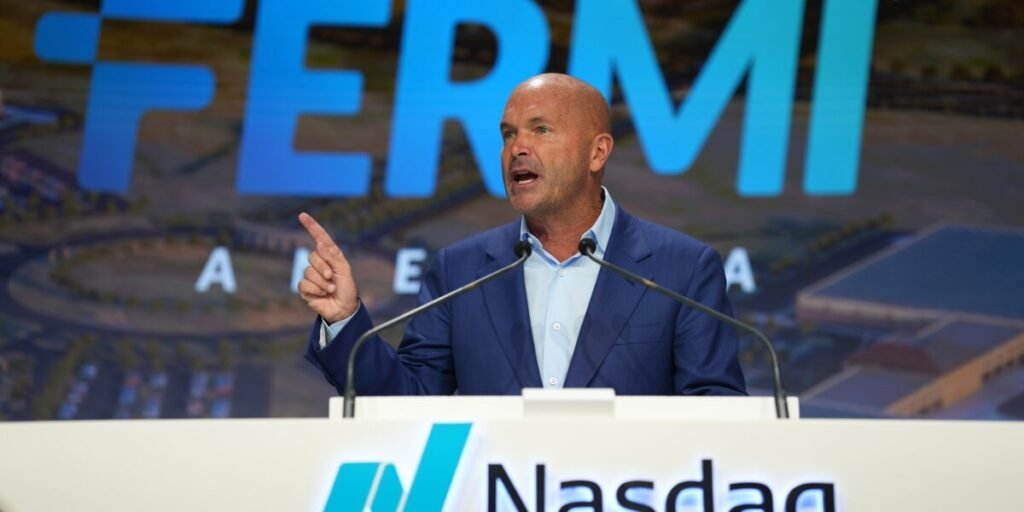
Fermi CEO Exit repercussions have sent unprecedented shockwaves through the real estate investment trust (REIT) and data center infrastructure markets as we pass the mid-point of May 2026. Following a sudden, late-night SEC Form 8-K regulatory disclosure, the immediate removal and subsequent termination of co-founder and Chief Executive Officer Toby Neugebauer has thrown the enterprise into an absolute governance crisis. The announcement triggered a immediate panic on the trading floor, forcing Fermi Inc. (NASDAQ: FRMI) shares to plunge to their lowest level since the initial public offering, wiping away over 80% of the firm’s peak institutional equity valuation overnight.
This devastating leadership vacuum has thrown the company’s Q2 financial guidance and intermediate development horizons into complete chaos. Wall Street analysts responded with near-unanimous alarm, immediately stripping away their premium buy ratings and downgrading the asset to sell or underperform in anticipation of deeper, long-term structural dysfunction. As institutional boards work under extreme, high-velocity pressure to assemble an emergency transition committee before the closing bell, the unfolding civil war between the former executive and the independent board serves as a critical case study in executive vulnerability, corporate entrenchment, and the fragile nature of market trust.
The Chronology of an Executive Governance Meltdown
To map out the structural damage caused by the Fermi CEO Exit, one must examine the highly volatile timeline of events that led up to this mid-May explosion. The initial rupture occurred on April 17, 2026, when the Board of Directors formally moved to strip Neugebauer of his operational duties as CEO. The decision, initially hidden behind opaque corporate phraseology, was subsequently clarified when an Independent Committee of the Board terminated his employment contract entirely for cause.
According to verified regulatory releases published via the SEC EDGAR Corporate Archive, the Independent Committee took this severe step due to documented misrepresentations made by the executive to the board, public communications executed in direct violation of his fiduciary obligations, and a consistent pattern of behavioral conduct that violated core company compliance policies. Rather than orchestrating an orderly transition, the suddenness of the disclosure exposed massive internal fractures, presenting an immediate threat to key stakeholder relations at a pivotal moment in the company’s capital-intensive growth trajectory.
The immediate operational fallout from the Fermi CEO Exit was compounded by the simultaneous mass resignation of seven of the company’s top executive officers and critical execution team members. Those who departed included senior personnel responsible for tenant acquisition, municipal permitting, and advanced financial stewardship. This mass exodus has left Fermi’s foundational operations severely exposed, leaving the company without the specialized human capital required to execute its core commercial deliverables.
Inside the SEC Form 8-K Filings and Interim Office Mandates
The regulatory mechanics of the Fermi CEO Exit demonstrate how rapidly modern compliance frameworks force material corporate events into the public eye. When a public entity experiences the departure of a principal officer, an SEC Form 8-K must be submitted within four business days to prevent catastrophic transparency failures. In Fermi’s case, the filing exposed not only the departure but also the hasty assembly of an “Interim Office of the CEO.”
| Executive Position | Outgoing / Incoming Personnel | Nature of Corporate Material Change | Strategic Impact on Operations |
| Chief Executive Officer | Toby Neugebauer | Terminated For Cause / Vacant | Complete suspension of long-term commercial contract sign-offs. |
| Interim Management | Jacobo Ortiz & Anna Bofa | Appointed to Interim Office | Defensive stabilization of core data center grid partnerships. |
| Board Allocation | Miles Everson (CFO) | Appointed to Board of Directors | Increased board size from 5 to 7 to dilute activist influence. |
| General Counsel Oversight | George Wentz | Issuing Corporate Revocations | Managing high-stakes litigation in the Northern District of Texas. |
To stem the bleeding of institutional equity, the board placed Chief Operating Officer Jacobo Ortiz and Board Observer Anna Bofa into the newly formed Interim Office of the CEO, while simultaneously elevating Chief Financial Officer Miles Everson to a vacant seat on the Board of Directors. This structural adjustment, executed under the provisions of a pre-existing Director Nomination Agreement, was designed to signal operational continuity to the market. However, the creation of a fragmented, multi-headed interim executive suite has instead heightened investor fears regarding slowed decision-making speeds and prolonged corporate paralysis.
The Destruction of Valuation: Analyzing the 80% Equity Wipeout
The financial damage tied directly to the Fermi CEO Exit can be measured by the absolute collapse of the company’s capital structure. Prior to the governance crisis, Fermi traded at a 52-week high of $36.99, riding a wave of speculative optimism regarding its massive Texas-based power grid and data center infrastructure plays. In the wake of the late-night SEC disclosure and the ensuing proxy battle, the stock collapsed down to $6.51, representing a brutal destruction of capital for public shareholders who entered the asset post-IPO.
The root cause of this vulnerability, which the Fermi CEO Exit pushed into the media spotlight, was the systemic absence of a signed anchor tenant across the company’s flagship properties. While the previous management team excelled at securing land leases and power generation commitments, they failed to convert those assets into recurring, predictable cash flow. When institutional portfolio managers reviewed the Form 8-K and realized the execution team had dissolved, they executed massive programmatic sell blocks, preferring to capture remaining liquidity rather than ride out a multi-quarter corporate restructuring process.
This valuation compression has created an intense misalignment of economic incentives between public retail investors and the founding group. Neugebauer and his internal affiliates acquired their substantial equity blocks pre-IPO at a consideration cost basis of less than $0.01 per share. Consequently, even at a depressed trading value of $6.51, the founding parties remain highly profitable on paper, whereas public market participants are locked into severe capital losses. This fundamental imbalance has fueled intense anger among institutional asset managers, who claim the initial corporate governance design lacked proper minority shareholder protections.
The Strategic Proxy War and Aggressive Corporate Entrenchment
Far from a typical corporate departure, the Fermi CEO Exit has transformed into a high-stakes proxy war for absolute control of the enterprise. Following his termination, Neugebauer launched an aggressive consent solicitation process targeting a Special Meeting of Shareholders, scheduled for approximately June 30, 2026. The objective of this activist push is to remove the current board members and replace them with a hand-picked slate of nominees committed to forcing an immediate, full-market value sale of the company to private infrastructure funds.
The independent board has responded with an intense defensive strategy, filing a comprehensive preliminary Consent Revocation Statement with the SEC to block the former CEO’s maneuvers. In their public communications, verified by major financial wires including PR Newswire Disclosures, the board characterized the special meeting push as a short-sighted, value-destructive attempt to force a liquidation at the absolute bottom of the market cycle, a transaction that would benefit only the founder’s ultra-low cost basis while permanently cementing the losses of public investors.
To fortify their position against the activist onslaught, the remaining board members executed an emergency amendment to the company’s internal bylaws. This structural change raised the voting threshold required to alter the size or composition of the board to a 70% supermajority of all outstanding shares. Because Neugebauer and his immediate family trusts control approximately 40% of Fermi’s voting equity, the 70% supermajority requirement makes it statistically improbable for either side to achieve a clean resolution without a prolonged legal battle. This defensive maneuvering has drawn sharp criticism from corporate governance purists, who view the bylaw amendment as an unprecedented act of board entrenchment designed to insulate directors from the direct will of the shareholder base.
Counterparty Attrition and the Future of Project Matador
The true operational risk stemming from the Fermi CEO Exit lies in the immediate threat of counterparty attrition across the company’s core infrastructure assets. Fermi’s primary long-term valuation is tied directly to “Project Matador”—a massive grid development asset in Texas boasting a 99-year ground lease with the Texas Tech University System, over 2 GW of total power generation facilities, and the nation’s second-largest Clean Air Permit. Executing a project of this scale requires flawless coordination with institutional lenders, utility providers, and hyperscale engineering clients.
In the days following the Fermi CEO Exit, the board disclosed that multiple critical commercial counterparties and private infrastructure funds had threatened to terminate their existing agreements if Neugebauer succeeded in retaking control of the governance structure. These key business partners conditioned their ongoing participation on complete assurances that the former executive would no longer exert operational control or destabilize management. Since his departure, the board claims these partners have expressed renewed confidence in the “Fermi 2.0” operational plan, highlighting that stable corporate governance is an absolute prerequisite for securing the remainder of the project’s $1.0 billion external financing facilities.
Despite the boardroom drama, Project Matador continues to mark minor engineering milestones, including the arrival of the first six Siemens SGT800 turbines at the port of Houston and the ongoing refurbishment of GE 6B frame units. However, engineering execution cannot completely decouple from capital constraints. If the ongoing proxy war delays the drawdowns on the credit facilities negotiated with lead lenders like Mitsubishi UFJ Financial Group (MUFG), the physical construction schedule will stall, pushing power delivery timelines well past their original 2027 targets and further depressing the company’s intrinsic asset valuation.
The C-Suite Playbook: Governance Lessons from the Fermi Crisis
For institutional asset managers, sophisticated retail investors, and corporate directors tracking updates on The Success Digest, the structural fallout from the Fermi CEO Exit provides three critical governance lessons for the modern corporate landscape:
- Dismantle Key-Man Dependencies Early: Public corporations operating in capital-intensive sectors cannot afford to tie their institutional credibility entirely to a single founding figure. Boards must mandate formal, multi-tiered succession planning across all C-suite positions to ensure an orderly transfer of power if a sudden removal becomes non-negotiable.
- Align Founder Options with Public Cost Basis: Dual-class share structures or extreme variations in pre-IPO equity cost bases create toxic incentives during market corrections. Compensation committees should utilize performance-vested equity structures that bind founder payouts to the long-term wealth creation of public market participants.
- Establish Independent Regulatory Firewalls: The quick deployment of an Independent Committee during the Fermi crisis shows the value of having objective, unconflicted board directors who can act decisively when internal policies are breached, preventing corporate malfeasance from completely paralyzing operational assets.
As the June 30 shareholder meeting approaches, the financial community will continue to monitor Fermi’s legal battles in the Texas federal courts. Until a stable, permanent chief executive is appointed via a structured national search, the stock will likely remain a highly volatile instrument, highlighting the reality that in the modern economy, governance stability is just as critical to equity preservation as underlying asset quality.
Internal Links
Read our latest cloud technology coverage on
Technology News.
Explore more AI industry insights at
AI Industry Updates.

