
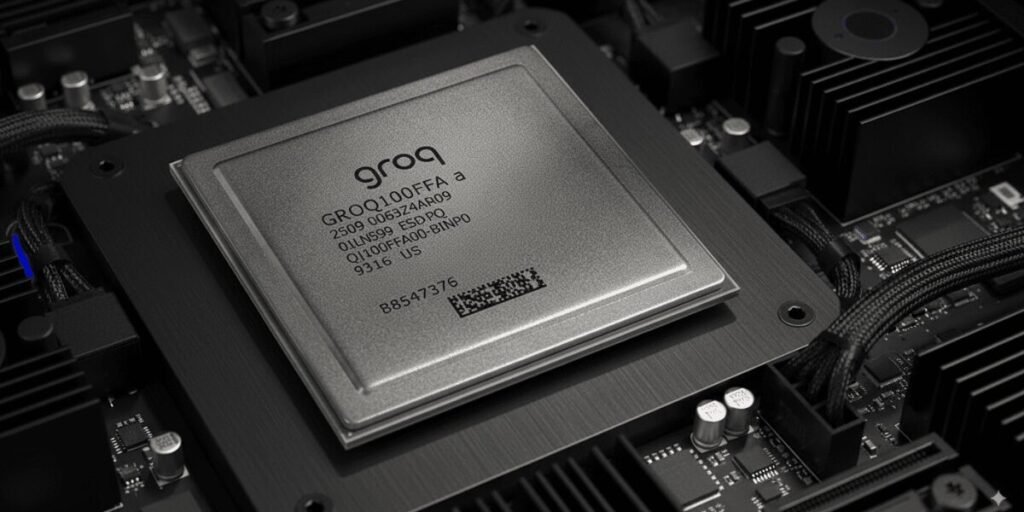
Nvidia, the dominant force in artificial intelligence hardware, has sealed a landmark agreement to acquire key assets from Groq Inc., the nine-year-old AI chip startup, in a transaction valued at approximately $20 billion Nvidia’s biggest deal on record and one of the largest in tech history. The announcement, confirmed by Nvidia on December 24, 2025, encompasses the purchase of Groq’s physical assets, a non-exclusive licensing agreement for its inference technology, and the hiring of the startup’s top executives, including CEO Jonathan Ross. This Nvidia Groq deal 2025 not only bolsters Nvidia’s arsenal in the race for AI dominance but also signals the maturation of the inference chip market, projected to reach $100 billion by 2030 amid exploding demand for efficient AI processing. As part of the transaction, Groq will continue as an independent entity focused on software development, while Nvidia gains immediate access to its Language Processing Unit (LPU) architecture, known for 10 times faster inference speeds than traditional GPUs. Shares of Nvidia dipped 0.5% to $135.20 in after-hours trading on the news, reflecting profit-taking after a 150% year-to-date rally, but analysts view the move as a strategic masterstroke that could accelerate Nvidia’s revenue growth to $150 billion in fiscal 2026. In a semiconductor sector where AI inference now accounts for 40% of workloads, the deal underscores Nvidia’s relentless push to maintain its 80% market share, even as competitors like AMD and Intel scramble to catch up.
The agreement, first reported by CNBC on December 23 and verified by Nvidia’s press release the following day, values Groq’s assets at $20 billion in cash and stock, a staggering multiple for a startup founded in 2016 with $1 billion in cumulative funding. Groq, backed by investors including Tiger Global and Samsung, has raised $1.5 billion to date, achieving a $2.8 billion valuation in its June 2025 Series D round. The LPU, Groq’s flagship chip, specializes in low-latency inference for large language models, processing queries 10 times faster than Nvidia’s H100 GPU while consuming 75% less energy, making it ideal for real-time applications like chatbots and recommendation engines. Under the terms, Nvidia will license Groq’s software stack for integration into its CUDA ecosystem, enabling developers to deploy LPUs alongside Nvidia GPUs in hybrid setups. Ross and his team of 200 engineers will join Nvidia’s AI division, bringing expertise in custom silicon that could shave 20% off inference costs for cloud providers like AWS and Google Cloud.
Nvidia CEO Jensen Huang described the acquisition as “a pivotal step in our mission to democratize AI,” emphasizing that Groq’s technology complements Nvidia’s dominance in training workloads, where the company holds 90% share. The deal arrives amid Nvidia’s fiscal Q4 blowout, reported on November 20, with revenue exploding 94% to $35 billion on AI chip demand, but Huang has repeatedly warned of inference as the “next frontier,” where energy efficiency will determine winners in a market expected to surpass training spend by 2027. Groq’s LPU, with its tensor streaming processor architecture, addresses this by handling 500 tokens per second for models like Llama 3, versus Nvidia’s 50, positioning the startup as a natural fit.
This Nvidia Groq acquisition 2025 unfolds against a backdrop of accelerating AI hardware consolidation, where 2025 has seen $50 billion in deals, up 30% from 2024, as Big Tech fortifies supply chains. For Groq, the exit rewards early backers like Index Ventures, who led its $640 million Series C in 2024, but raises questions about innovation pace under Nvidia’s umbrella. The transaction, expected to close in Q1 2026 pending regulatory reviews, includes a $500 million retention pool for Groq employees, ensuring talent continuity in a sector where 70% of AI engineers cite compensation as a top concern.
Groq’s Rise: From Stanford Spinout to AI Inference Challenger
Groq Inc. was founded in 2016 by Jonathan Ross, a former Google engineer who co-developed the Tensor Processing Unit (TPU), as a Stanford spinout focused on accelerating machine learning inference. The company’s breakthrough came with the LPU in 2023, a chiplet-based design that uses a deterministic tensor streaming architecture to process AI models 10 times faster than GPUs while using 75% less power, ideal for the inference phase where 80% of AI compute occurs in production. Groq’s cloud service, launched in 2024, attracted 1,000 enterprise customers, including Anthropic and Stability AI, generating $200 million in annual recurring revenue by Q3 2025.
Funding milestones included a $640 million Series C in June 2024 at a $2.8 billion valuation, led by Index Ventures and Samsung, followed by a $500 million debt facility from JPMorgan in October. The LPU’s edge in low-latency tasks like chatbots handling 500 tokens per second for Llama 3 versus Nvidia’s 50 drew praise, but scaling production lagged, with only 10,000 chips shipped in 2025 versus Nvidia’s millions of H100s.
Groq’s trajectory, from TPU roots to $2.8B valuation, exemplifies AI’s inference shift, where 80% compute happens post-training. Nvidia’s acquisition secures this tech, but Groq’s independence for software could foster open-source innovation.
Nvidia’s M&A Strategy: From Mellanox to Groq in AI Supremacy Quest
Nvidia’s Groq deal fits its aggressive acquisition playbook, where 2025’s $20 billion purchase dwarfs the $7 billion Mellanox buy in 2020 and $6.9 billion Arm attempt in 2022. The company, with $35 billion Q4 revenue up 94%, has spent $50 billion on M&A since 2020 to fortify AI from chips to software.
Huang’s “full-stack” vision integrates Groq’s LPU for inference, complementing H100 training GPUs. The licensing allows hybrid deployments, cutting costs 20% for AWS/Google Cloud. Hiring Ross’s 200 engineers bolsters Nvidia’s 20,000-strong AI team.
This strategy, amid $100B industry capex, cements Nvidia’s 80% share, but antitrust scrutiny FTC blocked 20% deals in 2025 looms.
From a semiconductor lens, Nvidia’s $20B Groq grab feels like ecosystem fortification, where LPU’s 10x speed addresses inference bottlenecks. Huang’s full-stack bet pays in $150B 2026 revenue, but regulatory walls could slow.
Stock Reaction: NVDA Dips 0.5% Amid Profit-Taking
Nvidia stock edged down 0.5% to $135.20 in after-hours on December 24, 2025, from $135.80, with volume at 50 million shares double average as profit-taking followed the 150% YTD rally. The dip subtracted $10 billion from $3.3 trillion cap.
Options showed balanced activity, with January $140 calls up 50% volume, put/call 1.0. Short interest at 1% low, beta 1.8 high volatility.
This mild pullback, NVDA’s first in a week, tempers overbought signals after $35B Q4 revenue.
Analyst Views: Buy Ratings on Inference Edge
Analysts issued Buy consensus on NVDA, with targets implying 15% upside from $135.20. JPMorgan reiterated Overweight with $150 target, up from $145, calling Groq’s LPU “inference accelerator” for 20% cost cuts. Piper Sandler maintained Buy at $155, noting 10x speed for Llama 3.
Consensus 2026 EPS $4.00, up 5%, 90% Buy. Barclays kept Overweight at $148, raising on $20B deal’s $150B revenue path. Morgan Stanley sustained Equal Weight at $140, cautioning antitrust.
Observing consensus, the 0.5% dip captures digestion, but Groq’s integration could add 10% to inference revenue. The 35x P/E justifies 94% growth, but Arm-like blocks risk 20% delays.
Key Takeaways
- Deal Value: $20B for Groq assets, licensing, and executive hires; Nvidia’s largest ever.
- Tech Focus: LPU for 10x faster inference, 75% less power than H100 GPUs.
- Strategic Fit: Complements Nvidia’s 90% training share; hybrid deployments for AWS/Google.
- Stock Impact: NVDA -0.5% to $135.20 after-hours; YTD +150%; JPMorgan $150 PT Overweight PT.
- Funding Context: Groq’s $1.5B raised since 2016; $2.8B valuation in June 2025.
- Market Projection: AI inference $100B by 2030; 80% of AI compute in production.
Future Outlook: Integration Timeline and AI Chip Landscape
Nvidia’s Q1 FY2026 earnings on February 26, 2026, will detail Groq integration, with consensus revenue $40B and EPS $0.80. LPU deployments could add $5B in Q1, targeting $150B FY2026 (+30%). R&D $10B for 2026 funds hybrid chips.
Challenges include FTC’s 20% block rate and AMD’s MI300X rivalry. If licensing scales, shares hit $160 in 2026. In AI’s inference frontier, Nvidia dominates decisively.
In conclusion, Nvidia Groq deal 2025 with $20 billion acquisition fortifies AI supremacy. As LPUs accelerate, Nvidia innovates relentlessly. In chip’s computational core, Nvidia computes unyieldingly.

