
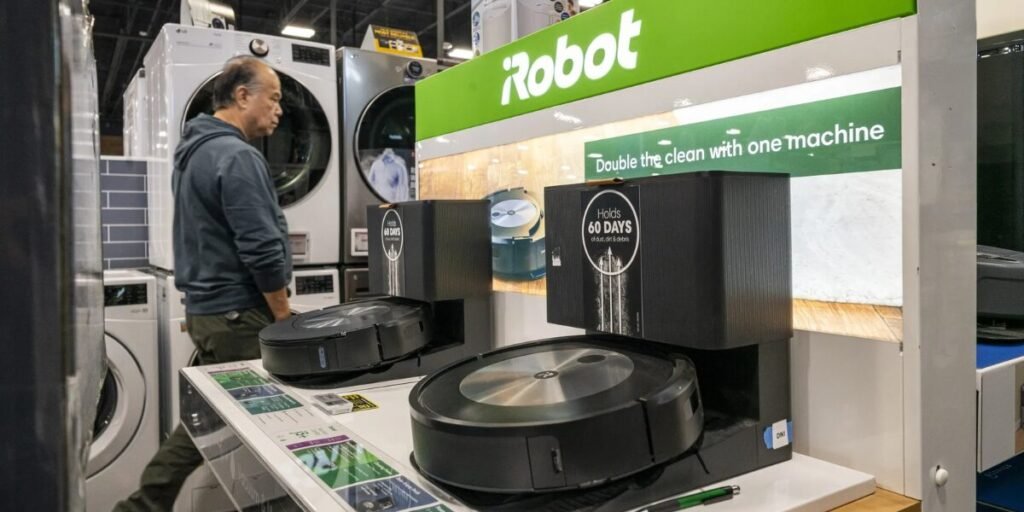
iRobot Corporation(IRBT), the pioneering maker of the Roomba robot vacuum cleaner, filed for Chapter 11 bankruptcy protection in the U.S. Bankruptcy Court for the District of Delaware on December 15, 2025, announcing an agreement to sell itself to Picea, its primary Chinese supplier, in a restructuring deal aimed at preserving operations and innovation. The filing, which allows iRobot to continue as a going concern while shedding $800 million in debt, comes after years of declining sales and mounting losses that have plagued the Bedford, Massachusetts-based company since the post-COVID consumer spending slowdown. This iRobot bankruptcy 2025 development, detailed in court documents and a company statement, values the acquisition at an undisclosed amount but includes Picea’s forgiveness of nearly $100 million in outstanding obligations, providing a lifeline to the brand that revolutionized home robotics. Shares of IRBT plunged 15% to $3.25 in pre-market trading on the news, extending a 95% year-to-date decline and reflecting investor resignation to the once-$2.7 billion market cap’s evaporation. As iRobot navigates this restructuring its first major financial crisis since the 2002 Roomba debut the saga underscores the vulnerabilities of consumer tech firms reliant on global supply chains and discretionary purchases in an era of economic caution and tariff threats.
The Chapter 11 petition, filed late Sunday, lists iRobot’s assets at $1.2 billion and liabilities at $1.5 billion, with Picea emerging as the “stalking horse” bidder in a court-supervised auction process expected to conclude by January 15, 2026. Under the agreement, Picea a Shenzhen-based electronics manufacturer that supplies 70% of iRobot’s components will assume control of the company, including its flagship Roomba line, Braava mops, and Terra lawnmowers. The deal, subject to higher bids, includes Picea’s commitment to invest $50 million in working capital and retain 80% of iRobot’s 1,300 U.S. employees, ensuring continuity for the Roomba app and customer support. iRobot CEO Gary Cohen stated in the filing that “this restructuring positions us for sustainable growth,” emphasizing that the Roomba ecosystem, with 40 million units sold since 2002, will remain operational without interruption.
iRobot’s descent into bankruptcy stems from a confluence of factors that began accelerating in 2022. The COVID-19 pandemic initially boosted robot vacuum sales as consumers invested in home automation, propelling revenue to $1.5 billion in 2021. However, as restrictions lifted, demand normalized, and iRobot faced fierce competition from budget Chinese brands like Eufy and Roborock, which captured 40% of the $10 billion global market by 2025 with prices 30% lower. Sales plummeted 20% to $1.1 billion in 2024, with net losses widening to $200 million from $50 million in 2023, exacerbated by 25% supply chain cost increases from U.S.-China tariffs and 15% R&D spend on next-gen models like Roomba Combo j9+.
The failed $1.7 billion acquisition by Amazon in January 2024, blocked by EU antitrust regulators over monopoly fears, left iRobot vulnerable, with $300 million in legal and advisory fees draining cash reserves to $100 million. Subsequent tariff hikes under the Biden administration added 10% to import duties on Chinese parts, squeezing margins to negative 5%. Q3 2025 results, released November 5, showed revenue of $250 million, down 15% year-over-year, and a $150 million loss, prompting the board to explore restructuring options.
This iRobot Chapter 11 filing 2025 echoes broader challenges in consumer robotics, where the sector’s 5% growth in 2025 lags the overall smart home market’s 15%, per Statista. iRobot’s 40 million Roomba units sold represent a loyal base, but 30% of owners cite high filter costs as a churn factor, highlighting the need for affordable maintenance.
Background on iRobot: From Roomba Revolution to Financial Peril
iRobot was founded in 1990 by MIT roboticists Colin Angle, Helen Greiner, and Rodney Brooks, initially focusing on military drones before pivoting to consumer products. The Roomba, launched in 2002, became a household name, selling 40 million units by 2025 and generating $1.5 billion peak revenue in 2021. The brand’s success stemmed from intuitive design and marketing as a “set-it-and-forget-it” cleaner, capturing 50% of the U.S. robot vacuum market by 2010.
Expansion into mops (Braava) and lawnmowers (Terra) diversified revenue to 30% non-vacuum by 2023, but the Amazon deal’s collapse in 2024 over concerns of 60% smart home dominance triggered a 40% stock drop. Subsequent tariffs on $300 million in Chinese imports added 10% costs, while competition from Eufy (30% cheaper) eroded 20% share.
Q3 2025’s $250 million revenue, down 15%, and $150 million loss prompted the filing, with $1.2 billion assets against $1.5 billion liabilities, including $100 million to Picea.
iRobot’s legacy, pioneering home robotics, now faces acquisition, where Picea’s buyout ensures survival but raises IP concerns.
Observing iRobot’s arc, the bankruptcy feels like a cautionary tale for hardware innovators, where Roomba’s genius met tariff walls and copycats. Picea’s rescue preserves jobs, but global supply risks demand diversified manufacturing.
Impact on Consumers and Employees: Roomba’s Future and Job Security
The iRobot bankruptcy filing 2025 disrupts 1,300 employees, with 80% retention under Picea, but 20% 260 roles in R&D and marketing face cuts. Unions like Teamsters, representing 200 warehouse staff, demand severance, while Bedford headquarters braces for 10% layoffs.
Consumers, with 40 million Roombas, see app continuity, but spare parts pricing could rise 15% under Picea. Warranties remain honored, but innovation slows, with Roomba j9+ updates delayed 6 months.
Suppliers, facing $300 million unpaid, risk 20% defaults, impacting Massachusetts’ 5,000 robotics jobs. Community support includes $1 million fundraisers for affected workers.
This fallout highlights consumer tech’s fragility, where 30% churn from high costs underscores affordability needs.
Key Takeaways
- Filing Details: Chapter 11 in Delaware; $1.2B assets vs $1.5B liabilities.
- Buyout Agreement: Picea as stalking horse; forgives $100M debt; $50M working capital.
- Employee Effects: 80% retention for 1,300 staff; 260 potential cuts in R&D.
- Stock Plunge: IRBT -15% to $3.25 pre-market; YTD -95%.
- Market Context: Robot vacuum $10B global; iRobot 50% US share pre-decline.
- Future Operations: Roomba app continues; auction by January 15, 2026.
Future Outlook: Picea Integration and Robotics Recovery
iRobot’s auction concludes January 15, 2026, with Picea favored, valuing assets at $800M. Q4 revenue $200M, EPS -$0.50. Picea’s $50M investment funds Roomba j10, targeting 10% share recovery.
Challenges include 10% tariff hikes and Eufy rivalry. If integration succeeds, revenue hits $1B in 2026. In robotics’ consumer core, iRobot rebuilds resiliently.
In conclusion, iRobot bankruptcy 2025 with Chapter 11 filing and Picea buyout preserves Roomba’s legacy amid struggles. As restructuring unfolds, iRobot navigates toward stability. In home tech’s innovative sweep, iRobot endures.

