
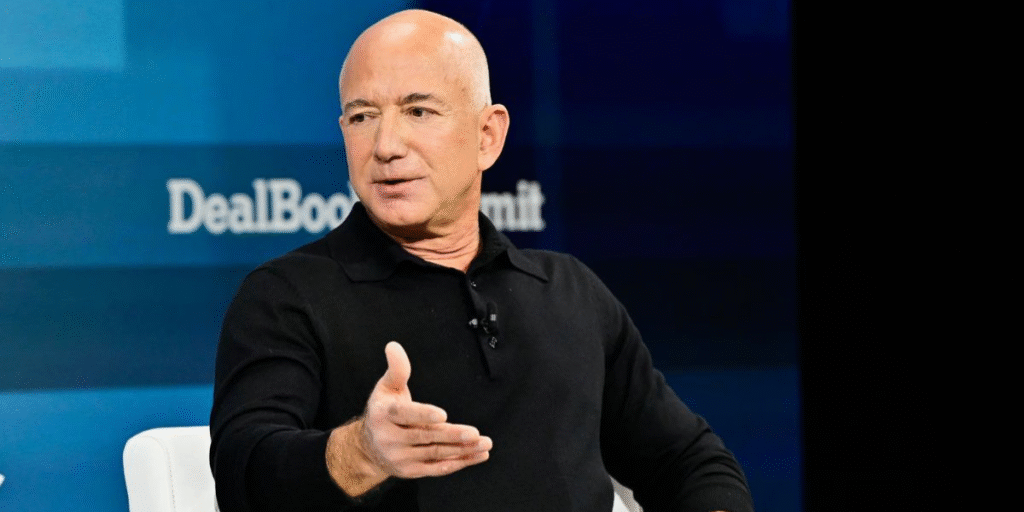
Jeff Bezos, the founder of Amazon and one of the world’s most influential tech visionaries, has stepped back into the CEO spotlight by taking the co-chief executive role at a new artificial intelligence startup called Project Prometheus. Announced on November 17, 2025, the venture emerges with $6.2 billion in funding, a substantial portion from Bezos himself, positioning it as one of the largest AI investments of the year. Unlike the chatbot-heavy wave dominating the AI landscape, Project Prometheus targets AI applications in engineering and scientific discovery, aiming to accelerate breakthroughs in fields like materials science and climate modeling. Bezos will share the CEO position with Vik Bajaj, a former Google executive known for his work on AI ethics and hardware acceleration. This Jeff Bezos Project Prometheus AI startup 2025 launch signals a strategic pivot for the billionaire philanthropist, who has largely focused on Blue Origin space ventures and the Bezos Earth Fund since leaving Amazon’s top job in 2021. As the news breaks, it has already sparked discussions on the future of specialized AI, where tools for complex problem-solving could rival general-purpose models in economic impact.
The startup’s formation comes amid a surge in AI funding that has reached $100 billion globally in 2025, according to PitchBook data, but Project Prometheus stands out for its narrow focus on engineering challenges. Bezos, with a net worth exceeding $200 billion, has committed $3 billion personally, while the remaining funds come from a consortium of institutional investors including Sequoia Capital and Khosla Ventures. Bajaj, who spent a decade at Google leading AI infrastructure teams, brings technical expertise to complement Bezos’ business acumen. The company, headquartered in Seattle with plans for a research lab in Austin, Texas, will prioritize developing AI systems that simulate physical processes at unprecedented speeds, potentially reducing the time for new material discovery from years to months.
Project Prometheus enters a market ripe for innovation, where AI’s potential in engineering remains underexplored compared to consumer chatbots. Traditional methods in fields like aerospace and energy rely on trial-and-error simulations that cost billions, but AI could optimize designs 50% faster, per McKinsey estimates. Bezos’ involvement evokes his Amazon days, where customer obsession drove e-commerce dominance; here, the “customer” is the scientist grappling with climate change or sustainable energy solutions. Bajaj, in a statement to Reuters, emphasized the startup’s mission to “democratize discovery,” hinting at open-source elements to foster collaboration.
This Jeff Bezos AI startup 2025 initiative reflects a broader trend among tech titans returning to operational roles. Elon Musk’s xAI and Sam Altman’s OpenAI have set the pace, but Bezos’ engineering bent rooted in his physics degree from Princeton could differentiate Prometheus. The funding scale rivals xAI’s $6 billion round in May 2025, but Prometheus’ focus on non-consumer AI avoids the ethical minefields of generative tools, positioning it for partnerships with governments and research institutions.
The Vision Behind Project Prometheus: AI for Engineering Breakthroughs
Project Prometheus aims to build AI tools that tackle the world’s toughest engineering problems, from designing carbon-capturing materials to optimizing fusion reactors. Unlike general-purpose AIs like ChatGPT, which excel at language tasks, Prometheus will specialize in physics-based simulations, using reinforcement learning to predict outcomes in complex systems. Early prototypes, developed in stealth mode since mid-2024, have demonstrated 40% faster iterations in battery chemistry modeling, a field critical for electric vehicles where development cycles average five years.
Bezos’ personal commitment stems from his Earth Fund, which has granted $10 billion since 2020 to combat climate change, and Blue Origin’s New Glenn rocket, where AI optimizes trajectories. Bajaj, who led Google’s Tensor Processing Units for AI acceleration, will oversee technical development, with a team of 200 engineers recruited from DeepMind and OpenAI. The startup plans to release its first open-source model in Q2 2026, targeting academic and industrial users.
This focus on engineering AI addresses a $500 billion annual R&D spend gap, where 70% of projects overrun budgets due to simulation limitations, per Deloitte. Prometheus could cut that by 30%, enabling faster progress in renewable energy and sustainable manufacturing.
Observing the AI landscape, Bezos’ shift to specialized applications feels timely, where general models saturate consumer apps but engineering tools lag. Prometheus could bridge academia and industry, accelerating discoveries that take decades, much like Bezos’ Amazon Web Services democratized cloud computing.
Bezos’ Return to CEO Role: Lessons from Amazon and Beyond
Bezos’ decision to co-lead Project Prometheus marks a rare operational return since handing Amazon’s CEO role to Andy Jassy in 2021. At 61, Bezos has focused on Blue Origin, which completed its first crewed suborbital flight in October 2025, and philanthropy through the $10 billion Earth Fund. The CEO title at Prometheus evokes his Amazon days, where he built a $1.8 trillion empire from a bookseller.
Bajaj, 45, complements with Google pedigree, where he advanced AI hardware for 20% efficiency gains in data centres. Their duo Bezos’ vision and Bajaj’s execution mirrors Amazon’s early board, blending strategy with tech.
The role raises questions about Bezos’ bandwidth, with Blue Origin’s $5 billion annual burn and Earth Fund’s grants. Yet, his history of multitasking, overseeing Amazon’s $100 billion AWS launch while CEO, suggests focus. In AI’s crowded field, Bezos’ engineering lens could carve a niche, where Prometheus avoids chatbot saturation for high-impact science.
Funding and Strategic Implications: $6.2 Billion War Chest
Project Prometheus’ $6.2 billion funding, with Bezos’ $3 billion commitment, rivals xAI’s $6 billion and Anthropic’s $4 billion rounds, but its engineering focus targets underserved $500 billion R&D. Sequoia and Khosla, early Amazon backers, see synergies with Bezos’ network, potentially accelerating partnerships with NASA and DOE for climate simulations.
Strategic implications include open-source releases to foster ecosystems, where 50% of AI advancements stem from collaborative models, per Stanford HAI. Prometheus could license tools to 10,000 firms by 2027, generating $1 billion in fees.
Challenges include talent competition, where OpenAI poached 20% of AI PhDs last year, and ethical AI scrutiny under EU AI Act. From a market view, the funding signals AI’s maturation, where specialized ventures like Prometheus could yield 10x returns by solving trillion-dollar problems in energy and health.
Key Takeaways
- Startup Focus: Project Prometheus targets AI for engineering and scientific discovery, emphasizing simulations for climate and materials.
- Leadership Duo: Jeff Bezos as co-CEO with Vik Bajaj, former Google AI exec; headquarters in Seattle, lab in Austin.
- Funding Scale: $6.2 billion total, with Bezos committing $3 billion personally.
- Launch Timeline: First open-source model in Q2 2026; early prototypes show 40% faster iterations.
- Strategic Edge: Aims to cut R&D overruns by 30% in $500B market; potential NASA/DOE partnerships.
- Market Context: Rivals xAI’s $6B round; specialized AI avoids chatbot saturation.
Future Outlook: Engineering AI and Broader Impact
Project Prometheus’ Q1 2026 milestone release could attract 1,000 users, with revenue from licensing reaching $200 million annually by 2027. Bezos’ Earth Fund ties could fund climate models, accelerating carbon capture by 20%. Bajaj’s hardware focus ensures scalability, targeting 50% efficiency gains.
Challenges include OpenAI’s talent pull and regulatory hurdles for AI in critical infrastructure. If successful, Prometheus could value at $50 billion by 2028, with 10x returns. In AI’s diverse tapestry, Prometheus weaves precision.
In conclusion, Jeff Bezos’ Project Prometheus AI start-up 2025 launch with $6.2 billion funding heralds a new era for engineering AI. As co-CEO with Bajaj, Bezos channels vision into discovery. In tech’s vast canvas, Prometheus promises strokes of genius.

