
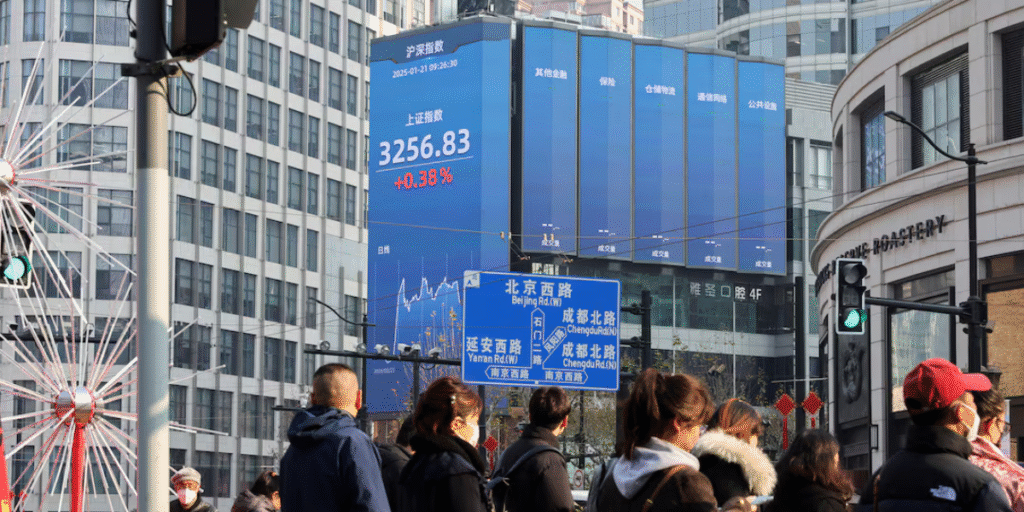
Asian markets took a sharp hit on October 13, 2025, as fresh US-China trade tensions created widespread uncertainty and led to heavy selling across the region. The Hang Seng index in Hong Kong dropped 3.2% to close at 18,450, while the CSI 300 index in mainland China fell 2.8% to 3,980. This marked one of the biggest single-day losses for Asian stock markets in recent months. Investors reacted to comments from US President Donald Trump about potential 100% tariffs on Chinese imports, which raised fears of a renewed trade war. Other major indices in the region also suffered, with Japan’s Nikkei 225 down 1.5% to 38,120 and South Korea’s Kospi slipping 1.8% to 2,610. As a result, safe-haven assets like gold gained 0.5% to $2,650 per ounce, while Brent crude oil prices dipped 0.8% to $78.20 per barrel due to worries about global demand. This Asian markets fall October 2025 shows how quickly geopolitical risks can wipe out recent gains and highlights the ongoing vulnerability of global trade-dependent economies.
The downturn started early in the trading session, as news of Trump’s tariff threats spread. China’s foreign ministry quickly called the comments economic coercion, adding to the tension. In Hong Kong, the Hang Seng index drop was driven by big losses in tech and real estate stocks. Alibaba shares fell 4.5%, and Tencent dropped 3.8%. These companies are sensitive to trade issues because they rely on global supply chains and exports. On the mainland, the CSI 300 index decline affected financial and consumer sectors the most. The Shanghai Composite index also lost 2.6% to end at 3,280. This came after a more stable September, when Asian markets had risen about 5% on hopes for US interest rate cuts and stimulus from China. Now, those gains have been erased in just one day, leaving investors to question the short-term outlook.
Global markets felt the impact too. European stocks opened lower, and US futures pointed to a 0.5% drop for the Dow Jones. The dollar index rose 0.3% to 102.80, making exports from Asia more expensive and adding pressure on local currencies. The yuan weakened 0.4% to 7.08 against the dollar. Commodity prices showed mixed reactions. Copper, important for manufacturing, fell 1.2% to $4.50 per pound because of fears about slower demand from China. This Asian stock markets October 2025 decline reminds everyone of the 2018-2019 trade war, which cut global GDP growth by 0.5% according to IMF estimates. If tensions escalate, it could slow economic recovery in the region even more.
From following these events closely, the quick market reaction shows how sensitive Asian economies are to US policy changes. During the last trade war, companies like Apple and Nike saw supply chain disruptions that cost billions. Now, with elections approaching, Trump’s comments might be part of a strategy to negotiate better terms. But if they lead to real tariffs, exporters in Asia could face big profit losses. On the positive side, some investors might see this as a chance to buy stocks at lower prices if the situation calms down soon.
This fall has wider effects on investors around the world. China and Hong Kong make up about 20% of the MSCI emerging markets index, so funds with exposure to Asia saw outflows of $1.2 billion last week according to EPFR data. Tech-focused funds were hit hardest. For big companies, this could mean rethinking supply chains. Firms like Samsung and TSMC, key players in electronics, dropped 2% each. The drop in oil prices shows worries about slower growth in China, the world’s top importer of crude.
Looking ahead, upcoming economic data could help stabilize things. US inflation numbers on October 10 might support more rate cuts, which could boost markets. For now, this event is a reminder to stay cautious in volatile times.
Key Takeaways
- Hang Seng Index Drop: Down 3.2% to 18,450, with tech stocks like Alibaba (-4.5%) and Tencent (-3.8%) leading losses.
- CSI 300 Index Decline: Fell 2.8% to 3,980; Shanghai Composite -2.6% to 3,280 on trade fears.
- US-China Trade Tensions: Trump’s 100% tariff threats met with China’s coercion accusations; echoes 2018-2019 impacts.
- Other Asian Indices: Nikkei -1.5% to 38,120, Kospi -1.8% to 2,610; dollar +0.3% to 102.80.
- Commodity Reactions: Gold +0.5% to $2,650/oz; Brent crude -0.8% to $78.20/bbl; copper -1.2% to $4.50/lb.
- Investor Flows: $1.2B outflows from Asian ETFs; potential 10% exporter profit hits if tariffs proceed.
As trading continues, keep an eye on US futures and Chinese policy responses. These could either deepen the losses or spark a quick recovery. In global finance, events like this show how connected everything is. One comment can send ripples across oceans and affect millions of investors. For now, the Asian markets fall serves as a lesson in preparing for uncertainty.

