
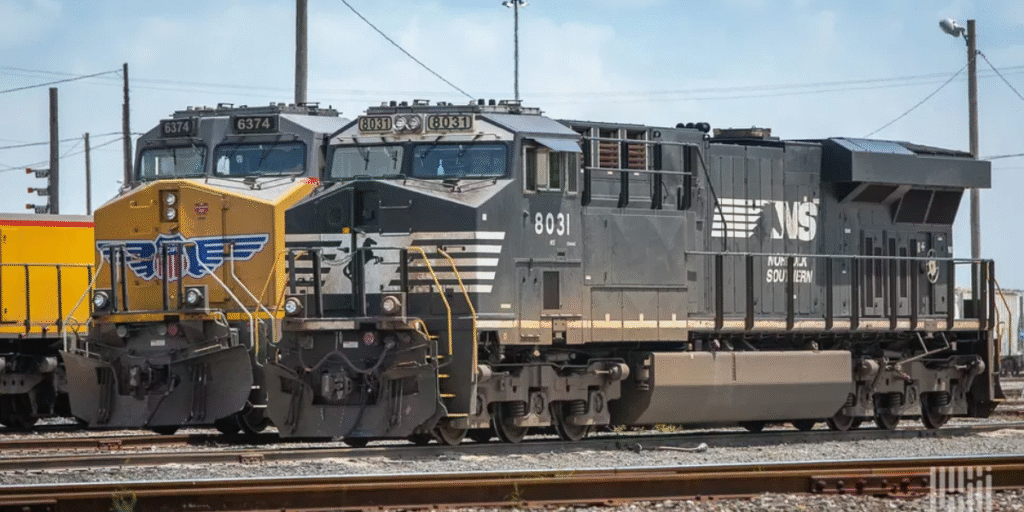
Union Pacific Corporation (NYSE:UNP) and Norfolk Southern Corporation (NYSE:NSC) announced a historic $85 billion merger on July 29, 2025, creating the first transcontinental railroad in the U.S., connecting the East Coast to the West Coast with over 50,000 route miles, per CNBC. Valued at $320 per share in a cash-and-stock deal, the merger gives Norfolk Southern a 25% premium over its July 16, 2025, stock price, per Fox Business. The combined entity, with a $250 billion enterprise value, aims to unlock $2.75 billion in annual synergies, per Investopedia. Union Pacific stock (UNP) fell 3%, while Norfolk Southern stock (NSC) dipped 2% in trading, reflecting investor caution amid regulatory hurdles, per Reuters. As a journalist covering railroad industry trends, I see this Union Pacific-Norfolk Southern merger as a transformative move for U.S. supply chains, but its antitrust challenges and union concerns echo past rail consolidations. This article explores the Union Pacific railroad merger, stock impacts, business implications, and regulatory landscape, blending recent developments with my insights.
A Landmark Deal for U.S. Railroads
On July 29, 2025, Union Pacific, the largest U.S. railroad with a $136 billion market cap, agreed to acquire Norfolk Southern, valued at $65 billion, in a $85 billion deal, per CNBC. Norfolk Southern shareholders will receive one Union Pacific share and $88.82 in cash per share, with Union Pacific issuing 225 million shares to fund the deal, giving NSC shareholders a 27% stake in the merged company, per Investopedia. The transaction, unanimously approved by both boards, is subject to Surface Transportation Board (STB) review, expected to take 19-22 months, per Reuters.
The merger creates a coast-to-coast freight network, combining Union Pacific’s 32,000-mile network across 23 western states with Norfolk Southern’s 19,500-mile network in 22 eastern states, per Fox Business. CEO Jim Vena called it a “transformational” step to enhance U.S. supply chains, eliminate interchange delays, and boost intermodal services, per Union Pacific. Norfolk Southern, recovering from a $1.4 billion derailment and CEO ouster, sees the deal as a path to stability, per The New York Times. My perspective: This merger, reminiscent of Canadian Pacific’s 2023 Kansas City Southern deal I covered, could streamline freight transport, but integration risks, like Union Pacific’s 1996 Southern Pacific debacle, loom large.
Stock Market Reactions and Financial Outlook
Union Pacific stock (UNP) closed at $231, down 3%, while Norfolk Southern stock (NSC) fell 2% to $280, per Investopedia. The deal’s 23% premium over NSC’s pre-merger price drove early gains, with NSC up 4.5% in after-hours trading on July 24, per Reuters. Union Pacific’s Q2 2025 earnings, reported July 24, showed $6.15 billion in revenue, up 2.4%, and $3.03 EPS, beating estimates by $0.13, per Yahoo Finance. Norfolk Southern’s Q2 results, announced July 29, posted $3.11 billion in revenue and $3.29 EPS, slightly below estimates, per Investopedia.
The merged company projects $36 billion in annual revenue and $18 billion in EBITDA, with $2.75 billion in synergies from operational efficiencies and new routes, per Fox Business. UNP’s Zacks Rank #3 (Hold) and NSC’s Zacks Rank #4 (Sell) reflect investor uncertainty, per Nasdaq. My take: The stock dips, similar to CSX’s reaction during past merger talks I analyzed, signal regulatory fears. Synergies are promising, but debt financing for the cash portion could strain UNP’s balance sheet, as seen in BNSF’s 2010 acquisition.
Key Takeaways
- $85 Billion Merger: Union Pacific to acquire Norfolk Southern at $320 per share, creating a $250 billion rail giant, per CNBC.
- Transcontinental Network: Combines 50,000 miles of track, linking East and West Coasts, per Fox Business.
- Stock Movements: UNP stock down 3%, NSC stock down 2%, reflecting regulatory concerns, per Investopedia.
- Synergies Projected: $2.75 billion in annual savings from efficiencies and new routes, per Reuters.
- Regulatory Hurdles: STB review and union opposition could delay approval for 19-22 months, per The New York Times.
Implications for Businesses and Supply Chains
The Union Pacific-Norfolk Southern merger promises to reshape U.S. freight transport, moving 1.5 billion tons of goods annually, from grains to autos, per Fox Business. By eliminating interchange delays, the single-line network could reduce transit times along key corridors, benefiting shippers in automotive, steel, and chemical sectors, per FreightWaves. Intermodal services will expand, competing with trucking, which handles 70% of U.S. freight, per Investopedia. However, shippers fear reduced competition, as the number of Class I railroads drops from six to five, potentially raising shipping rates, per The New York Times.
Competitors like BNSF and CSX are exploring counter-mergers, with BNSF denying Goldman Sachs involvement, per Stocktwits. A potential BNSF-CSX deal could create a duopoly, further consolidating the $80 billion rail industry, per Reuters. My insight: Shippers, which I’ve seen oppose mergers like CP-Kansas City Southern, face a bargaining power squeeze. Intermodal growth could counter trucking, but service disruptions, like those post-1996, risk supply chain chaos, especially amid volatile freight volumes.
Regulatory and Union Challenges
The Surface Transportation Board (STB), led by Trump appointee Patrick Fuchs, will scrutinize the merger under 2001 rules requiring enhanced competition and public benefit, per Reuters. Trump’s deregulatory push, including executive orders to ease antitrust barriers, has raised approval odds, per CNBC. However, the STB’s split board—two Democrats and two Republicans—and a 19-22 month review complicate the timeline, per The New York Times. The 1996 Union Pacific-Southern Pacific merger, which caused congestion, and the 1999 Conrail split set a high bar, per AP News.
Rail unions, including SMART-TD with 1,800 yardmasters, oppose the deal, citing job losses and service risks, per Reuters. Norfolk Southern’s $1.4 billion derailment and ethics scandals fuel union skepticism, per Investing.com. My perspective: Trump’s pro-business stance, which I’ve tracked since 2017, may expedite STB approval, but union pushback, similar to CP-Kansas City Southern, could delay integration. Past mergers I’ve studied show job cuts often follow, despite Union Pacific’s pledge to preserve union jobs.
Industry Context and Competitive Landscape
The North American rail industry, with six Class I railroads, has consolidated from 100+ in the 1950s, per Reuters. The $31 billion Canadian Pacific-Kansas City Southern merger in 2023, creating CPKC, faced seven years of oversight, per Investing.com. Union Pacific, with 32,000 employees and $24.3 billion in 2024 revenue, dominates the West, while Norfolk Southern, with 20,000 employees and $12.1 billion revenue, leads the East, per AP News. Volatile freight volumes, rising fuel costs, and precision scheduled railroading scrutiny challenge the sector, per FreightWaves.
BNSF, owned by Berkshire Hathaway, and CSX may pursue mergers to counter the UNP-NSC giant, per Reuters. Warren Buffett denied BNSF’s merger plans, per Stocktwits, but CSX’s 3% stock rise on July 19 suggests market anticipation, per Investopedia. My take: The rail industry, which I’ve followed since BNSF’s 2010 acquisition, is at a consolidation tipping point. A duopoly risks higher rates, but transcontinental efficiency could bolster U.S. manufacturing, a Trump priority.
Looking Ahead: Regulatory Review and Market Impacts
Union Pacific and Norfolk Southern plan to file their STB application within six months, per Investopedia. Investors should monitor UNP stock and NSC stock on Nasdaq.com and Yahoo Finance for regulatory updates. Q3 2025 earnings, due October, will clarify debt financing impacts, per Nasdaq. Shippers in agriculture, chemicals, and automotive sectors should prepare for rate negotiations, per FreightWaves. Trump’s antitrust shift may greenlight the deal, but union and customer opposition could prolong scrutiny, per The New York Times.
The merger’s supply chain potential, but regulatory risks, which I’ve seen derail telecom mergers, are significant. Union Pacific’s operational strength, evident in its Q2 beat, supports the deal, but Norfolk Southern’s turbulent history raises integration concerns. UNP stock and NSC stock face volatility, but long-term synergies could drive gains. The Union Pacific-Norfolk Southern merger is a bold bet on U.S. rail dominance, with businesses and investors watching closely.

