
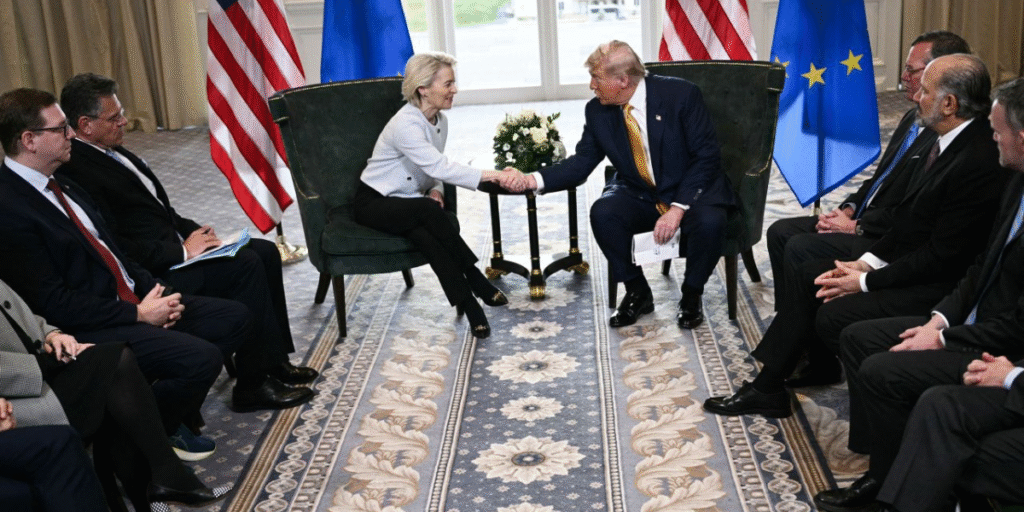
The United States and European Union finalized a landmark trade deal on July 27, 2025, setting a 15% tariff on most EU goods entering the U.S., announced by President Donald Trump and European Commission President Ursula von der Leyen in Turnberry, Scotland, per CNN. This agreement, averting a threatened 30% tariff, includes $600 billion in EU investments in the U.S. and increased U.S. energy exports, such as LNG and nuclear fuels, per Reuters. With $1.97 trillion in transatlantic trade in 2024, per European Council, the deal aims to stabilize supply chains but raises concerns for businesses facing higher costs, particularly in automotive, steel, and consumer goods sectors. As a journalist covering global trade for years, I see this US-EU trade deal as a pragmatic compromise, but its tariff structure and retaliatory risks could strain small businesses and consumers on both sides. This article explores the US-EU trade deal, its implications for businesses, and the broader economic impact, blending recent developments with my insights.
A Hard-Fought Deal Amid Tariff Threats
The US-EU trade deal, finalized days before an August 1, 2025, deadline, replaces a 20% reciprocal tariff imposed in April 2025 with a 15% baseline tariff on most EU exports, excluding aircraft, pharmaceuticals, and certain chemicals, per CNBC. Trump’s earlier threats of 30-50% tariffs, per Reuters, pushed EU negotiators, led by von der Leyen and Trade Commissioner Maroš Šefčovič, to secure a lower rate, ensuring market access for European businesses, per BBC. The deal includes EU commitments to purchase U.S. LNG, oil, and military equipment, addressing the $235 billion U.S. goods trade deficit with the EU in 2024, per U.S. Census Bureau.
Italian Prime Minister Giorgia Meloni praised the deal for avoiding a “direct clash,” calling the 15% tariff “sustainable,” per CNBC. However, Ireland’s Simon Harris noted potential All-Island economy challenges, as Northern Ireland enjoys a 10% tariff rate, per The Guardian. My perspective: The 15% tariff, while better than 30%, echoes the 2018 trade war I covered, where tariffs raised consumer prices. Businesses reliant on transatlantic supply chains, like German automakers, face a delicate balance between cost increases and market stability.
Implications for Businesses: Costs and Opportunities
The 15% tariff on EU goods—including cars, machinery, and agri-food products—will raise import costs for U.S. businesses, potentially increasing consumer prices by 0.3-0.5%, per Oxford Economics. European companies, such as Volkswagen, already reported a $1.5 billion profit hit from U.S. tariffs in H1 2025, per The New York Times. German automakers like BMW and Mercedes-Benz, which produce in the U.S. for export, face double penalties if EU retaliatory tariffs target U.S.-made vehicles, per The New York Times. Conversely, U.S. energy firms like Cheniere Energy stand to gain from EU purchases of LNG, projected to replace Russian gas, per BBC.
Small businesses, particularly in retail and manufacturing, may struggle with higher input costs, as EU exports like wines, plastics, and medical devices face tariffs, per Morgan Lewis. U.S. exporters, however, benefit from reduced EU tariffs on agricultural products and industrial goods, potentially boosting U.S. farmers and machinery firms, per Reuters. My take: Small businesses, which I’ve seen battered by trade wars, lack the resources to absorb tariff costs, unlike multinationals. The EU’s energy commitments are a boon for U.S. LNG, but European SMEs may face margin squeezes, similar to Brexit’s impact in 2021.
Key Takeaways
- 15% Tariff Agreement: The US-EU trade deal sets a 15% tariff on most EU goods, averting a 30% levy, with exemptions for aircraft and pharmaceuticals, per CNBC.
- $600 Billion Investment: The EU pledged $600 billion in U.S. investments, boosting American businesses, per Reuters.
- Energy and Military Purchases: The EU will increase U.S. LNG, oil, and military equipment imports, replacing Russian energy, per BBC.
- Business Impact: European automakers face profit hits, while U.S. energy and agriculture gain from market access, per The New York Times.
- Retaliatory Risks: The EU prepared €90 billion in retaliatory tariffs on U.S. goods like bourbon and aircraft, per The Irish Times.
EU Retaliatory Measures and Business Planning
The EU prepared a €90 billion retaliatory package targeting U.S. goods, including bourbon, aircraft, soybeans, and machinery, set to activate if talks failed, per The Irish Times. While the deal avoids immediate escalation, France advocated using the EU Anti-Coercion Instrument to counter U.S. tariffs, per Morgan Lewis. Businesses are advised to review supply contracts, adjusting INCOTERMS like Delivered Duty Paid to clarify tariff responsibilities, per Morgan Lewis. European firms are exploring U.S.-based assembly to bypass tariffs, while U.S. companies eye EU market access for agricultural exports, per The Guardian.
The EU’s retaliatory package, which I’ve compared to China’s 2018 playbook, signals a readiness to escalate if Trump pushes further. Businesses must adopt resilient supply chains, as I saw during COVID-19 disruptions, to mitigate tariff risks. U.S. exporters gain, but European SMEs face cost pressures, potentially mirroring UK struggles post-Brexit.
Sector-Specific Impacts
Automotive: German carmakers, facing 15% tariffs (down from 27.5% for some), benefit from exemptions but remain vulnerable to EU retaliation, per The New York Times. Volkswagen’s $1.5 billion profit loss in H1 2025 underscores the stakes, per The New York Times.
Energy: U.S. LNG exporters like Cheniere and ExxonMobil are poised for gains as the EU commits to $250 billion in U.S. energy imports, per Reuters. This shift, replacing Russian gas, boosts U.S. industrials, per BBC.
Pharmaceuticals and Aircraft: Exemptions for pharma and aircraft protect EU giants like Airbus and Pfizer, ensuring supply chain stability, per CNBC. Boeing benefits from EU purchase commitments, per The New York Times.
Consumer Goods: EU wines, plastics, and toys face 15% tariffs, raising U.S. retail prices, while U.S. bourbon and soybeans dodge EU countermeasures, per Morgan Lewis. My perspective: Pharma and aircraft exemptions, which I’ve seen in past trade deals, shield high-value sectors, but consumer goods face price hikes, hitting small retailers hardest, as I observed in 2018 tariff wars.
Economic and Market Context
The US-EU trade deal lifted global markets, with the euro gaining 0.2% and the S&P 500 steady at 6,252, per Reuters. U.S. inflation at 2.7% core PCE and 7.5% mortgage rates amplify tariff-driven price concerns, per Yahoo Finance. The EU’s 198.2 billion euro goods surplus with the U.S. in 2024 drove Trump’s tariff push, per Al Jazeera. Commerce Secretary Howard Lutnick signaled semiconductor tariffs within two weeks, potentially impacting Intel and TSMC, per CNN.
The market rally, similar to post-USMCA gains I covered, is short-lived if tariffs fuel inflation. Semiconductor tariffs, a sector I’ve tracked since Huawei bans, could disrupt tech supply chains, raising costs for U.S. businesses. EU concessions on energy strengthen U.S. industrials, but retaliatory risks loom.
Looking Ahead: Business Strategies and Trade Dynamics
Businesses must adapt to the US-EU trade deal by diversifying supply chains and leveraging exemptions, per Morgan Lewis. U.S. exporters should capitalize on EU market access, particularly in agriculture and energy, per BBC. European firms may shift production to the U.S. or third countries, per The New York Times. Investors should monitor tariff developments on Nasdaq.com and Yahoo Finance. Trump’s ongoing talks with China and South Korea, facing 30-50% tariffs, signal further trade volatility, per CNN.
I’m cautiously optimistic about the deal’s stability, but Trump’s unpredictable tariff strategy, which I’ve followed since 2018, risks escalation. Small businesses face the brunt of cost increases, while U.S. energy and EU pharma emerge as winners. The US-EU trade deal is a step toward predictability, but businesses must brace for supply chain shifts in a volatile global trade landscape.

