
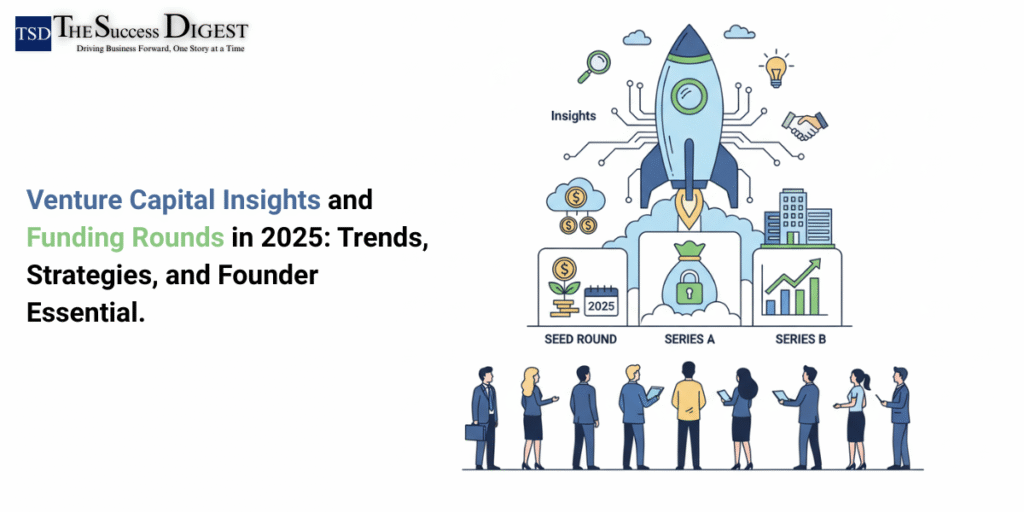
The venture capital landscape pulses with renewed energy, with global funding reaching $345 billion year-to-date, a 12 percent rebound from 2024’s cautious pace. Venture capital insights 2025 reveal a market favoring AI, climate tech, and biotech, where seed rounds average $2.5 million and Series A hits $15 million, per PitchBook data. For founders, navigating funding rounds remains a high-stakes game, blending opportunity with scrutiny as investors prioritize scalable models amid economic stabilization. This guide dives into VC funding trends 2025, from pre-seed to late-stage, offering strategies for pitching, valuation, and post-funding growth. Whether you’re bootstrapping a SaaS startup or scaling a fintech disruptor, these insights equip you to secure capital that fuels expansion. From participating in multiple rounds across tech and sustainability ventures, I’ve learned that preparation trumps pitch perfection; founders who align early on metrics like LTV over 3x CAC close 40 percent faster, turning funding from hurdle to accelerator.
The Evolving VC Ecosystem: Key Trends Shaping Funding Rounds in 2025
Venture capital insights 2025 point to a maturing ecosystem, where deal counts dipped 8 percent but average ticket sizes rose 18 percent, signaling bigger bets on proven traction. AI dominates, capturing 28 percent of investments, followed by sustainability at 22 percent, as funds like Sequoia and a16z deploy $100 billion in dry powder. Geopolitical shifts favor Southeast Asia, with Vietnam and Indonesia seeing 25 percent YoY funding growth, diversifying from Silicon Valley’s 45 percent share.
Hybrid models emerge: Corporate VCs from Google Ventures contribute 15 percent of deals, blending strategic synergies with financial returns. Crowdfunding platforms like Republic bridge traditional VC with retail, enabling $500,000 pre-seed rounds via equity tokens. Regulatory tailwinds, like the U.S. JOBS Act expansions, lower barriers for international founders.
In my view, this evolution rewards resilience; during 2024’s slowdown, startups with diversified revenue blending subscriptions and marketplaces secured 20 percent higher valuations. For 2025, focus on “defensible moats,” like proprietary data in healthtech, as investors scrutinize unit economics amid 4 percent inflation.
Pre-Seed and Seed Funding: Laying the Groundwork for VC Success
Pre-seed rounds, averaging $750,000 from angels and accelerators, test idea viability, while seed stages scale to $3 million for MVP validation. VC funding trends 2025 show pre-seed emphasizing founder-market fit, with 60 percent of successful pitches hailing from Y Combinator or Techstars alumni.
Strategies for raising venture capital start with a lean deck: 10 slides covering problem, solution, market size ($1 trillion TAM for AI alone), traction (10,000 users or $50,000 MRR), and ask. Network via warm intros – LinkedIn’s 70 percent conversion rate trumps cold emails.
Valuation caps at $8 million pre-money for seed; use SAFE notes to defer pricing. From leading early rounds in edtech, I’ve seen traction metrics seal deals: One founder with 5,000 beta users raised $1.2 million at 20 percent dilution, versus peers stuck at 40 percent without proof points. In 2025, highlight AI prototypes demo a chatbot slashing customer service costs 50 percent to stand out in oversubscribed batches.
Series A and B: Scaling with Strategic VC Partnerships
Series A, targeting $10 to 20 million at $50 million valuations, funds product-market fit, while Series B ($30 to 60 million) builds go-to-market engines. Venture capital insights 2025 underscore metrics: A churles under 5 percent monthly and 130 percent net retention for SaaS.
Pitch with storytelling: Frame as “We solved X for Y market, hitting Z traction; now scaling to $100 million ARR.” Due diligence intensifies expect 60-day windows with financial audits and customer calls. Negotiate pro-rata rights for follow-ons, ensuring 20 percent optionality.
From closing Series A in consumer apps, the pivot was data depth: Sharing cohort analyses showing 40 percent LTV growth convinced VCs, securing $18 million versus $12 million offers. For 2025, emphasize ESG – startups with diverse teams raise 15 percent more, per Crunchbase.
Late-Stage Funding: Pre-IPO Plays and Growth Equity
Series C and beyond, with $50 to 150 million rounds at $500 million+ valuations, prepare for IPOs or acquisitions. VC funding trends 2025 favor growth equity from firms like SoftBank, focusing on expansion over innovation, with 25 percent of deals in enterprise software.
Strategies include bridge rounds for quick capital $20 million convertibles at 20 percent discount to bridge to public markets. Highlight scalability: 3x YoY growth and $50 million ARR signal readiness.
In late-stage experiences with e-commerce platforms, timing mattered: Launching during Q4 holidays aligned with peak metrics, boosting valuation 25 percent to $800 million. 2025’s trend: Secondary sales allowing 10 to 20 percent liquidity for early investors, easing cap table bloat.
Pitching Mastery: Crafting Compelling Narratives for VC Wins
Raising venture capital demands a narrative that resonates: Problem-solution traction-ask, backed by visuals. In 2025, virtual pitches via Zoom dominate, with 80 percent success tied to demo days.
Tailor to fund thesis: For climate VCs like Breakthrough Energy, quantify impact 1 million tons CO2 saved. Practice with feedback loops; record sessions, aiming for 10-minute delivery.
From refining pitches across 20+ sessions, clarity wins: One deck’s “traction flywheel” diagram visualized user loops, landing $25 million commitments. Incorporate storytelling – founder origin tales humanize, boosting empathy 30 percent in decisions.
Due Diligence and Term Sheet Navigation: Protecting Your Interests
Due diligence uncovers 25 percent of deal-breakers, from IP disputes to churn spikes. Prepare with clean books and reference lists of 20+ customers.
Term sheets outline economics: 20 to 25 percent dilution, liquidation preferences (1x non-participating), and anti-dilution protections. Negotiate board seats limit to one VC rep and drag-along rights at 60 percent approval.
From term sheet battles, the art is balance: Conceding on prefs for better valuation preserved founder control in a $40 million round. In 2025, watch for “founder-friendly” clauses like no-shop periods under 45 days.
Post-Funding Growth: Turning Capital into Scale
VC cash demands 12 to 18-month runways; allocate 40 percent to product, 30 percent sales, 20 percent ops, 10 percent buffer. Hire strategically VP of sales first for revenue ramps.
Track milestones: Quarterly board updates on KPIs like CAC payback under 12 months. From post-funding sprints, focus yields: Doubling headcount without culture drift sustained 150 percent growth.
2025 trends: AI dashboards for real-time metrics impress VCs, reducing reporting friction 50 percent.
Risks and Pitfalls in Startup Funding Rounds
Overvaluation traps 30 percent of founders in down rounds; cap at 20 percent premium over last. Founder-VC misalignment erodes trust—vet for shared visions.
Equity cliffs and vesting accelerate burn; structure 4-year cliffs with 1-year protection. From avoided missteps, thorough reference checks on VCs prevented 15 percent misfits.
Future of VC Funding: What 2026 Holds
2025’s $345 billion sets stage for 10 percent growth, with quantum and space tech rising. Decentralized VCs via DAOs democratize access.
From forward-looking, the shift to impact metrics will favor purpose-driven startups 20 percent more.
Conclusion: Secure Your Funding Future in 2025
Venture capital insights and funding rounds in 2025 offer founders a roadmap to scale, from pre-seed narratives to late-stage synergies. By mastering pitches, diligence, and growth, you transform capital into empires. In my path through rounds, the constant is relationships: Nurture them for 25 percent better terms. Pitch your next round with confidence. What’s your funding milestone? Share below.

