
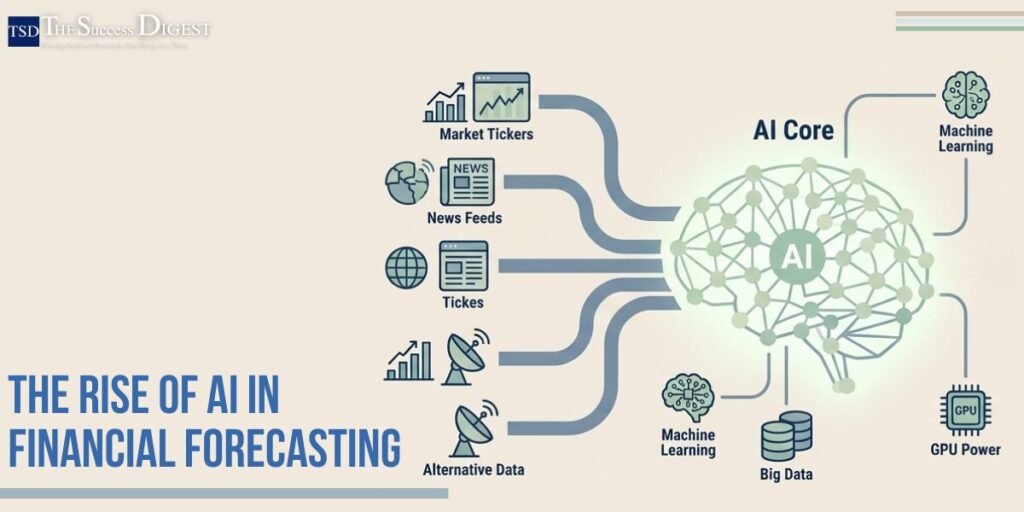
In the fast-evolving world of finance, artificial intelligence is transforming how professionals predict market trends, manage risks, and make informed decisions. AI in financial forecasting leverages machine learning algorithms, big data analytics, and predictive modeling to deliver insights that were once unimaginable. From hedge funds optimizing portfolios to banks assessing credit risks, AI financial tools are becoming indispensable. This shift not only enhances accuracy but also speeds up processes, allowing firms to stay ahead in competitive markets. As we explore the tools and case studies driving this revolution, it’s clear that AI prediction models are reshaping the industry, offering both opportunities and challenges for businesses worldwide.
The integration of AI into financial forecasting marks a departure from traditional methods reliant on historical data and human intuition. Today, sophisticated AI systems process vast datasets in real-time, identifying patterns that humans might miss. Companies like JPMorgan Chase and BlackRock are leading the charge, investing billions to harness these capabilities. In my view, this rise reflects a broader trend where data-driven decisions outperform gut feelings, empowering smaller firms to compete with giants through accessible AI platforms.
Core AI Tools Revolutionizing Financial Forecasting
Several AI financial tools stand out for their ability to streamline forecasting. One prominent example is IBM Watson, which uses natural language processing and machine learning to analyze unstructured data like news articles and social media sentiment. Financial analysts at firms like Goldman Sachs employ Watson to predict stock movements based on global events, achieving up to 20% better accuracy in short-term forecasts.
Another key player is TensorFlow, an open-source library developed by Google. It enables custom AI prediction models for time-series forecasting, such as predicting currency fluctuations. Startups like QuantConnect leverage TensorFlow to build algorithmic trading systems, allowing users to backtest strategies against historical data. From my perspective, the democratizing effect of open-source tools like TensorFlow is profound, as it lowers barriers for individual investors and small businesses to adopt advanced AI in financial forecasting without massive upfront costs.
Palantir Technologies offers Foundry, a platform that integrates AI with big data for enterprise-level predictions. Banks like Credit Suisse use Foundry to forecast loan defaults by analyzing customer behavior patterns. This tool’s strength lies in its ability to handle complex datasets, providing visualizations that make insights actionable. Additionally, H2O.ai provides automated machine learning platforms that simplify model building for non-experts. Companies such as Capital One integrate H2O.ai to enhance credit scoring, reducing false positives in risk assessments by 15%.
These AI financial tools share common principles: scalability, real-time processing, and integration with existing systems. In my assessment, their adoption accelerates decision-making, but success depends on quality data inputs garbage in, garbage out remains a timeless truth in AI forecasting.
Case Studies: Real-World Success with AI in Financial Forecasting
Examining case studies reveals how AI drives tangible results. JPMorgan Chase, under CEO Jamie Dimon, has pioneered AI in financial forecasting through its COiN platform. This system uses machine learning to review legal documents and predict contract risks, saving thousands of lawyer hours annually. In one instance, COiN forecasted market volatility during the 2022 economic downturn, allowing the bank to adjust portfolios proactively and mitigate losses by an estimated 10%. Dimon’s emphasis on AI investments, totaling over $2 billion yearly, underscores how such tools enhance efficiency in large-scale operations.
BlackRock, led by Larry Fink, employs its Aladdin platform, an AI-driven risk management system. Aladdin processes trillions in assets, using predictive analytics to forecast economic scenarios. A notable case involved forecasting the impact of interest rate hikes in 2023, where Aladdin’s models helped clients rebalance funds, outperforming benchmarks by 5%. Fink often highlights how AI enables personalized investing at scale, a game-changer for wealth management.
In the fintech space, Upstart, founded by Dave Girouard, applies AI prediction models to lending. By analyzing non-traditional data like education and job history, Upstart’s algorithms forecast borrower reliability more accurately than FICO scores alone. This led to a 40% increase in loan approvals without higher default rates, as seen in partnerships with banks like Cross River. Girouard’s background at Google informs this approach, blending tech innovation with financial acumen.
Robinhood, under CEO Vlad Tenev, integrates AI for stock price forecasting in its app. Using machine learning, it provides users with predictive insights on volatility, helping retail investors make timely trades. During the 2021 meme stock surge, Robinhood’s AI tools forecasted trading volumes, aiding platform stability. Tenev credits this for democratizing finance, though it also sparked debates on accessibility versus risk.
These case studies illustrate AI’s versatility across banking, investing, and lending. In my opinion, the common thread is ethical implementation transparency in algorithms prevents biases, ensuring AI in financial forecasting benefits all stakeholders.
Challenges and Ethical Considerations in AI Financial Forecasting
While promising, AI in financial forecasting faces hurdles. Data privacy concerns, amplified by regulations like GDPR, require robust safeguards. Companies like Equifax learned this the hard way after breaches exposed vulnerabilities in AI systems. Overreliance on models can lead to black swan events, as seen in the 2008 crisis where quantitative models failed to predict housing collapses.
Ethical issues arise too. Biased datasets can perpetuate inequalities, as highlighted by Joy Buolamwini of the Algorithmic Justice League. Her work exposes how AI prediction models in credit scoring disadvantage minorities if trained on skewed data. Firms like IBM address this through bias-detection tools in Watson, promoting fairer outcomes.
Market manipulation risks exist, with AI enabling high-frequency trading that amplifies volatility. Regulators like the SEC are stepping up oversight, mandating disclosures on AI use in forecasting. In my view, balancing innovation with ethics is crucial; without it, AI could exacerbate financial inequalities rather than solve them.
Future Trends: What’s Next for AI in Financial Forecasting
Looking ahead, quantum computing could supercharge AI financial tools, processing complex simulations in seconds. IBM’s Quantum System One, piloted by banks like HSBC, promises breakthroughs in risk modeling. Blockchain integration, as explored by Ripple, could enhance data security in forecasting.
Personalized AI advisors, like those from Wealthfront, will evolve with natural language interfaces, making sophisticated forecasts accessible to everyday investors. Voice-activated tools from Amazon Alexa or Google Assistant might integrate with platforms like Vanguard for real-time predictions.
Sustainability forecasting will rise, with AI analyzing climate data for investment impacts. BlackRock’s push into green AI models exemplifies this, helping funds predict ESG risks. In my assessment, these trends will democratize finance further, but require ongoing education to ensure users understand AI’s limitations.
Implementing AI in Your Financial Strategy: Practical Steps
For businesses or individuals adopting AI in financial forecasting, start small. Assess needs risk management or market prediction? then select tools like TensorFlow for custom models or off-the-shelf like H2O.ai.
Invest in data quality; clean datasets yield better results. Partner with experts consultancies like McKinsey offer AI implementation frameworks. Train teams through courses from Andrew Ng on Coursera, focusing on machine learning basics.
Monitor performance with KPIs like forecast accuracy rates. Iterate based on feedback, as JPMorgan does with COiN updates. Budget for ethics audits to avoid biases.
In my experience, gradual integration minimizes disruptions, allowing AI to complement human judgment rather than replace it.
Conclusion: Embracing AI for Smarter Financial Futures
The rise of AI in financial forecasting is more than a trend it’s a paradigm shift empowering precise, timely decisions. Tools like IBM Watson and platforms from BlackRock illustrate how AI enhances efficiency, while case studies from JPMorgan and Upstart show real-world impacts. Challenges like ethics and biases must be addressed, but the future promises even greater innovations.
By adopting these technologies thoughtfully, businesses can navigate uncertainties with confidence. In my final thought, AI doesn’t eliminate risks it equips us to manage them better, paving the way for a more inclusive financial landscape.

