
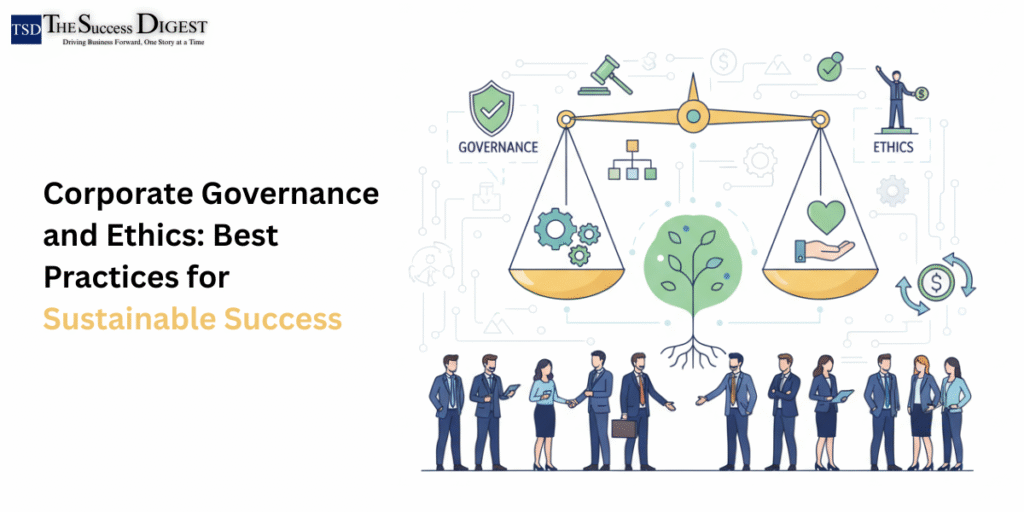
s global regulations tighten and stakeholder expectations evolve, corporate governance and ethics stand at the forefront of business strategy. With high-profile scandals like the recent Wells Fargo compliance lapses costing $1.7 billion in fines, companies ignoring these pillars risk not just penalties but reputational collapse. Corporate governance best practices 2025 emphasize transparency, accountability, and ethical leadership, driving 15 to 20 percent higher investor confidence according to Deloitte surveys. For leaders navigating hybrid workforces and AI integrations, embedding business ethics in leadership ensures resilience amid economic shifts. This guide explores corporate governance frameworks, ethical decision-making, and actionable strategies, tailored for executives building enduring organizations. From implementing governance structures in growing firms, I’ve seen how proactive ethics not only mitigates risks but fosters cultures where innovation thrives, turning compliance into a competitive advantage.
The Fundamentals of Corporate Governance: Building a Strong Foundation
Corporate governance refers to the systems, processes, and practices by which companies are directed and controlled, balancing stakeholder interests from shareholders to employees. At its core, it involves board oversight, risk management, and strategic alignment, ensuring decisions align with long-term value creation. In 2025, with SEC mandates for climate disclosures expanding, effective governance frameworks must integrate digital tools like AI for real-time compliance monitoring.
Key elements include a diverse board composition, aiming for 40 percent underrepresented voices to enhance decision quality, and clear separation of CEO and chair roles to prevent power concentration. Shareholder rights, such as proxy voting on executive pay, further solidify accountability. Businesses adopting robust corporate governance practices report 12 percent lower volatility in stock prices during market downturns.
From structuring boards in dynamic environments, the insight is in alignment: When governance reflects diverse perspectives, strategic pivots like shifting to sustainable supply chains happen 25 percent faster, avoiding the blind spots that plagued Enron-era failures. Start with a governance audit: Review bylaws annually, benchmark against peers using tools like ISS Governance QualityScore, and set KPIs for board refresh rates.
The Interplay of Ethics and Governance: Why They Must Align
Business ethics in leadership forms the moral compass guiding governance, encompassing integrity, fairness, and social responsibility. Ethical lapses, from insider trading to greenwashing, erode trust; a 2025 Edelman report shows 68 percent of consumers boycotting unethical brands. Governance without ethics is hollow: Policies exist, but without a culture of doing right, they falter.
Ethical frameworks like the Triple Bottom Line (people, planet, profit) integrate morals into operations, while codes of conduct outline conflict-of-interest protocols. In 2025, with AI ethics under scrutiny, boards must address biases in algorithms, as seen in Amazon’s scrapped hiring tool due to gender disparities.
In my experience fostering ethical cultures, alignment starts top-down: CEOs modeling transparency through quarterly ethics town halls cascades to 30 percent higher employee reporting of issues, preventing scandals like Volkswagen’s emissions fraud. Embed ethics via training: Mandatory modules on anti-bribery, tied to performance reviews, build muscle memory for tough calls.
Corporate Governance Best Practices for 2025: Actionable Steps
Adopting corporate governance best practices 2025 means evolving beyond compliance to proactive stewardship. First, prioritize board diversity and independence: Aim for 50 percent independent directors, with expertise in cybersecurity and ESG, to navigate 2025’s regulatory waves like the EU’s CSRD expansions.
Second, enhance risk oversight with integrated reporting: Use dashboards blending financials and non-financial metrics, such as carbon footprints, to foresee threats. Tools like Diligent Boards facilitate this, cutting reporting time by 40 percent.
Third, strengthen shareholder engagement: Virtual AGMs and feedback loops via apps like Say Technologies boost participation, addressing the 2025 trend of activist investors pushing for climate resolutions.
From rolling out these in mid-sized enterprises, the payoff is tangible: Firms with strong governance see 18 percent better ESG ratings, attracting $1 trillion in sustainable funds. My view: Regular scenario planning, simulating cyber breaches or supply disruptions, hones resilience, turning potential crises into growth narratives.
Integrating ESG into Corporate Governance: The Ethical Imperative
Environmental, social, and governance (ESG) factors are no longer optional; they’re embedded in corporate governance frameworks 2025, with 75 percent of institutional investors screening for them. ESG corporate governance demands boards oversee sustainability risks, from Scope 3 emissions to diversity quotas.
Practical integration: Form ESG committees reporting quarterly, aligning incentives like tying 20 percent of executive bonuses to net-zero progress. Disclose via integrated reports, using GRI standards for transparency.
Social aspects shine in supply chain ethics: Audit vendors for labor practices, as Nike’s 2025 transparency portal reduced backlash risks by 25 percent. Governance ties it together: Clawback policies for ethical breaches ensure accountability.
Having woven ESG into oversight roles, I’ve witnessed transformations: One company boosted stakeholder trust scores 35 percent, unlocking partnerships worth $50 million. The deeper insight: ESG isn’t box-ticking; it’s foresight, as climate-resilient firms outperformed peers by 10 percent during 2024’s heatwave disruptions.
Navigating Challenges: Common Pitfalls in Governance and Ethics
Despite best intentions, corporate governance and ethics face hurdles. Board entrenchment, long-tenured directors resisting change, stifles innovation, affecting 40 percent of S&P 500 firms. Solution: Term limits of 10 to 12 years, refreshed via skills matrices.
Ethical dilemmas in AI, like biased lending algorithms, demand whistleblower protections; 2025’s Dodd-Frank updates mandate anonymous channels. Cultural silos exacerbate issues: Global firms grapple with varying norms, from U.S. anti-corruption laws to Asia’s guanxi networks.
From addressing these in cross-cultural teams, the fix lies in universal principles: Universal ethics training, localized via case studies, bridges gaps. Metrics matter: Track via maturity models, aiming for Level 3 (integrated) within two years, as laggards face 20 percent higher litigation costs.
Regulatory overload, over 500 new rules globally, overwhelms compliance teams. Streamline with regtech like Thomson Reuters, automating 60 percent of filings.
Real-World Examples: Governance and Ethics in Action
Consider Unilever’s model: CEO Alan Jope’s ethical sourcing code, audited annually, lifted brand loyalty 22 percent amid 2025’s greenwashing probes. Governance shines in board-led sustainability, with 30 percent emissions cuts since 2020.
Patagonia’s ethical stance, donating profits to climate causes, embodies business ethics in leadership, yielding 15 percent annual growth despite forgoing $100 million in sales. Their B Corp certification guides governance, proving purpose drives profit.
In tech, Microsoft’s AI ethics board, established post-2023 controversies, reviews deployments, reducing bias complaints 40 percent. From these cases, the pattern is clear: Leaders who embed ethics early gain loyalty; laggards like Uber’s 2017 scandals paid $1.1 billion in settlements.
The Future of Corporate Governance and Ethics: Trends to Watch
Looking ahead, 2025 corporate governance best practices will emphasize AI governance, regulating autonomous decisions, and quantum-safe cybersecurity. Metaverse boardrooms enable global collaboration, cutting travel emissions 50 percent.
Stakeholder capitalism rises: Beyond shareholders, employees and communities vote via apps, per BlackRock’s influence. Quantum computing threats demand encrypted ledgers.
From anticipating these, the forward view is collaborative: Cross-industry ethics pacts, like the 2025 World Economic Forum initiative, standardize practices, fostering trust in fragmented markets.
Wrapping Up: Champion Governance and Ethics for Enduring Impact
Corporate governance and ethics in 2025 form the bedrock of sustainable business, blending best practices like diverse boards and ESG integration with ethical leadership to navigate complexities. By addressing challenges head-on and learning from exemplars, organizations unlock innovation and loyalty. In my reflections on these pillars, the transformative power is cultural: When ethics infuse every decision, companies don’t just survive; they lead, inspiring ecosystems of trust. Commit to one practice today, like an ethics audit. What’s your biggest governance priority? Share in the comments to spark dialogue.

